











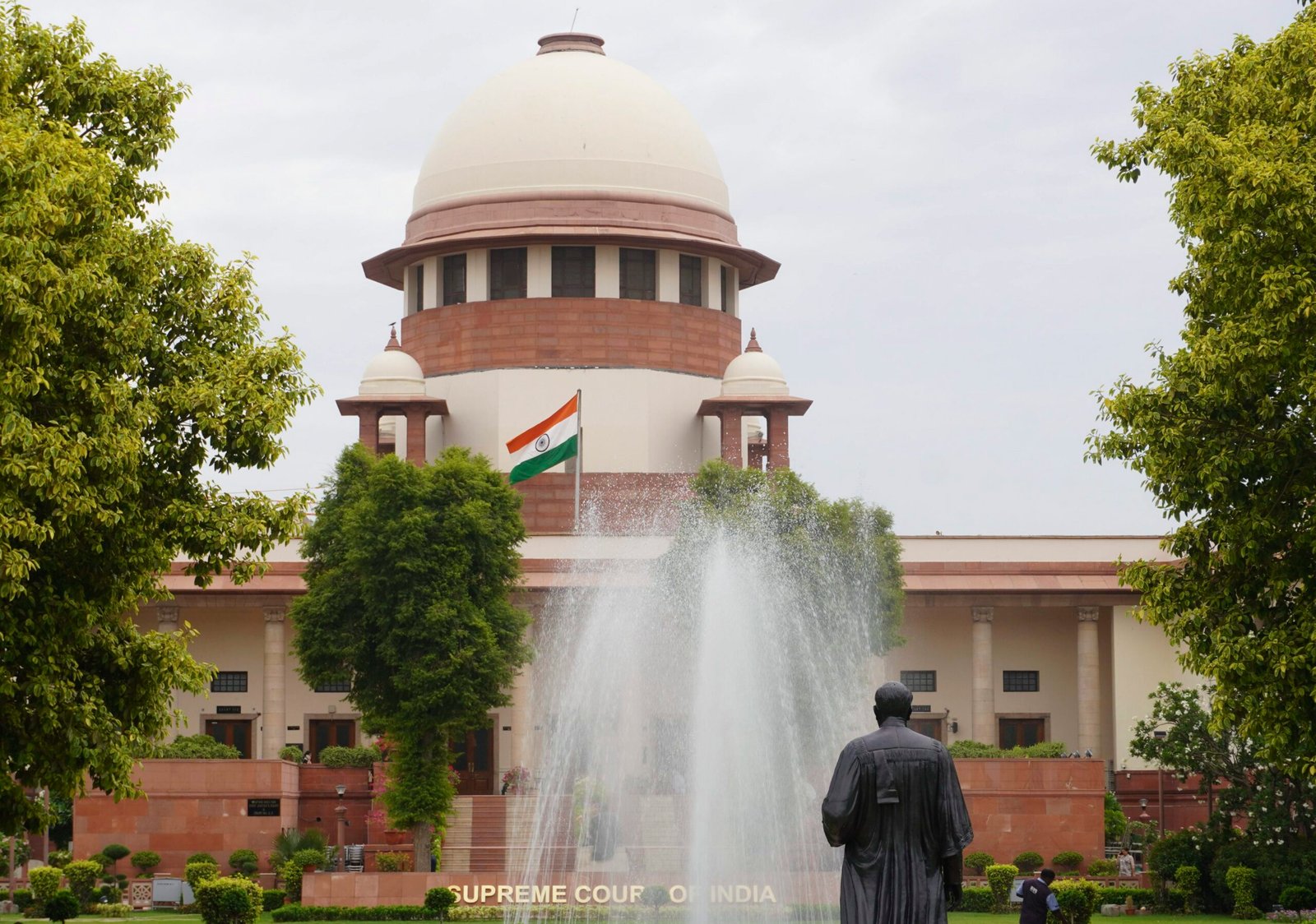
New Delhi, Jul 29: In a significant verdict, the Supreme Court on Wednesday quashed the 2021 Office Memorandum permitting the Centre and other authorities to grant retrospective environmental clearances (ECs) to projects that had commenced without obtaining the green nod.
A bench comprising Chief Justice Surya Kant and Justices Joymalya Bagchi and Vipul M Pancholi, in its unanimous verdict, held that the judgement will apply prospectively, thus saving projects that got retrospective ECs from demolition and other punitive measures.
These projects include an AIIMS in Odisha, a greenfield airport in Vijayanagar in Karnataka and several common effluent treatment plants crucial for pollution control.
The top court, however, held that the Centre has the power to grant post-facto ECs through valid statutory notifications issued under Section 3 of the Environment (Protection) Act, 1986, and it cannot be done by issuing a mere administrative office memorandum (OM).
“The 2021 OM (Office Memorandum) is an administrative order, and provides for a perpetual regime for grants of EC to projects undertaken without prior approval.
“It substantially alters the nature of enquiry as well as the criteria for grants of the EC under the 2006 notification. The 2021 OM thereby subplants an earlier dedicated legislation through an administrative instruction, which is impermissible in law,” the bench said.
Setting aside the OM, Justice Bagchi, who authored the verdict, said even otherwise, having “a perpetual amnesty scheme” applicable to all projects, fails to lay down any good criteria.
It said, “the OM does not satisfy the test of proportionality and reasonableness and is violative of Article 14 (right to equality) and 21 (right to life) of the Constitution. Thus, the 2021 OM is quashed, but with prospective effect.”
It made clear that no further applications for grant of ECs under the 2017 notification and the 2021 OM shall be entertained.
“The Central government is also restrained from passing administrative orders in future to grant post-facto ECs to projects which commenced in violation of the 2006 notification, save and except by way of a valid notification in exercise of powers under Section 3 of the Environment (Protection) Act, 1986,” it said.
The bench said the directions, however, will not constrain the powers of the top court to grant its post-facto ECs under Article 142 to do complete justice in appropriate cases.
Article 142 of the Constitution gives the Supreme Court the power to pass any order or decree needed to do complete justice in any case pending before it.
On April 1, the top court had reserved its verdict on as many as 49 petitions after hearing the matter for six days. The pleas include review petitions related to the granting of retrospective ECs to projects found violating green norms.
The top court heard afresh the pleas challenging the May 16, 2025, Vanashakti verdict.
The case has seen many twists and turns in the top court.
On May 16, 2025, a bench of Justices A S Oka and Ujjal Bhuyan had barred the Ministry of Environment, Forests and Climate Change and the authorities concerned from granting retrospective clearances to violating projects.
However, on November 18, 2025, a three-judge bench headed by the then CJI B R Gavai, by a 2:1 majority verdict, paved the way for retrospective environmental clearances by the Centre and other authorities to such projects on payment of heavy penalties, observing that otherwise “thousands of crores of rupees would go waste”.
The top court had held that numerous vital projects constructed with nearly Rs 20,000 crore from the public exchequer would be demolished if the May 16, 2025 verdict was not recalled.
It had ordered a fresh hearing on the pleas. (PTI)