











By Baston Singh Lyngdoh
The economic development and growth of any country, or part thereof, depends mainly upon the following sectors: transport and communication, power (electricity) and education. Power and education aside, the focus in this article will be transport and communication, in a particular part of the Khasi and Jaiñtia Hills, the southern or Ri War region. Transport and communication play an important role in the opening up of any part of the country. Wherever there is a good and efficient system of transport and communication, the economic growth of the region is assured. This is usually followed by healthy social growth, where closer ties with the rest of the country would naturally lead to an all round development.
As a necessary preliminary to a discussion of the most effective means of transport and communication for the Ri War region, it would help to take a look at its physical features and its main products.
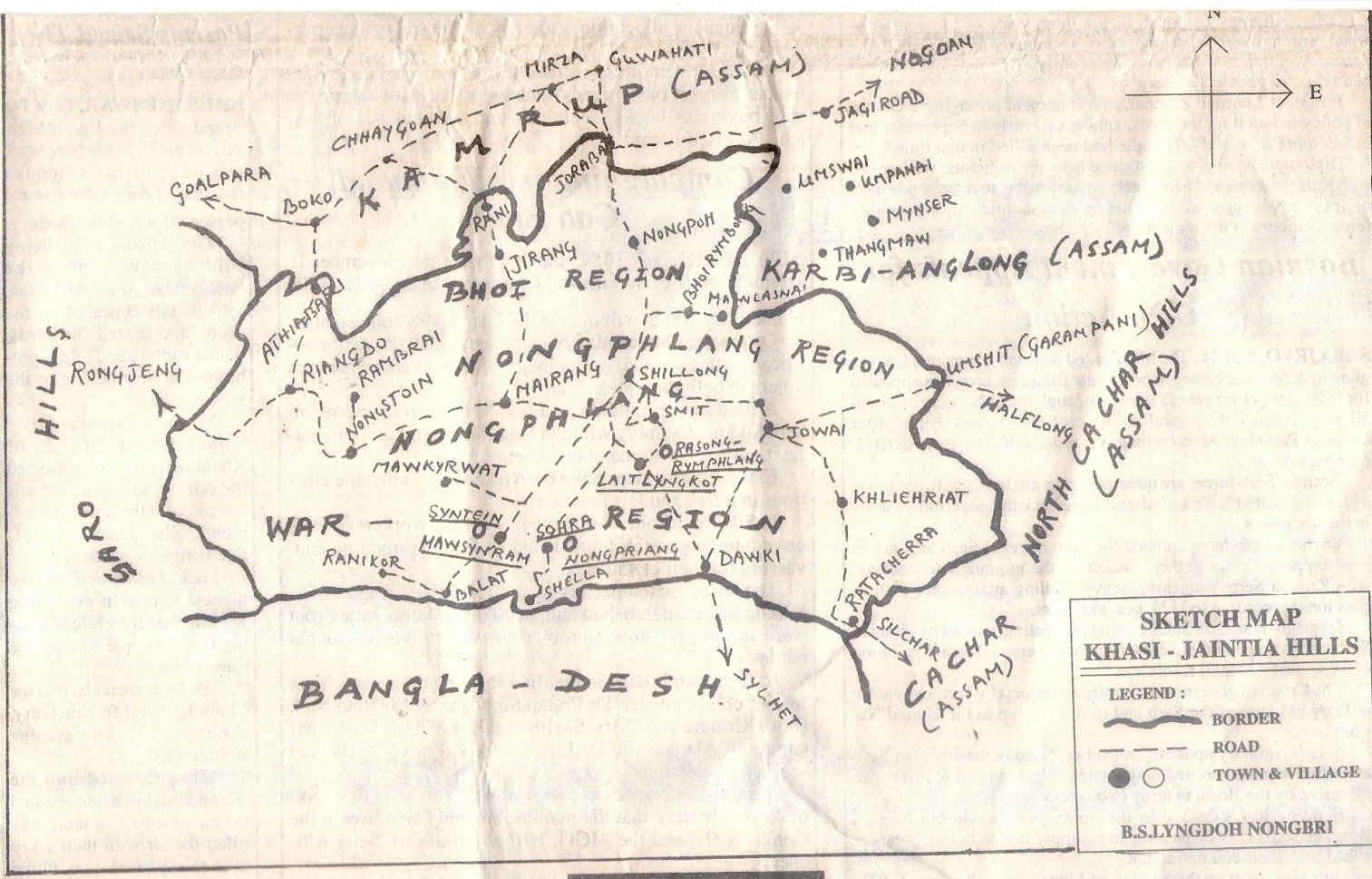
The region covers the southern part of the Khasi and Jaintia Hills, a belt stretching east to west from the border of Cachar District in Assam to the border of the Garo Hills. Bangladesh lies to the south of it.
Physically, the area is literally a steep rising gradient from the plain-lands of Sylhet District (Bangladesh), in the south, to the escarpment merging with the main highland (Nongphlang), in the north. Many major rivers of the Khasi and Jaiñtia Hills flow to the region roughly from north to south: the Myntdu river, the Umngot river, the Umsohryngkew river, the Umiew (Shella) river, the Umngi river and the Kynshi river along with its tributaries – the Rilang and the Wahblei. The terrain consists mostly of deep ravines and gorges along the courses of the respective rivers and their tributaries. They lie between the numerous sharp rising hill ranges and table lands jutting from north to south. The depths of these gorges vary from 180 metres (600 feet) to approximately 300 metres (1000 feet).
The steep gradient of the region acts as a rain barrier to the south-west monsoon causing heavy rainfall in the area during summer and autumn. Combined with the hot climatic conditions, the region is well-suited for horticulture: citrus fruits (oranges and lemons), pineapple, banana, guavas, and jack-fruit grow in abundance. Honey, pepper, latyrpad (tezpata), u synsar (the household broom), betel nut, betel leaf and bamboo mats are the commercial products of the region. Rice is grown along the plain-lands adjoining Bangladesh. The region is also rich in flora, especially orchids, as well as in mineral resources.
Although rich in resources, the greater part of the region is more or less economically backward. One of the main reasons for the economic imbalance is the lack of transport and communication. At present, there are only the following major roadways through the region: The Jowai-Khliehriat-Ratacherra road, the Jowai-Dawki road, the Shillong-Pynursla-Dawki Road, the Shillong-Smit-Mawkynrew-Syntung Road the Shillong-Sohra-Shella Road and the Shillong-Balat-Ranikor Road. Few auxiliary roads like Nohwet, Umñiuh Tmar, Nongjri, Ichamati, Lawbah, Nongtrai, Thyllaw, Sohbar are extensions from the main roads. The rest of the region still remains unconnected by road. The main hurdle for the development of road transport lies in the difficult topography of the region itself: the absence of stable land along the slopes of the cliffs for the construction of safe uninterrupted roads. In most parts, road construction is almost impossible, costs being prohibitive. The lack of roadways and the absence of other transport systems in the region are major obstacles to its economic development. There is little scope for further economic expansion.
In such a situation, an alternative means of transport and communication has to be explored and the ropeway appears to be the most viable since Meghalaya has an abundance of electricity, which is the prime-mover of the ropeway. As already known, the ropeway in many mountainous European countries, in the United States of America and in Canada is used as an additional system of transport and communication. In fact, it is the main carrier of tea from the processing units around the tea gardens to the marketing centre in Darjeeling. It may be recalled that the ropeway operated by the Cherra-Chhatak Ropeway Co Ltd existed between Sohra and Chhatak during 1930-53 for carrying coal from the mines in Sohra area to Chhatak Cement Factory in Bangladesh.
In operation, the ropeway would smoothly connect the main station or exporting centre at the top of a tableland with an auxiliary station or collecting centre located deep in the depth of a ravine around the orchards and groves. The main station would be connected by roadway to the various marketing centres. In this way, the products from the valley would be transported to the marketing centres by ropeway and cable cars. In a reversed process, essential commodities could be easily dispatched to the people of the Ri War valley.
To begin with, there are three suitable locations in the Ri War region from where the ropeway could be launched: (1) Laitlum-Rasong-Rymphlang, (2) Sohra-Nongpriang and (3) Phlangmawsyrpat-Synnei. These have been selected on the basis of the partly fulfilled infra-structures; the existence of a well connected road and the constant supply of electricity.
A close look at the Laitlum-Rasong-Rymphlang sector would make matters clear. Laitlum is connected to Shillong through the Smit-Jongksha Road. Laitlum is already electrified and can be upgraded for the ropeway system. With the main ropeway station either at Laitlum or Laitkyrhong village, the auxiliary station may be located deep down in the valley in the vicinity of Rasong and Rymphlang villages. At present there is a rudimentary ropeway in this sector. This may be upgraded to a well-established modern ropeway system/network to open up the fertile inaccessible valley stretching along the Umsong river (a tributary of Umngot river) valley. Similarly, a main ropeway station at Phlangmawsyrpat and an auxiliary station at Synnei village would take care of the economic development of the rich valley along the Umiew (Shella) river valley famous for citrus fruits. Again a main station in the vicinity of Sohra and the auxiliary station at Nongpriang would pave the way for the development of the inaccessible Umsohryngkew valley rich in citrus fruits, peppers, honey, etc.
Besides, electrically-operated ropeway transport is pollution-free and environmentally friendly. It is a mode of transport that should be greatly encouraged for a safe and clean atmosphere.
The net advantage of the ropeway transport system in this difficult terrain of the country is incalculable. Its introduction would greatly enhance the easy movement of people and goods to and fro from the Ri War region, lifting it out of the prevailing economic destitution and hence bringing about an all around development. The region would then have a strong and dependable link with the rest of the country with no real sense of isolation. Citrus fruits, bananas, pineapples, handicrafts, etc. for which it is famous would easily procure a place in ready markets all over the country.
(The author was Executive Engineer in the MeECL until he resigned in 1997. This is an updated version of an article first published in Apphira Daily News on November 15, 1994)