











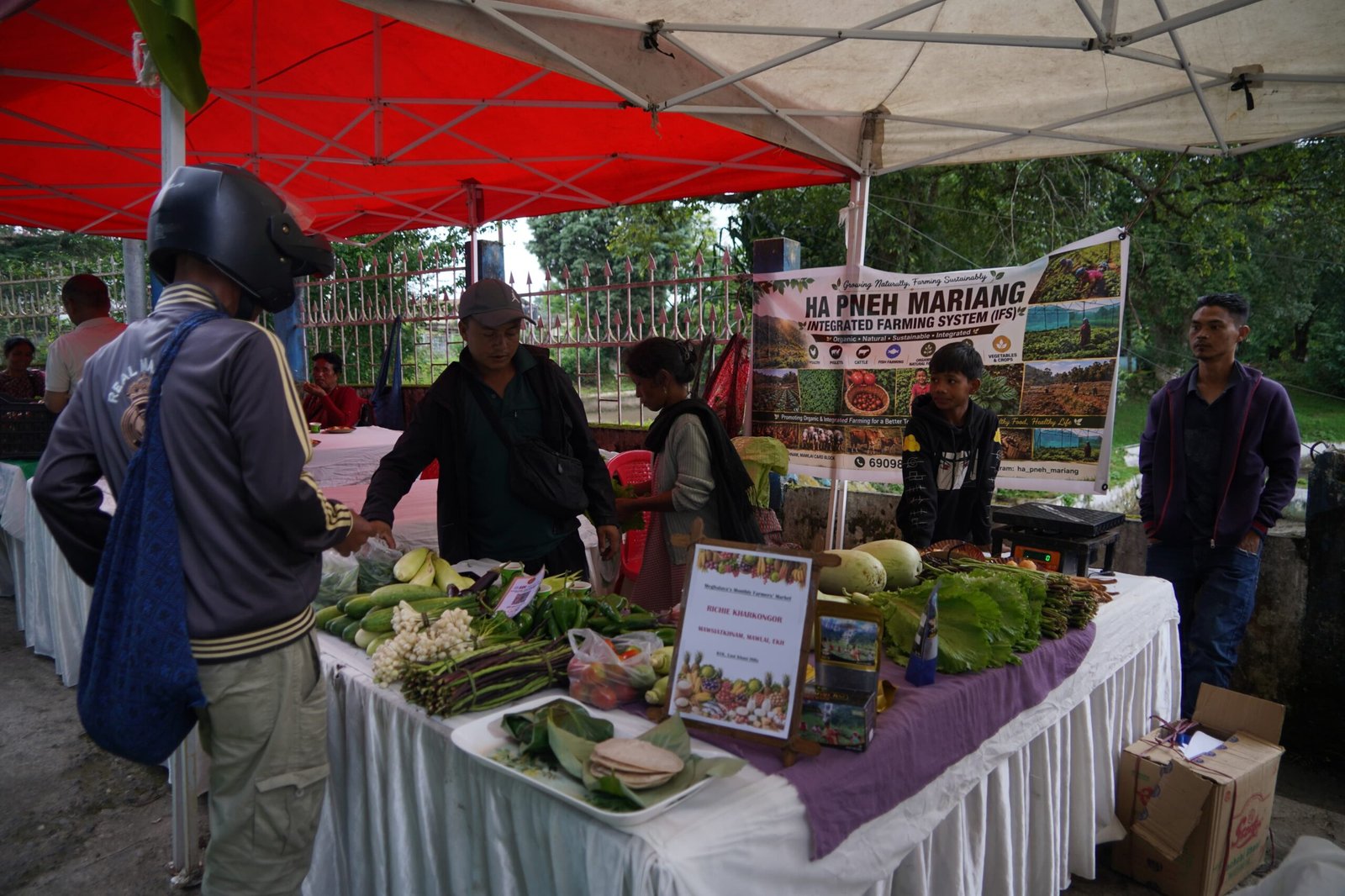
Shillong, Aug 8: By mid-morning on Saturday, the tables at the eighth edition of the Farmers’ Market in Shillong were already thinning. Baskets of cabbage and maize were half empty. Pineapples were gone. For many of the farmers who had traveled in from villages across Meghalaya, that was the best sign.
The monthly farm-to-consumer market, organized by 1917 iTEAMS under the Department of Agriculture & Farmers’ Welfare with support from the Meghalaya Farmers’ Empowerment Commission, has slowly become more than a sale.
It is where growers meet the people who eat what they grow, talk about how it was planted, and walk home with cash in hand and orders for next month.
This August, the grounds were full again. Farmers from Jaintia Hills, Ri-Bhoi, East Khasi Hills and beyond laid out seasonal produce, fresh vegetables, fruits, and value-added products made in home kitchens.
Consumers came looking for what they could not find in regular shops: food picked a day ago, sold by the person who grew it.
For Aroma Talang of Thadmuthlong B in Laskein Block, West Jaintia Hills, it was her second time at the market.
She started organic farming only in 2025, and said the shift has already changed her household income.
“At a time when chemical fertilisers and pesticides are widely used, organic farming is a natural and healthier alternative for both farmers and consumers,” she said as she arranged her produce.
She spoke of customers who asked questions, who wanted to know if the leaves were sprayed, and who came back to buy more.
“The market gives us a place to show what we grow. I am happy to see so many people coming every month.” She thanked the Department, 1917 iTEAMS and the government for backing farmers who choose to grow organically.
First-time seller Store Kharlukhi from Kdiap in Thadlaskein had a similar story, but faster. Invited to join this month, she watched her products sell out within hours of the market opening.
“I was surprised by how many people came,” she said. “For a first-time participant, it was very encouraging.” The response was enough for her to plan for the next edition. She said the platform gave small producers like her a chance to be seen without middlemen.
That direct link is exactly what the market was built for. The initiative aligns with Chief Minister Conrad K. Sangma’s push to empower farmers, shorten the gap between field and city, and create sustainable livelihoods through better market access.
By cutting out layers of traders, farmers get better returns, and consumers pay for freshness, not transport and commissions.
The reach now extends beyond the venue too. Through a partnership with SOMOI, Shillong’s home-grown quick-commerce platform, produce from the market is delivered to households across the city.
Orders have grown with every edition. For local youth working as delivery partners, it has also meant new work.
Visitors over the last few editions kept coming back for the same reasons: the produce was fresh, the prices were fair, and they could talk to the farmer.
Many said they liked learning how things were grown organically, and that buying directly meant more money stayed with the producer.
Till date, the Monthly Farmers’ Market has seen over 5000 visitors. What began as a monthly sale has grown into a community space. Women farmers, young growers, and elders all have a stall.
Local entrepreneurship gets a boost, and urban consumers get a reason to choose what is grown in their own state.
As the market completes eight editions, the message from the ground is simple. For farmers like Aroma and Store, it is not just about selling cabbage or pineapple.
It is about a steady buyer, a fair price, and the confidence to keep farming.