









Shillong, Jun 2: Meghalaya Chief Minister Conrad K. Sangma on Tuesday announced plans to launch a state-level technology and innovation competition aimed at encouraging students and young entrepreneurs to develop practical solutions to some of Meghalaya’s pressing challenges.
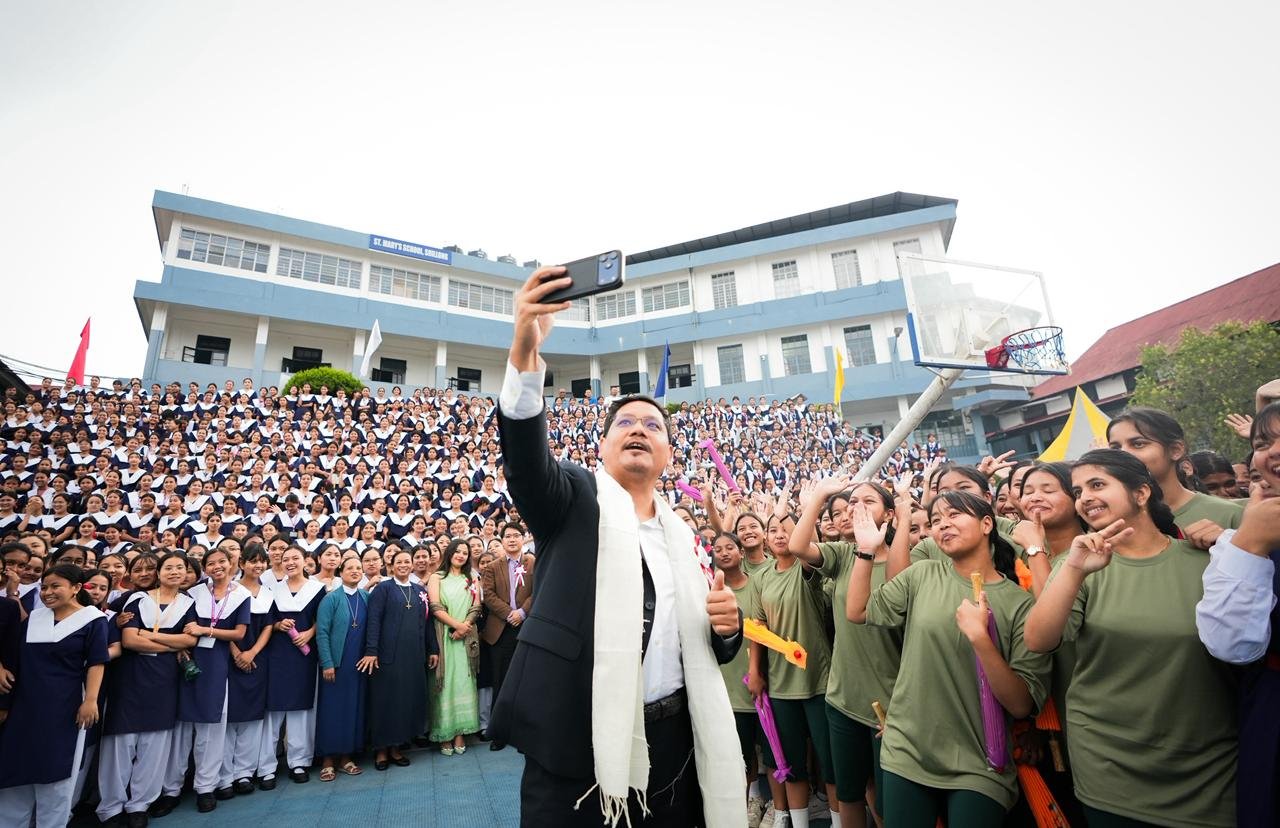
In his address during the inauguration of a 50 KW Solar Photovoltaic (PV) Plant at St. Mary’s Higher Secondary School, Sangma said the competition, expected to be launched within the next one to two months, is set to encourage creative problem-solving for some of the pressing challenges faced by the state, including electricity supply, waste management, water accessibility, and healthcare.
He encouraged participants to leverage available technology and work collaboratively to develop scalable solutions. Unlike traditional business plan competitions, this initiative emphasises practical implementation and problem-solving, he added.
The chief minister revealed that the best ideas could receive substantial funding worth crores of rupees. “I’m talking about good money. Not ₹10,000 or ₹20,000. I’m talking about crores that we are going to invest. The first prize itself could amount to ₹2-3 crore or even more. We are still working on the final figures,” he stated.
According to Sangma, the government plans to select at least five to ten of the best ideas and provide large-scale support for their implementation.
The solar plant is being implemented by the Meghalaya New and Renewable Energy Development Agency (MNREDA). The project is among the largest solar power installations in an educational institution in the state.
The system, valued at approximately Rs 50 lakh, includes battery backup facilities and is designed to meet a significant portion of the school’s energy requirements through renewable energy.
The chief minister said renewable energy is no longer merely an option but “the need of the hour” as governments and societies respond to the effects of climate change on livelihoods and daily life.
He noted that many solar projects in the past failed to deliver expected results because they lacked adequate storage and backup systems. “Technology in itself is not enough. We need to apply technology in a way that provides a solution to the problem,” Sangma said.
He explained that the CM’s Solar Mission differs from conventional solar projects because it integrates solar panels with inverters and battery storage systems, ensuring that electricity generated during daylight hours can be stored and used when required.
Under the mission, over 1.5 megawatts of solar capacity has already been installed across nearly 700 schools in Meghalaya, with another 1,300 schools expected to benefit in the coming phases. While smaller institutions are being provided with lower-capacity systems, larger schools such as St Mary’s are receiving 50 KW installations.
The newly commissioned solar plant is expected to generate savings of around 6,000 electricity units every month, translating into an estimated monthly reduction of Rs 40,000 in power expenses for the school.
He further stated that the government plans to integrate such solar installations with the electricity grid through net metering, allowing surplus power generated by schools to be fed back into the state’s power network.
The initiative will contribute to reducing carbon emissions and lowering dependence on conventional power sources.
Speaking on the occasion, Dr Joram Beda, Commissioner and Secretary in the Power Department, said the project reflects the state’s commitment to expanding renewable energy infrastructure and converting Meghalaya’s estimated 14.6GW renewable energy potential into reality.
He noted that while hydropower remains a major source of renewable energy in the state, solar technology offers an effective complementary solution.
Under the CM’s Solar Mission, launched in 2024 and implemented from 2025, the government has targeted 2,000 government schools across Meghalaya for solar installations, with a substantial portion of the work already completed.
Dr Beda added that the mission has also enabled the distribution of off-grid solar inverter systems to households in remote areas across several districts, helping improve energy access in locations beyond the reach of conventional power infrastructure.