










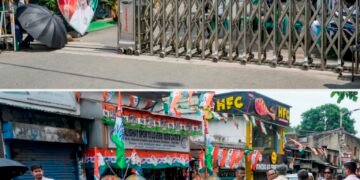



By RJR- A youth citizen of Shillong
The romanticization of the “middle class” is just a costume rich kids wear to cosplay humility.
To brand resistance as “dishonesty” is to strip people of their pain and agency. Defiance isn’t lawlessness; it’s the instinctive, necessary act of anyone who sees and feels the rot in systems never built to protect them. One resists not to destroy but to demand better. One is “threatened” only when they have something to lose, and often, it’s power, not peace, that trembles in fear.
In an article in the Shillong Times on the 4th of July 2025, Lyzander E. Sohkhlet declares himself a concerned citizen, a victim of the “lawless” presence of street vendors. What follows, however, is not the voice of someone burdened by empathy or structural understanding, but a rigid, alarmist defense of state power that reads more like a government press release than genuine civic concern. It’s easy to quote laws when you’ve not felt their oppressive weight. Let’s make one thing clear: legality is not the same as morality.
Sohkhlet misquotes the Street Vendors Act, BNS sections, IPC (he must know this is repealed?) and Supreme Court judgments as if legality alone should be enough to end debate. He quotes a single section from the Act which talks about the need for the street vendors for adhering to the conditions of vending but does not explain how the certificates are given in the first place and who can give them based on the provisions as given in the Act itself, which can get confusing even for the educated. In doing that he has revealed that he hasn’t really read the law or even if he has skimmed through it, it didn’t leave any useful impression on him. Still what he forgets is that laws are often designed without the participation of those most affected. We’ve seen this before: Dalits breaking caste laws, women defying patriarchal customs, protesters resisting unjust evictions, all once “illegal.” Sohkhlet sees it as defiance, for the hawkers its resistance and resistance is survival.
Throughout his piece, Sohkhlet reduces dissent to danger. He cites one vendor allegedly wielding a machete (it’s actually an axe) as reason enough to delegitimize the entire movement. One could interpret this as the self-defense of a woman turned tigress protecting her endangered and starving cubs. To loosely quote her from the videos, she says, “shwa ban iap thngan ki khun jong nga, hato nud?” which loosely translates to, “before my kids starve and die, do you dare?” He never differentiates between violence and civil disobedience. One act of aggression is used to erase a thousand acts of dignity.
He frames the poor not as people, but as problems, as if the very presence of the working class in public space is an affront to decency. This is not just cruel; it is intellectually lazy and ethically hollow.
He invokes the story of Bertina Lyngdoh, a visually impaired PhD scholar who was harassed on a crowded footpath. Her story deserves our deepest compassion. But Sohkhlet uses her experience to create a false binary: that accessibility and informality cannot coexist. He pits one marginalized identity against another to serve the state’s narrative. It’s performative empathy, used to justify punitive urbanism. Why not advocate for design solutions that accommodate both vendors and disabled citizens? Why not question a state that pits them against each other?
Sohkhlet praises the government’s creation of 400 stalls at the MUDA complex as proof of its “compassion.” But has he even seen these cages that reflect utter disdain? The MUDA stalls are cages: poorly ventilated, hidden from pedestrian traffic, impossible to attract customers from. They’re not spaces of livelihood; they’re containment units. You can’t romanticize a relocation that vendors themselves describe as a death sentence to their trade. People do not fight to stay on the streets because they love hardship; they fight because the alternatives are worse.
At its core, Sohkhlet’s argument is this: if the poor do not follow rules, they deserve to be removed. This is the heart of neoliberal authoritarianism, a city that markets itself as “for the people” but pushes out anyone who disrupts its glossy facade. He argues that “even parked cars get towed,” so vendors should too. But parked cars don’t feed families. Parked cars don’t educate children. Parked cars don’t resist being moved because they don’t lose their entire economy when displaced. This is the dangerous equivalence he wants us to swallow.
But cities are not airports. They are not meant to be regulated down to the last footstep. Cities are messy. They are full of people with needs and histories and rhythms that don’t fit into bureaucratic grids. That’s what makes them alive. What Sohkhlet demands is a city without the poor, a city that is not a city at all.
The hawkers are not asking for charity. They are asking for space. There is nothing dishonest about resisting injustice. There is nothing lawless about demanding dignity.
Lyzander’s words carry no empathy, no awareness of what it means to grow up with less. A Google search reveals that Sohkhket is a recipient of some Government grants, but surely this should not mean that you are gagged with a trumpet you have to forever blow in the States favour. He does not understand what it means to walk through bureaucracy barefoot, to watch the elite write op-eds from glass houses. It’s easy to preach order when you’ve never been crushed by it.
If there is lawlessness in Shillong, it is not on the street corner; it is in the policies that plan without people. Must we forget that our government is US -the people. It is in the decisions made in air-conditioned offices that ignore those sweating under the sun. It is in the cages of the MUDA complex, built to stifle life instead of enabling it.
Sohkhlet writes that “the government is not the villain here.” But when a government brutalizes the poor in the name of tidiness, when it silences protest with force, and when it builds “solutions” no one can survive in, then villainy wears the mask of virtue.
The street vendor is not the threat to this city’s future. The idea that a city belongs only to those who drive fast, talk law, boast about the crowded asian cities they visit, and force everything into an aesthetic is a narrow and warped lens with which to see ones immediate world. We are fascinated by and we praise street vending culture everywhere else but here. We allegedly love the unpretentious, non-consumerist thrift culture, but we forget the faces and lives of those who make this culture and economy possible. We love to talk about what a bustling city is, the energy, the vibes a space can hold so why are we silencing and drowning the rhythm that the street hawkers bring to our hometown. This is sheer hypocrisy.
We must resist it.