










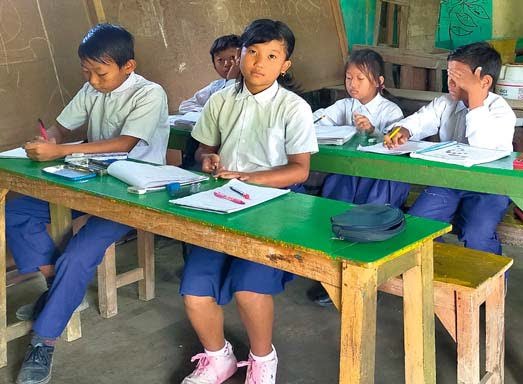
Not even 10 per cent of students in Classes 6 to 8 can do arithmetic division in East Garo Hills, South Garo Hills or West Garo Hills, data from the Annual Status of Education Report 2022 has reported.
Six districts of Meghalaya are included in the 2022 figures, three in Garo Hills and three in Khasi-Jaiñtia Hills.
All six do fairly well in keeping children in school – the percentage of children between the ages of 6 and 14 not enrolled in school is low, ranging from 1.4 per cent in WGH to 7.9 per cent in SGH.
However, this schooling is not having much benefit to students’ reading and mathematical skills in Garo Hills. For example, only 10.1 per cent of children in Classes 3 to 5 in EGH can read up to Class 2 level. The figure is 12.3 per cent in WGH and 20.7 per cent in SGH. This is lower than the 26.9 per cent in Meghalaya as a whole and much lower than the highest scoring of the six districts, Jaiñtia Hills (it is not mentioned in the report whether this is West, East or combined Jaiñtia Hills) at 45.9 per cent.
Garo Hills also does badly in maths – only 16.0 per cent of children in Classes 3 to 5 in WGH can do subtraction, with the figure being 19.1 per cent in EGH and 23.3 in SGH. The Meghalaya average is 31.1 per cent. Again, Jaiñtia Hills performs best with 48.2 per cent being able to do subtraction.
For students in Classes 6 to 8, only 40.7 per cent of students in WGH can read up to Class 2 level, with this being 48.1 per cent in EGH. Here SGH does fairly well at 63.7 per cent, which is higher than the state average of 60.3 per cent. East Khasi Hills does best in this category with 89.1 per cent.
The figures for division are the worst, however.
Here, only 3.3 per cent of students in WGH in Classes 6 to 8 can do division, with this rising only to 3.5 per cent in SGH and 6.7 percent in EGH. Even the percentages in Khasi-Jaiñtia Hills are not great in this regard, being only 28.0 in Jaiñtia Hills, 35.1 in Ri-Bhoi and 39.8 in EKH.