












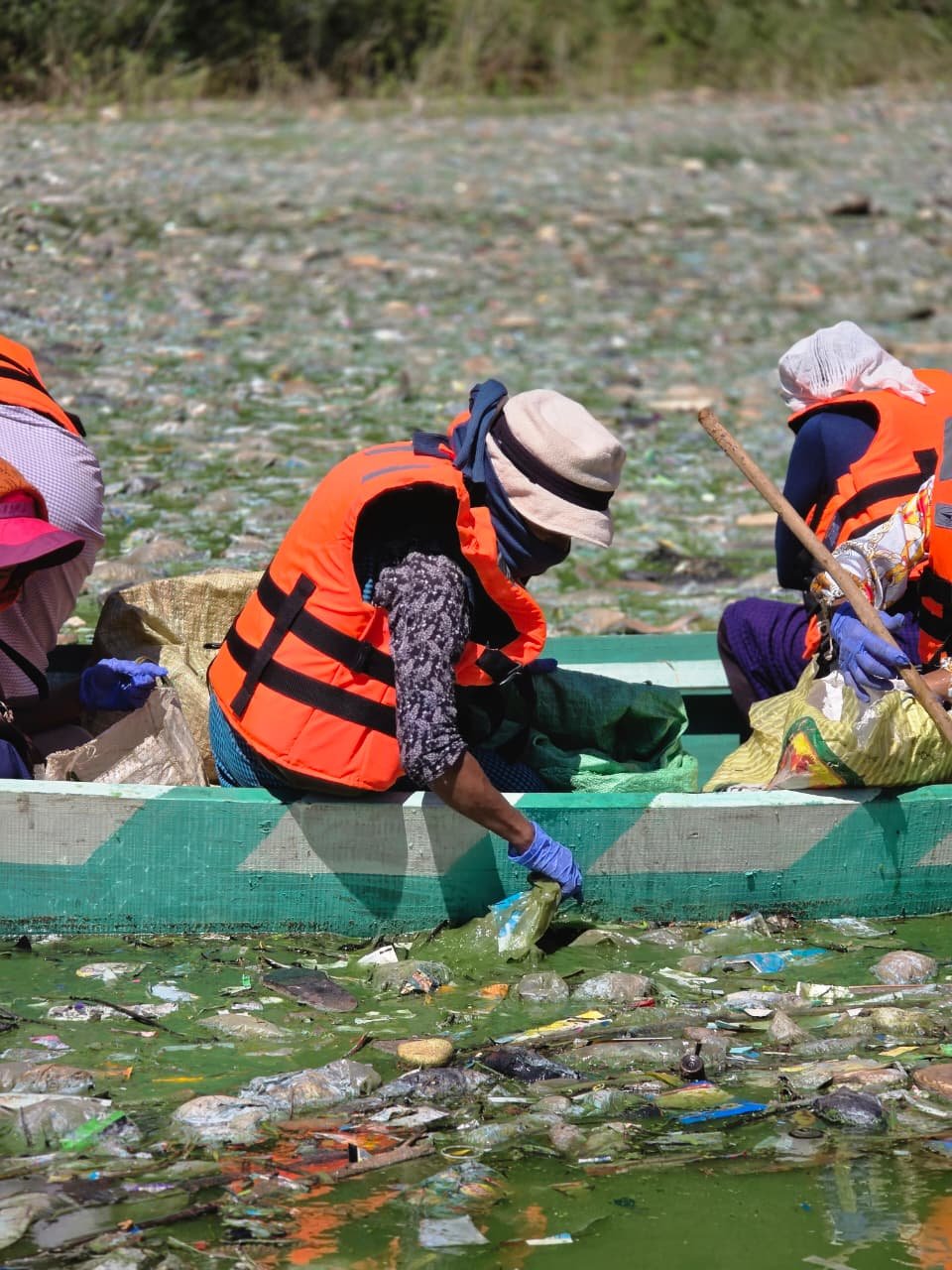
Shillong, Oct 13: In a last-ditch effort to save Meghalaya’s dying lifeline, the Green-Tech Foundation (GTF) along with residents and villagers of Mawdun today launched a mass clean-up at Wah Iap-Ngor – the critical choke point where waste carried by Wah Umkhrah and Wah Umshyrpi accumulates before spilling into Umiam Lake.
The drive is not another photo-op clean-up. It is an interception operation to stop hundreds of tonnes of floating waste at source before currents drag it across Wah Umiam – the reservoir that powers the state’s 172 MW Umiam hydropower station.
Sounding the alarm, GTF Chairman H. Bansiewdor Nonglang said Umiam is choking under neglect.
“We cannot simply stand by and watch the condition of Umiam Lake deteriorate. Every year, substantial quantities of sediment enter the reservoir, with estimates indicating more than 40,000 cubic metres annually. This raises a serious question about the long-term sustainability of a hydropower reservoir that is so important to Meghalaya’s electricity supply,” Nonglang said.
“Today, we are not here merely to conduct another cleaning drive. We are here because we believe that every tonne of waste we remove, every stretch of the river we restore, and every intervention we make to prevent further pollution is a step towards protecting Umiam Lake,” he said.
Nonglang said if GTF can prevent even hundreds of tonnes of waste from spreading, it will be a significant achievement, but warned that cleaning alone will not save the lake.
“Cleaning up the waste is only part of the solution. Preventing it from entering the lake in the first place must become our priority,” he said.
Lashing out at viewpoint tourism that hides the rot, he said, “When we look at Umiam from viewpoints such as Ryndang Briew, we see its beauty. But the real condition of the lake cannot be understood from a viewpoint alone. Beneath that beautiful landscape lies a growing environmental challenge involving waste accumulation, sedimentation and the continuous pressure on the reservoir ecosystem.”
“We must ask ourselves; how did we allow this situation to develop, and what are we collectively prepared to do about it? Are we going to stand by, point fingers and watch our lake deteriorate? No. We cannot afford to do that any longer. This is not about blaming the Government, the public or any particular individual. It is about recognising the seriousness of the problem,” he said.
GTF appealed to Shillong residents, government departments, environmental groups and community stakeholders to wake up to the reality that Umiam is not just a scenic lake for selfies and boating.
“Especially to the people of Shillong, we appeal to you to wake up to the reality of Umiam Lake. This reservoir is not merely a scenic destination for tourism and recreation. It is part of the infrastructure that supports our electricity supply, while also carrying significant ecological and environmental value,” Nonglang said.
He urged the government to bring together communities, technical experts and environmental organisations for a coordinated protection plan, asserting it cannot be left to one foundation or one village.
The foundation demanded an integrated, scientifically guided restoration strategy — river rejuvenation and waste interception along Wah Umkhrah and Wah Umshyrpi, scientific sedimentation assessment and management, catchment afforestation, continuous waste collection and prevention, and stakeholder coordination.
It also warned against prioritising luxury hotels and high-impact developments over ecological survival.
“Umiam does not need us to compete over who is responsible for its condition. It needs us to work together to change that condition. We need river rejuvenation, afforestation, scientific sediment management and continuous waste interception. We need solutions that address the causes, not just the visible symptoms,” Nonglang said.
“If we cannot stop the waste at its source, we will watch Umiam Lake slowly lose its life,” he added, pledging to continue the drive with the people of Mawdun.