








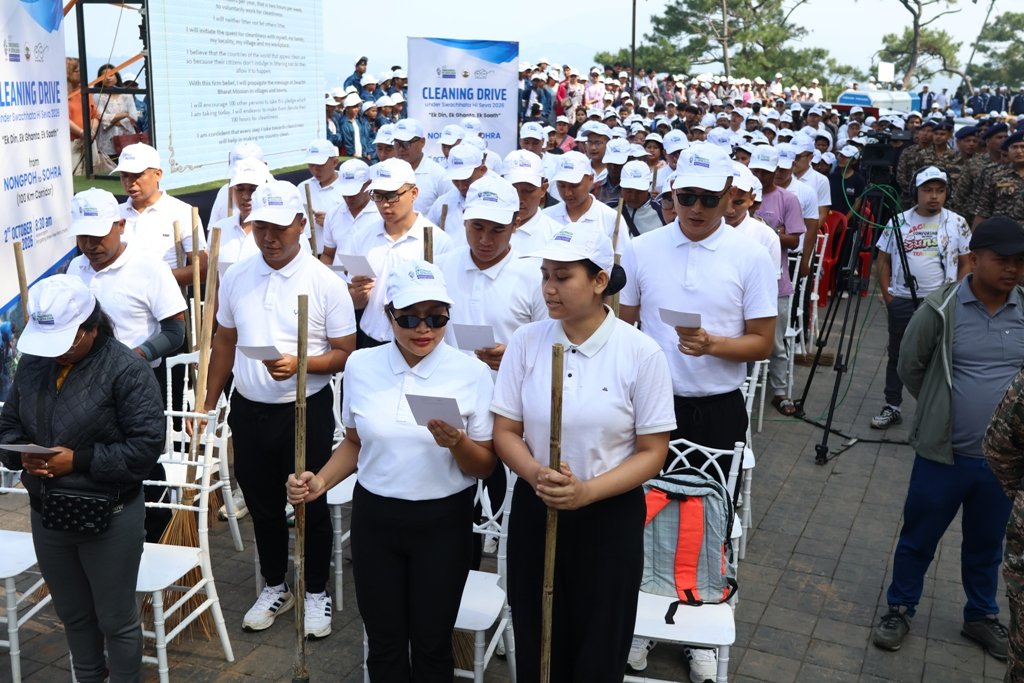
Shillong, Oct 2: The Directorate of Urban Affairs, through the Swachh Bharat Mission (Urban), today organised a mass cleanliness drive covering an approximately 100km stretch from Nongpoh to Sohra as part of the nationwide Swachhata Hi Seva (SHS) 2026 campaign.
Held under the theme ‘Ek Din, Ek Saath, Ek Ghanta’, the drive witnessed the participation of students, colleges, Dorbar Shnongs, community-based organisations, government departments and other stakeholders.
Addressing the gathering, Deputy Chief Minister Sniawbhalang Dhar, who holds the Urban Affairs portfolio, said the initiative was aimed at bringing about a change in the cleanliness and civic environment of Meghalaya through collective participation and a change in public mindset.
He said the Swachh Bharat Mission was not merely a cleanliness programme but a people’s movement aimed at developing a sense of civic responsibility among citizens.
“No one can do it, but everyone can do it,” Dhar said, stressing that cleanliness could not be achieved by the government alone and required the participation of every section of society.
He said the state government was seeking greater convergence between the urban and rural departments, local communities, youth, women, schools and other sections of society to strengthen cleanliness efforts across Meghalaya, particularly in Shillong.
The Deputy CM emphasised the need to develop a habit of maintaining cleanliness, saying that people often behave differently when they travel outside Meghalaya because of cleaner surroundings and stronger civic practices.
He said the government wanted to make cleanliness a regular civic responsibility and encourage people to take ownership of their streets, villages, towns and cities rather than viewing cleanliness as solely a government responsibility.
He also highlighted ongoing efforts to address solid waste management in the state. He said locations including Jowai, Tura and Nongpoh were among those where landfill facilities were being considered or identified, with the objective of ensuring that towns and cities across Meghalaya have scientific waste-management facilities in the coming years.
He called for greater public cooperation in establishing landfill facilities, noting that opposition sometimes arises due to misconceptions about such facilities.
Dhar said the government was also exploring convergence between different departments and schemes, including rural development programmes, to support waste-management infrastructure in larger villages and ensure that communities have designated systems for garbage collection and disposal.
He urged citizens to take responsibility for maintaining cleanliness in their respective areas, saying that roads, villages, towns and the state belonged collectively to the people.
“This is our road, this is our village, this is our city, this is our state,” he said, calling for a stronger sense of ownership and civic responsibility.
He also said cleanliness efforts would be strengthened in schools through greater engagement with principals, headmen and communities to promote proper waste collection and disposal practices among students and residents.
Dhar said Meghalaya, which has emerged as a major tourist destination, needed to maintain its natural and civic environment to sustain the State’s growing reputation among visitors.
He said the cleanliness campaign was intended not only to clean public spaces but also to encourage lasting behavioural change and establish Meghalaya as an example of community-led cleanliness initiatives.
As part of the initiative, Dhar flagged off 24 vehicles, including 18 small vehicles and six trucks.