








By Balakmen Suting
Some phrases are spoken in a few seconds and then acquire a life of their own.
“Dimaagi Naxal” is one such phrase. Prime Minister Narendra Modi used the expression during his Independence Day address from the Red Fort on August 15, warning that although armed Naxalism had been pushed back, an ideological form of the movement continued to pose a threat. He argued that such people sought to influence young minds and create unrest, and called for them to be identified and isolated.
The remark immediately triggered a political controversy. Critics argued that the phrase risked expanding the vocabulary used to describe critics and dissenters. The government, meanwhile, maintained that the Prime Minister was referring not to ordinary political opposition but to people who support Maoist or separatist ideologies.
The argument is important precisely because both sides are talking about something real: the security of the country on one hand, and the freedom to question those in power on the other.
Why the phrase struck a nerve
The political memory surrounding the words matters. For years, Indian political discourse has used terms such as “urban Naxal” to describe people accused of sympathising with Maoist ideology. In 2020, the Ministry of Home Affairs told Parliament that the government did not use or recognise the term “Urban Naxals”.
That history helps explain why the new expression attracted such immediate attention.
Congress leader Jairam Ramesh criticised the terminology, describing it as an escalation in the language used against critics. P. Chidambaram, meanwhile, said he was proud to be called a “dimaagi Naxal”, turning the label back on those who had used it.
The government’s response was equally clear. Union Minister Kiren Rijiju said the expression was not intended as a blanket description of opposition leaders or young people. He said it referred instead to those who support Maoist violence, separatism, or positions that the government regards as contrary to the Constitution.
That clarification is important. A democracy has every right to oppose armed insurgency and ideologies that advocate violence against the state and its citizens. But the distinction between advocating violence and merely disagreeing with the government must remain unmistakable.
That is where the controversy becomes larger than two words.
When a political label becomes a public argument
The speed of the public reaction says something about the India of 2026. Within days of the Prime Minister’s speech, an anonymous social-media account calling itself the “Dimagi Naxal Party” appeared and attracted a large following. Reports on August 17 said its Instagram account had crossed 1.7 lakh followers, while the identity of its founder remained unknown. The account’s style, like the earlier Cockroach Janta Party phenomenon, relies heavily on satire and internet humour.
Whatever one thinks of such political parody, its popularity is worth noticing. It demonstrates how quickly a political label can be reclaimed, mocked or transformed by the very public at which it is perceived to be directed.
This is not unique to one political party or one government. Political language has always had consequences. But social media has dramatically shortened the distance between a powerful person’s statement and the public response to it.
A phrase spoken from the ramparts of the Red Fort can become a meme within hours. And sometimes the meme becomes the story.
The line we should not lose
There is a legitimate argument to be made against Maoist violence. India has suffered enormously from armed insurgency. Civilians, security personnel and communities have paid the price. No democracy is required to be neutral about violence directed against the state and its citizens.
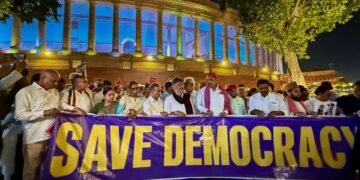
But there is an equally important principle on the other side. Questioning the government is not the same as betraying the country. A citizen who asks why a project is delayed, why an examination has gone wrong, why an electoral roll has omitted someone’s name, why a public policy has failed, or why a government decision should be reconsidered is not automatically thinking like an enemy.
They are participating in democracy. That distinction should never become blurred. A government may legitimately challenge an ideology. It may prosecute violence. It may investigate genuine threats to national security. But when broad political labels begin to substitute for precise explanations, ordinary disagreement can become unnecessarily suspicious.
And once that happens, people begin asking a different question: Was the criticism answered, or was the critic simply labelled? That is not a healthy question for any democracy to have to ask.
What we owe each other
I did not grow up with any illusion that Indian politics is gentle. Politics has always involved disagreement, ambition, rhetoric and confrontation.
But I have grown up believing and I still believe that questioning one’s government is not the same as betraying one’s country.
Somewhere along the way, those two ideas have increasingly been placed too close together.
This is not an argument against the government. Nor is it an argument in favour of every critic of the government. Critics can be wrong. Opposition parties can be irresponsible. Commentators can exaggerate. Citizens can spread misinformation. And ideological extremism is real. But none of that changes the basic democratic principle that disagreement must have room to exist.
A democracy does not become weaker because its citizens ask difficult questions. In many cases, it becomes stronger because somebody was willing to ask them.
India’s Constitution did not establish a system in which citizens were expected merely to applaud those in power. It created a republic built around liberty, equality, justice and democratic participation. That means the government has a responsibility to protect the country from violence and extremism.
It also means citizens have a responsibility to protect the space in which governments can be questioned. Both responsibilities can exist at the same time.
Precision matters
I do not think either side of this argument is entirely right or entirely wrong.
The government is entitled to warn against ideological support for violent extremism. Opposition parties are entitled to question the language used to describe that threat. Citizens are entitled to examine both claims critically.
What matters is precision. If “dimaagi Naxal” refers specifically to people who support Maoist violence or a separatist agenda, then say exactly that. If the term has a broader meaning, explain what that meaning is.
Political language becomes dangerous not merely when it is strong, but when it is undefined.
A country does not stop being democratic overnight. Its democratic culture is weakened gradually, when questions are treated as hostility, when criticism is treated as disloyalty, and when labels replace arguments.
The public reaction to “dimaagi Naxal” offers a small but revealing lesson.
People will answer political language with political language of their own. Sometimes they will respond with speeches. Sometimes with protests. And increasingly, they will respond with memes, satire and millions of views.
Leaders would lose very little by being precise about whom they mean.
The rest of us would gain something valuable: the certainty that disagreeing with the government does not, by itself, make us enemies of the country.