









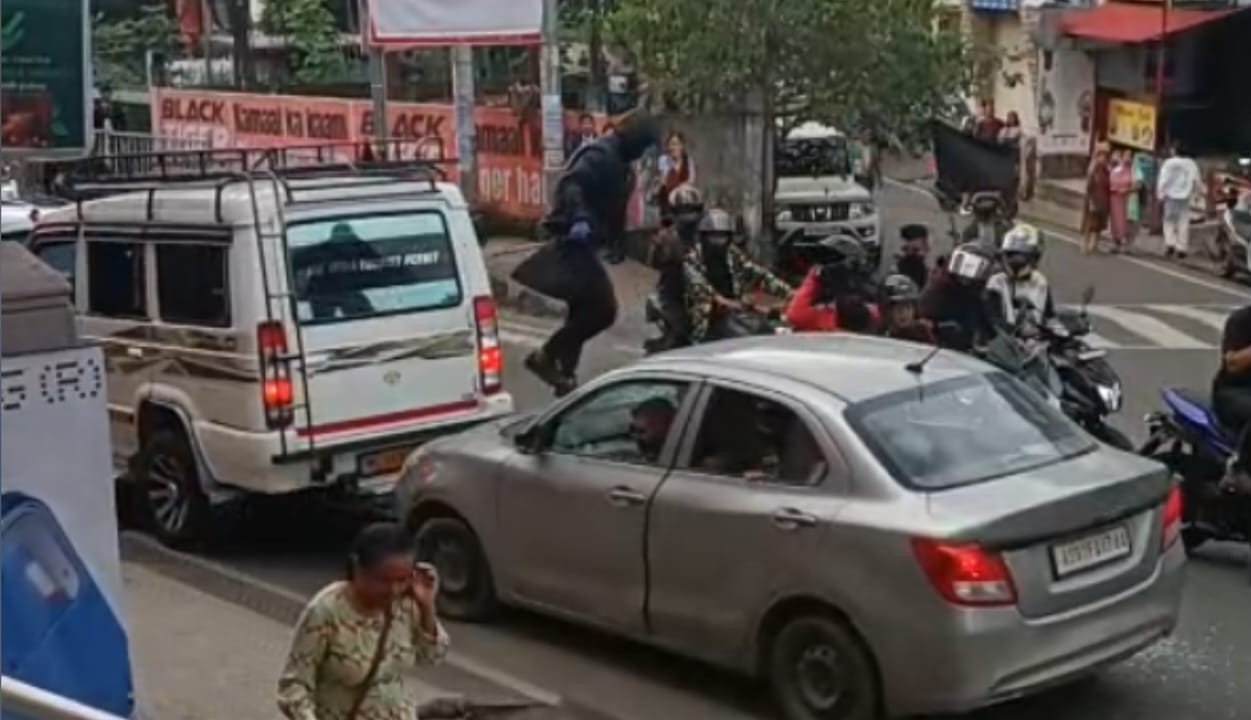
Shillong, Aug 20: Different civil organisations have expressed deep concern over the violence yesterday that accompanied a bike rally organised by the Khasi Students’ Union (KSU), which resulted in damage to property and injuries to 16 innocent bystanders.
Some groups, who broadly share the KSU’s ideology and aims, were also troubled by the way the police arrested three senior members of the organisation late yesterday.
The Civil Society Women’s Organisation (CSWO) has strongly condemned the recent incidents of assault and violence in Shillong, stating that children are being exposed to fear and terror in the city. The rally took place during the day, with children directly exposed to the violent scenes. At least one child was directly caught up in an attack on a car.
In a press release, CSWO general secretary Evangeline Thabah and president Agnes Kharshiing said such acts cannot be allowed to continue and called on the authorities to take responsibility for protecting children, women and citizens who are living in fear.
The organisation said terror will not be allowed in the state. It added that the government receives inputs on groups involved in assaults targeting other communities and must take strong action to ensure the safety of citizens.
Referring to yesterday’s incident, the CSWO said it does not reflect the sentiments of the people of Meghalaya but is the handiwork of some elements who prey on vulnerable people to create fear. Describing Meghalaya as a peaceful state, the organisation urged the youth to stay away from violence.
Thma U Rangli-Juki (TUR) also condemned the violence, especially the communal attacks on non-tribals.
“Physical assaults, communal targetting of persons, vandalism and the destruction of public property undermine democratic dissent,” it said. “Such actions divert attention from legitimate community grievances and violence is never an acceptable path to resolution of issues.”
TUR also slammed the state government’s “inability to maintain law and order,” adding that adequate pre-emptive security measures and proactive stakeholder dialogues were completely absent, for which the state must be held accountable.
One of the KSU demands revolves around the proposed Shree Cement cement factory and limestone quarry in East Jaintia Hills. The KSU wants the controversial public hearing held at the end of July to be cancelled.
TUR said that “high-handedness” during the public hearing against citizens attempting to voice environmental and community concerns is also condemnable. “We call for swift legal action against perpetrators of violence and inquiries into arbitrary state action that attempted to silence voices during the public hearing. True peace requires both strict adherence to the law and a government that genuinely listens to its people.”
Tourism stakeholders were one of the first to condemn yesterday’s violence, profoundly aware that attacks on visitors from Assam or anywhere else and a general sense of uneasiness in Shillong could lead to a crippling blow to the industry.
In a meeting held today, representatives of different tourism stakeholder bodies said that while they respect the democratic right to protest, such actions “must not be exploited by anti-social elements to create fear, violence or damage to public property.”
The groups warned the attacks could seriously damage Meghalaya’s reputation as a safe tourism destination. “We are already witnessing cancellations and concerns among visitors, including retaliatory developments from Assam,” they said, adding that tourism supports the livelihoods of over 30 percent of the state’s population, especially in rural areas.
The stakeholders also called for a review of security arrangements during the rally, stating that since government permission was granted, adequate police and district administration arrangements were expected.
They urged the government to identify those responsible and take legal action, while protecting the rights of peaceful protesters. The bodies also appealed to all organisations and citizens to exercise restraint and avoid retaliation.
A body representing Meghalaya government drivers also decried the violence meted out to state vehicles, which resulted in several drivers being injured when the vehicles they were in as part of their official duties were attacked by rallyists.
On the other side of the equation were groups like the Jaintia National Council (JNC), Jaintia Students’ Union (JSU) and Federation of Khasi, Jaintia and Garo People (FKJGP). All three pressure groups expressed concern over the manner in which police made the arrests last night of three senior KSU leaders in a raid on the organisation’s headquarters in Jaiaw.
The JNC, while not condoning the violence during the rally, said that the police’s action later was an attempt to “weaken, suppress and silence” indigenous voices in the state.
In a statement, JNC president Sambormi Lyngdoh said the arrests were carried out “without a proper and transparent investigation.” He termed the manner of arrests “highly unusual,” stating that it is rare for student body offices to be raided and top leaders arrested immediately. “This raises serious suspicions that there may be motives or instructions operating behind the scenes,” he added.
The JNC also linked the current developments to the entry of Shree Cement in East Jaiñtia Hills, alleging that the company’s activities have created “controversy, division and tension among communities” and reportedly divided Elaka Nongkhlieh and caused differences with Elaka Sutnga. The JNC has been at the forefront of opposition to the Shree Cement project.
The JNC had set its own deadline for the government to revoke the public hearing held last month and this will expire on August 23. It said that “peaceful and lawful democratic actions” will be initiated after that if the government does not respond positively.
The JSU also slammed the way the public hearing into the Shree Cement project was conducted and pinned the blame on the Meghalaya government.
It also sided with the KSU’s general secretary Reuben A Najiar who yesterday (before his arrest) claimed that outside elements tried to hijack the rally by causing violence.
“The conduct in which the police took to arrest the protesters is as though they were portrayed as terrorists, which is seen in the police’s resort to tear gas, which caused distress among the residents of Jaiaw,” the JSU said. “It has been noted that, time and again, whenever there have been agitations by student and civil society organisations, certain individuals have taken advantage of the situation and attempted to tarnish the image of such agitations and protest and this is not the first time such incidents have occurred during a KSU agitation.”
The FKJGP, meanwhile, expressed serious concern over the rising tensions in the state following the government’s handling of demands raised by the KSU.
In a statement, FKJGP president Dundee Cliff Khongsit said the organisation does not want the situation to escalate further, but stressed that it is the responsibility of the government to resolve the issues urgently before it is too late. He strongly condemned what he called the “high-handed” action of the police, including the raid on the KSU office, damage to property and the use of tear gas and force as if dealing with armed groups.