













By Bedanga Chutia & Swastika Chutia
A Radical Protest Model:
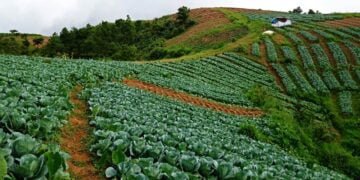
For decades, global agrarian protests have spoken the language of destruction: French dairy farmers dumping 100,000 liters of raw milk, European growers spilling 50 tonnes of produce, or American agribusinesses ploughing under 15% of edible crops when market returns crash. In mid-July 2026, indigenous smallholders in Meghalaya, North East India, offered a radical alternative. Facing an 88% price collapse where farm-gate cabbage rates plummeted to just ₹2 ($0.024 USD) per kilogram—yielding a meager ₹12,000 ($143 USD) revenue against ₹60,000 ($715 USD) in cultivation costs per acre—the Hill Farmers Union of the East Khasi Hills loaded six tonnes of fresh harvest into trucks and distributed it entirely free to Shillong residents. Rather than destroying produce or blocking transit corridors, these growers absorbed a direct ₹48,000 ($572 USD) per-acre loss to transform financial ruin into a profound moral indictment of broken market supply chains—feeding urban neighbors while showing a world grappling with food insecurity what dignified, constructive resistance looks like.
Mountain Agrarian Crisis:
The defining metric of this crisis is the gap between the ₹2 ($0.024 USD)/kg farm-gate price and the ₹15–₹20 ($0.18–$0.24 USD)/kg charged at Shillong’s Iewduh market—a 650%–900% markup over just 25 kilometers that leaves smallholders unable to recover ₹10/kg cultivation costs. Value vanishes into structural bottlenecks: zero pricing power, high mountain freight (₹4–₹6/kg), market tolls (₹40/sack), porterage fees, and commission agents taking 10%–18% cuts. Beyond Mawsynram’s 11,872 mm rainfall record, Meghalaya reflects a vulnerable mountain agrarian economy where 80% of its 3.2 million people depend on farming, 84% hold <1 hectare across 15°–45° slopes, and mechanization remains under 0.15 hp/ha. Yielding 548,000 tonnes of horticultural produce annually—18% being cabbage and cauliflower—these indigenous Khasi, Garo, and Jaintia family farms rely on informal credit at predatory 24%–36% interest without Western-style subsidies. Every price collapse plunges household incomes below the $2.15/day poverty line, making Shillong’s quiet protest an existential test for global smallholder survival.
Mountain agriculture faces structural disadvantages rarely analyzed in trade policy: freight costs above 1,400 meters are 2.5–3 times higher per ton-kilometer than in lowland plains due to fuel inefficiency, steep grades, and frequent monsoon landslides that paralyze key arteries like National Highway 6 for up to 30 days annually. Perishability compounds this isolation—uncooled cabbages lose 5% of their saleable weight daily through transpiration, while Meghalaya’s total cold storage capacity sits below 5,000 metric tonnes, covering under 1% of annual vegetable output. Fresh cabbage loses 20%–30% of its value with every 24-hour transport delay, leaving commission agents in three regional wholesale yards with absolute price-setting power. Accelerating climate change across the Eastern Himalayas intensifies this vulnerability: a 12% drop in seasonal monsoon days alongside a 35% surge in extreme deluge events (>100 mm) and localized temperature rises (+1.5°C to +2.2°C) disrupt maturation cycles, dumping over 15,000 tonnes of cabbage into spot markets simultaneously. When localized harvest surges collapse spot prices, climate adaptation cannot stop at field-level seed technology—it must encompass climate-resilient transport, micro-chilling networks, digital linkages, and local processing units, lest adaptation end abruptly at the farm gate.
Global Agrarian Injustice:
By delivering two truckloads—6,000 kilograms—of fresh cabbage directly to central Shillong and feeding over 500 urban households in under an hour, Meghalaya’s smallholders executed a profound political inversion. Rather than blocking highways or pleading for subsidies, they positioned themselves as generous providers whose labor retains intrinsic value even when spot markets assign it near-zero rates, asserting moral authority over an extractive commercial system. In doing so, the protest forces a public reckoning with the invisible supply chains behind urban food security: who absorbs the complete financial loss of market gluts, who bears the biological risks of climate volatility, and who captures the 80% retail markup. While global central bank metrics strictly track consumer food price inflation, they routinely ignore farm-gate volatility that swings by over 80% in a single week—a systemic policy blind spot that demands equal, urgent intervention.
The Meghalaya story resonates internationally because it reflects a structural imbalance spanning the developing world. Smallholders across Kenya, Nepal, Peru, Ethiopia, Indonesia, Vietnam, and Colombia confront near-identical economic barriers. According to the Food and Agriculture Organization (FAO), small farms under two hectares generate roughly 35% of the global food supply on just 12% of agricultural land, yet smallholder households account for over 60% of the world’s extreme poor living below $2.15 per day. In Kenya’s Rift Valley, dairy producers receive barely 28% of final retail prices, while Peruvian potato farmers retain less than 15% of consumer expenditure. Small farms feed the planet, yet they systematically capture the smallest share of consumer spending. The Shillong action is a universal case study in unequal global value chains.
Rethinking Mountain Agrarian Infrastructure:
International coverage of India’s North East historically focuses on 1,600 kilometers of sensitive international borders, complex ethnic politics, or historical insurgencies. This story offers another perspective. The region—spanning 262,179 square kilometers—can serve as a global laboratory for sustainable organic agriculture, indigenous land stewardship, short-distance local food networks, and climate-resilient mountain farming. With Meghalaya supporting over 500 Farmer Producer Organizations (FPOs) and cooperatives aggregating organic produce across 11 districts, the state provides an active testbed for decentralized rural development. Furthermore, as global maritime freight transitions toward zero-carbon fuels like green hydrogen and ammonia, regional mountain economies connected to local Asian trade corridors can establish short, sustainable trade loops that bypass long-distance, high-emission shipping routes entirely.
In response to agrarian distress, governments and venture capital funds frequently promote agritech applications as a total solution, driving India’s agritech sector to attract over $1.5 billion in venture funding across 3,000 startups. However, software cannot replace physical logistics: a mobile app cannot bridge missing cold stores, high light-truck freight rates (₹50/km), or the absence of regional processing units. With over 85% of remote mountain farmers lacking 4G connectivity at the farm gate and fewer than 0.1 refrigerated trucks available per 10,000 smallholders, digital portals risk merely accelerating existing market inequalities unless complemented by physical infrastructure investments.
Ethics and Policy Reform:
Globally, the United Nations estimates that 1.3 billion tonnes of edible food—worth $1 trillion USD—is wasted annually while 733 million people experience chronic hunger. In developing nations, post-harvest losses exceed 30% to 40% for perishables before reaching retail markets. Meghalaya’s growers challenged this status quo: rather than allowing six tonnes of fresh cabbage to rot or dumping it on roads, they redirected their harvest to urban households, transforming an economic loss into community value. Future agricultural policy must incentivize such community-centered distribution through emergency procurement funds rather than allowing edible produce to become waste.
Reforming mountain agriculture requires guaranteed floor prices (covering ₹10/kg costs at ₹11/kg) and Market Intervention Schemes to cover the ₹8/kg deficit when spot rates crash to ₹2—backed by capitalizing 500+ regional cooperatives, installing solar cold storage, and mandating direct institutional procurement. Shillong’s quiet protest serves as an urgent global case study. In a world where 733 million people face hunger while 1.3 billion tonnes of food are wasted annually, forcing smallholders to absorb total market risk for a mere ₹2 ($0.024 USD) per kilogram is morally and economically unsustainable. By giving away six tonnes of harvest rather than destroying it, Meghalaya’s indigenous growers proved that true agricultural resilience begins not with louder destruction, but with a structural reordering of value, dignity, and equity across the global food system.
(Authors are commentators covering global issues and justice across major Indian dailies. They can be reached at bedanga987@gmail.com | swastikachutia@gmail.com)