









By Antriksh Kar Singh
A university campus has always existed as a breeding ground for politics because of a hierarchical structure inheriting systemic issues. The primary stakeholders including students and teachers have, however, worked in a mutually cohesive manner, supporting each other on all issues affecting them substantially.
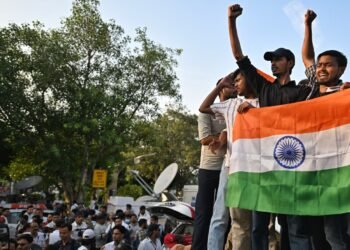
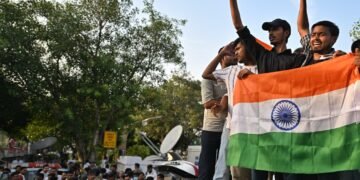
But it seems this value of supporting each other on their issues has changed in contemporary times. It is evident from the fact that there exists an unusual silence on university campuses across the country on the matter of brutal police action against students and young people on July 20, during their march towards the Indian Parliament, following a three-week-long protest over the NEET exam paper leak issue.
The silence is primarily from the teachers’ side. Students across university campuses organised protest marches in solidarity with the ongoing protest in the national capital seeking accountability and reform in the system. The university teachers, who are supposedly among the most intellectually sound individuals of the nation, however, failed to come forward to express solidarity with the students on this issue. Not only individually, but most of the university teachers’ associations also restrained from expressing solidarity with the student protestors and criticising police brutality.
How has this kind of silence been made possible in a diverse country like India? Is it individual fear of speaking truth to those in power, or a systematic takeover of universities over the years, or something else like ideological beliefs, or all of these factors operating together? In my view, it is a mix of all these with the most prominent being the systematic takeover of universities through pushing extremely biased ideological supporters of current dispensation on the campus spaces.
These ideological biased individuals (especially teachers) not only support the ruling dispensation at every cost but also demotivate and criticise others with different perspectives on any issues. The university spaces have remained a place for highly contested ideas, ideologies, voices but there existed some bottom lines that students need teachers support. However, this support has eroded with time due to other reasons like individual teachers being fearful of speaking truth to power in public.
It is worth mentioning here, whatever be the reason behind this, it is a sad reality of the Indian higher education system that university teachers failed to rise to a historical moment though they claim to significantly contribute to nation building through education and research. It is now incumbent upon the university teachers to reflect and answer how they have become so weak and spineless that they can’t take a stand for the students — the students they teach, the students who are the future of this country and who are protesting for a right cause.
This protest is not only limited to one examination paper leak but also focuses broadly over systemic issues hampering the higher education system. But this current silence from the teachers’ side has once again highlighted the shrinking space for dialogue, discussion, constructive criticism and argument on Indian university campuses. This is happening even though our forefathers, who fought for our independence, conceptualised universities as a place for holistic development rather than mere literacy. India’s father of the nation, M.K. Gandhi, in an article titled ‘National Education,’ published in Young India on 1 September 1921, argued that education is not only meant to impart literary knowledge — that is, knowledge of the letters of the alphabet or the study of literature.
Instead, our forefather dreamt that education shall do more, i.e., to develop an individual morally, physically and mentally. And, university campuses are ideally the suitable places for achieving these objectives. But a million-dollar question lies before fellow Indians: how can these objectives of the holistic development of the individual be achieved when those responsible for inculcating these values have failed to act morally on contemporary issues affecting society including students?
The situations were not the same in the past, when the university teachers and their associations expressed their solidarity with several protests, including the Lokpal movement, and organised a protest march against police brutality on students at the campus of Jamia Millia Islamia University. However, since then, several things have seemingly changed, as a few cases of suspension of public university teachers for asking questions — including those related to comparisons of ideologies and atrocities against a particular community — and the resignation of professors from a private university after a controversy over a research paper on Indian elections have taken place.
There may still be fear among the university teachers’ community about their future, but they are forgetting that youngsters and students are the present and the future in reality. The universities or educational institutes can’t function without students, who are the lifeline of the Indian education system, and their future shall be of utmost importance.
However, there are some glimpses of hope too. A few teachers-turned-politicians, like Rajya Sabha MP Manoj Jha, DU’s terminated teacher-turned-social-activist Dr Laxman Yadav, among others, have sided with the protesting students, attempting to help them, alongside several unnamed individuals who came forward providing food packets and water through instant delivery apps and small financial contributions to the cause.
(The author is a third-year PhD research scholar in Department of Journalism and Mass Communication, North-Eastern Hill University, Shillong)