











Shillong, Jun 13: The Partition of 1947 left deep scars across the hills of Meghalaya, severing ties that had existed for centuries between Khasi and Jaintia communities and their ancestral lands.
When the Radcliffe Line was drawn and Sylhet was merged with East Pakistan, many indigenous families living along the border found their homes and fields suddenly falling on the other side.
Persons belonging to the Khasi and Jaintia communities lost not just their livelihoods but entire villages.
They were forced to relocate deeper into the Khasi and Jaintia Hills, leaving behind paddy fields, betel nut gardens, and market ties that had sustained them for generations.
For the Khasis settled near the Sylhet border, the Partition was more than a political division.
It cut off access to the haats, or local markets in Sylhet where they had traditionally sold their oranges, betel leaves, potatoes, and other produce. Weekly markets were central to their economy. Once the border was sealed, farmers lost direct access to buyers, prices fell, and entire trading networks collapsed.
Many families who had cultivated land on both sides of the present boundary had to abandon plots they had tilled for generations.
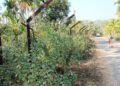
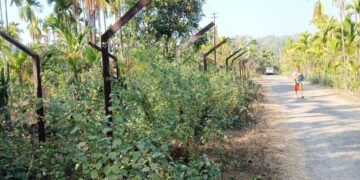
Decades later, fears of losing agricultural land resurfaced with proposed border fencing located 150 yards from the international boundary with Bangladesh. Residents living along the border in Meghalaya say they are not opposed to fencing itself, but they fear losing agricultural land that they have cultivated since the time of the Jaintiapur Kings.
Kmen Myrchiang of the Coordination Committee on International Border said border residents earn their livelihood mainly through agriculture, and fencing set 150 yards inside Indian territory would push vast tracts of farmland into Bangladesh.
“We are not opposing border fencing, we want it for our safety and security but we are against losing our agricultural lands to Bangladesh,” Myrchiang said.
According to Myrchiang, opposition to the 150-yard setback has existed since 2003.
From Nongjri up to Jaliakhola and Pasadwar, the terrain is complex, with fields, betel nut groves, and orchards spread across the borderline.
He noted that after Bangladesh was liberated in 1971, and even earlier in 1947 when the area was tagged with Pakistan, border residents had been cultivating these lands continuously. He claimed there are documents proving ownership dating back to British times and to the District Council.
“How can the government now say these lands belong to Bangladesh,” Myrchiang asked.
He informed that around 150 to 200 acres of land cultivated by Meghalaya residents currently lie outside the boundary. These are plots where betel nuts, fruits, and other crops are grown. He argued that under the Sixth Schedule, such lands belong to the community and not to the government.
Myrchiang also pointed out that the 1975 Joint India-Bangladesh Guidelines for Border Authorities prohibit both nations from constructing permanent defensive structures or posts within 150 yards of the international boundary.
A 2011 agreement was signed later, but border residents say they were not consulted through public hearings as stakeholders.
The terms of the India-Bangladesh Land Boundary Agreement remain unclear to many villagers, leaving them in the dark about how it affects their holdings.
The concerns are not limited to land alone. Myrchiang referred to the Nehru-Noon Agreement of 1958, under which the Umngot river was to form the natural boundary between India and Bangladesh, with residents of both countries allowed to use it.
He alleged that after 2017, from Pillar No. 1267 up to 1273, portions of the Umngot have shifted to Bangladesh, further affecting traditional access.
The fear of losing land has been echoed recently by residents of Lyngkhong village in East Khasi Hills, who have expressed apprehension about being cut off from India if fencing is built 150 yards from the boundary.
Myrchiang said similar incidents could repeat in other border villages if the setback is enforced without consultation.
He stressed that if fencing is carried out on the Zero Line, it would protect both security interests and ancestral lands.
Without those lands, he said, families would have no other source of income.