










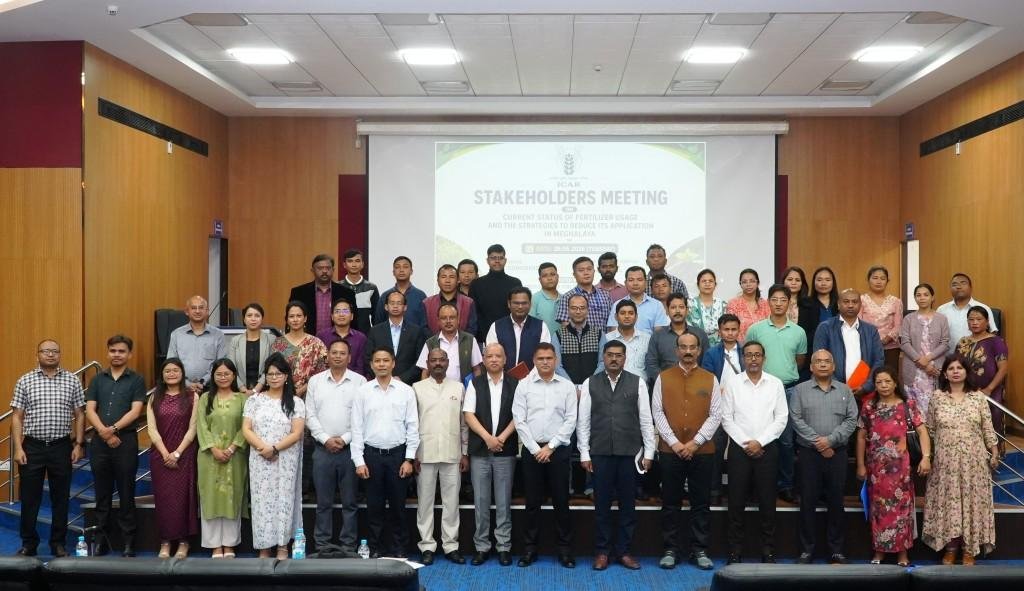
Shillong, May 26: The ICAR Research Complex for NEH Region convened a stakeholders meeting at its headquarters in Umiam on the theme ‘Current Status of Fertilizer Usage in Agriculture and Strategies to Reduce Its Application in Meghalaya’
Participants, including government officials, field extension workers, input dealers, and farmers, engaged in discussions aimed at addressing the pressing issue of fertilizer consumption in the region.
Dr. B.P. Singh, Head DTAC said the primary objective of the meeting is to collect insights about the current fertilizer consumption patterns in Meghalaya. He said that a reduction in fertilizer use can significantly alleviate the financial burden on farmers while fostering sustainable agricultural practices.
Dr. G. Kadirvel, Director of ICAR RC NEH, noted that despite lower fertilizer usage in Meghalaya compared to other states, there remains an urgent need for a coordinated approach to further decrease its application. He highlighted the importance of sensitizing stakeholders and farmers on balanced fertilizer use and sustainable soil health management.
Director ATARI, Dr. Mohanty emphasised the urgent need for the development of green manuring as an alternative to chemical fertilizers. He also highlighted the potential for promoting bio-input manufacturing entrepreneurship to address the present challenges associated with fertilizer dependency.
Dean CPGS-CAU stated that for ensuring balanced fertilization, the State Government should place fertilizer indents in a manner that enables farmers to receive inputs in the required proportion. He further emphasized that under-fertilization is also a form of imbalanced fertilization and needs to be corrected by the use of alternative organic nutrient sources.
During the discussions, participants explored alternative practices such as promoting biofertilizers, green manuring, and organic waste-based fertilizers. The meeting highlighted the importance of strengthening biofertilizer production at the district level and incorporating traditional bio-formulations to enhance soil health.
Furthermore, the stakeholders discussed creating short-, medium-, and long-term strategies aimed at reducing fertilizer dependence, thereby contributing to sustainable agriculture in Meghalaya.