











Shillong, May 9: Chief Justice of India Justice Surya Kant today made a landmark visit to Meghalaya, focusing on challenges that hinder citizens from accessing justice and welfare schemes.
This visit marked a historic first by any chief justice as he attended a mega camp-cum-awareness program themed, ‘Bridging the Gap’, organised by the Meghalaya High Court in conjunction with the Meghalaya State Legal Services Authority (MSLSA) at Marngar, Ri Bhoi district.
During the event, Chief Justice Kant highlighted how distance, paperwork, and lack of awareness keep citizens from availing justice and welfare schemes.
Sharing a personal account from his previous experience as a judge, he recounted the struggle of a construction worker who faced significant hurdles while trying to secure disability benefits for his injured wife.
This case showed that barriers such as distance, language, procedure and technology often prevent citizens from accessing justice and welfare schemes. “The real challenge is not the absence of schemes, but whether the system is capable of reaching people where they are,” he said.
Chief Justice Kant touched upon a fundamental issue where “a right unknown is often a right denied.” He stressed that lack of awareness remains one of the biggest challenges, particularly in geographically remote areas. He added that procedural requirements, documentation issues and repeated travel to distant offices often deprive citizens of benefits already guaranteed under the Constitution.
He stressed the need for convergence of legal aid and welfare schemes to ensure last-mile delivery of justice. “It is very essential that under one roof, all these welfare schemes implemented by government departments, organisations and legal institutions are made available to all,” he said, urging all stakeholders to work in tandem to strengthen access to justice.
The CJI also acknowledged the role of para-legal volunteers in delivering legal services at the grassroots level and called for strengthening their recruitment.
He further encouraged greater public participation in community-based justice systems to ensure inclusive and compassionate justice delivery.
Supreme Court Judge, Justice Ujjal Bhuyan stressed the importance of aligning traditional systems of justice with the modern justice delivery system as enshrined in the Constitution of India for a more robust legal framework that respects cultural nuances while upholding modern legal principles.
He also referred to Ri Bhoi’s famed pineapple cultivation, remarking in a lighter vein that the people of Meghalaya were “as sweet as the pineapples grown there”.
Meghalaya Law Minister Lahkmen Rymbui said MSLSA had devised a comprehensive state action plan aimed at effectively responding to local legal issues in consonance with national laws and policies.
He said achieving access to justice is not solely the responsibility of the government or judiciary; rather, it requires a unified effort from society as a whole.
Chief Justice of the High Court of Meghalaya Justice Revati Mohite Dere said the mega camp was aimed at ensuring legal help reached the people at their doorstep.
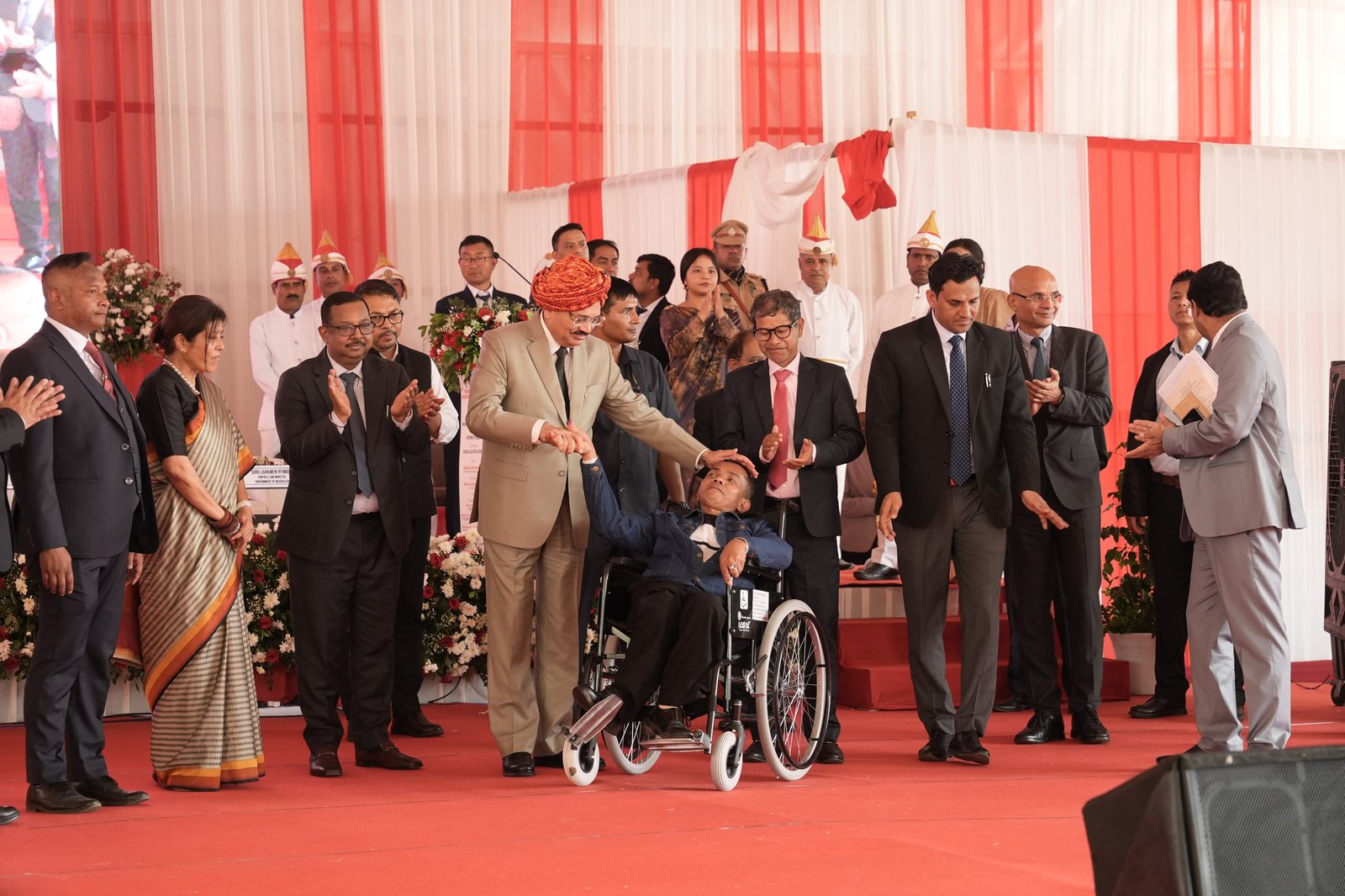
During the programme, dignitaries distributed assistive devices to persons with disabilities, financial assistance and work orders to self-help groups and village organisations, and certificates to legal aid lawyers and para-legal volunteers for their performance during 2025.
Later, High Court judges Justice Hamarsan Thangkhiew and Justice Wanlura Diengdoh flagged off multi-utility vehicles under the NALSA Grant-in-Aid Scheme.