










Shillong, Dec 13: The National Highways Authority of India (NHAI), PIU Shillong has issued corrected toll revenue figures following an RTI application.
A clarification was issued on December 8 in response to the RTI filed by Centre for Efficient Governance (CEG) Executive Director Rakesh Hazarika who had raised concerns over transparency in highway toll accounting.
Earlier, the CEG has raised concerns over a significant discrepancy in two separate RTI replies stating it was statistically improbable.
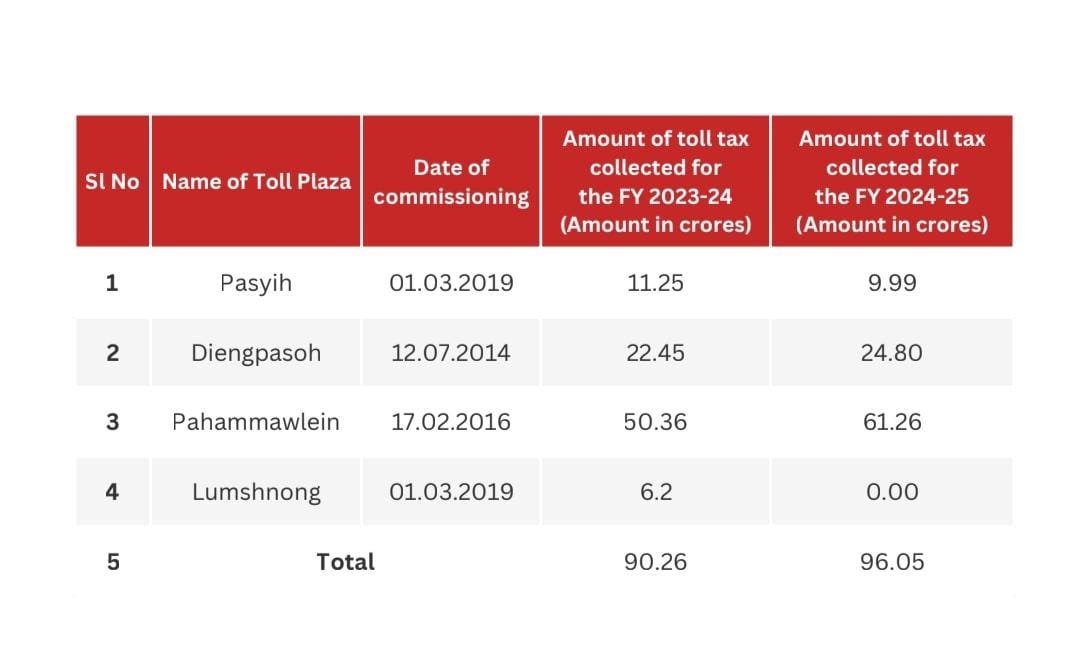
The NHAI had provided identical revenue collection for the financial year April 2023–March 2024 and the calendar year January–December 2024 for all four toll plazas in Pahammawlein, Diengpasoh, Pasyih, and Lumshnong, which prompted the CEG to seek a re-verification of the data.
According to the revised figures, Pahammawlein Toll Plaza accounted for the highest collection at Rs 61.26 crore, followed by Diengpasoh with Rs 24.80 crore and Pasyih with Rs 9.99 crore, while Lumshnong reported no toll revenue during the period.
The fresh data shows that toll plazas in Meghalaya generated a total of Rs 96.05 crore during the 2024–25 financial year.
Hazarika said that while the corrected information is welcomed there is an urgent need for greater accuracy and diligence in NHAI’s toll revenue reporting. He emphasised that transparent and reliable data is essential for ensuring accountability in toll-based infrastructure operations.
He also reiterated his concern regarding the long-standing absence of Wayside Amenities (WSA) across Meghalaya.
A previous RTI reply from NHAI confirmed that no WSA has been developed anywhere in the state of Meghalaya, despite toll operations continuing for over eleven years since the first toll plaza at Diengpasoh began operations in 2014.
Hazarika stated that this prolonged gap in essential infrastructure for tourists reflects serious institutional neglect. Meghalaya’s economy relies heavily on tourism and the absence of rest areas, clean toilets, emergency services, and basic facilities along national highways poses a continuing setback for both commuters and tourists.