









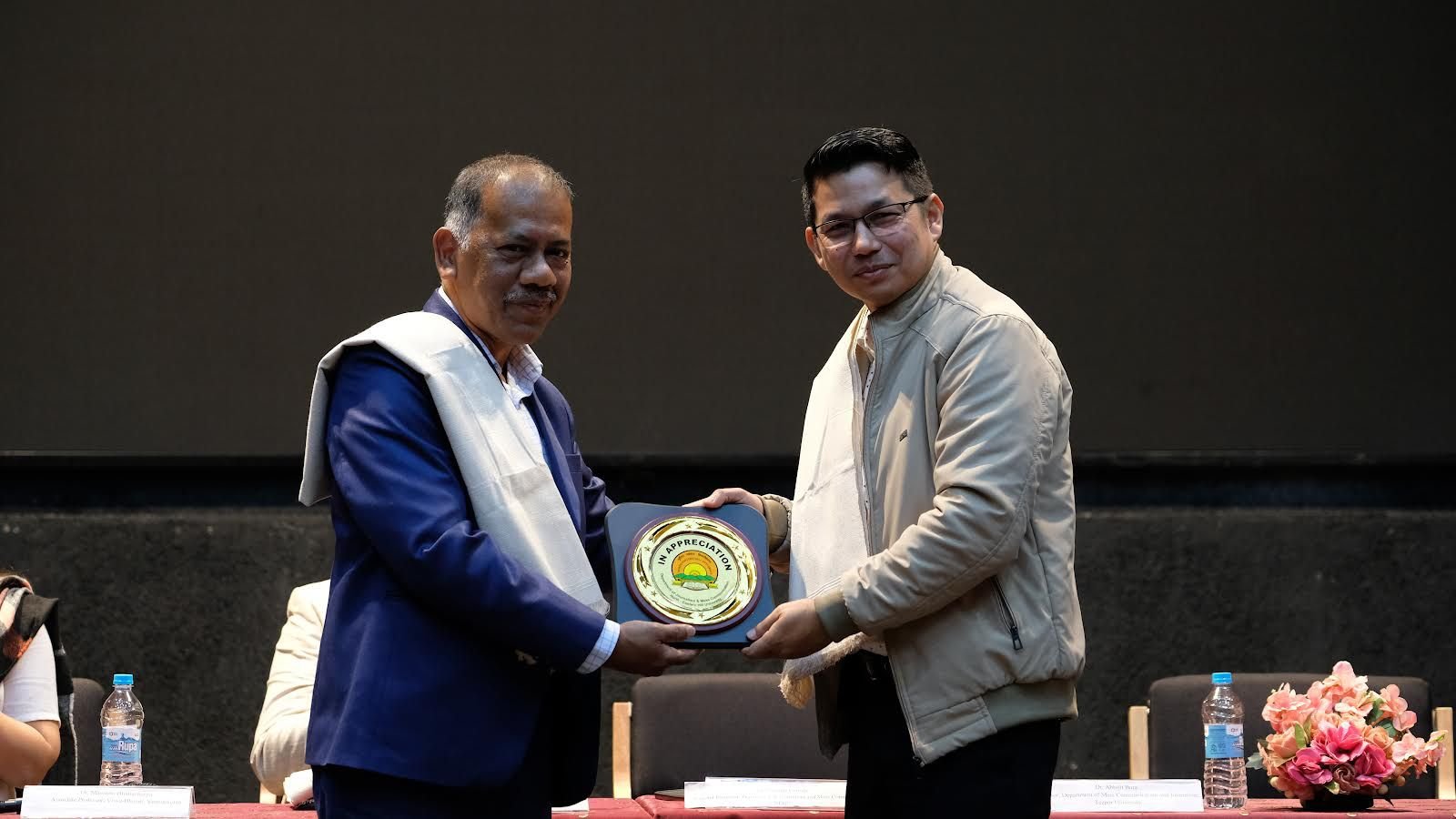
Shillong, Nov. 11: The scope of Khasi cinema extends beyond artistic expression as it serves as a powerful pedagogical platform for teaching and learning, fostering innovation in storytelling, themes, and cultural representation.
These insights were shared by Dr. Lapynshai Syiem, Associate Professor, Department of Cultural and Creative Studies, North-Eastern Hill University (NEHU), Shillong, during her address on ‘Evolutionary Journey of Traditional Khasi Music in Cinema’ at the national seminar on ‘Craft, Culture and Commerce of Cinema in North-East India.’
Dr. Syiem highlighted that cinema plays a significant role in shaping and preserving traditional Khasi music and culture. She emphasised that cinema enriches both personal and societal growth while strengthening cultural identity.
She further explained the distinctions between experimental, entertainment, and aesthetic cinema, noting that traditional Khasi music serves diverse purposes across these forms: driving innovation in experimental films, contextualizing narratives in entertainment cinema, and providing symbolic cues in aesthetic works.
Prof Streamlet Dkhar, Department of Khasi, NEHU, Shillong, in her presentation on ‘Adaptation and Portrayal of Traditional Khasi Literature in Cinema’ observed that the adaptation of Khasi literature on screen represents an evolving dialogue between the past and the present, as filmmakers reinterpret folk narratives for contemporary audiences, and sometimes even departing from their original forms.
“While such reinterpretations may enhance cinematic appeal, they risk diluting cultural essence,” she cautioned. “In many cases, matrilineal traditions are misrepresented or the subtle patriarchal nuances within Khasi society are overlooked,” she added.
She also underscored the importance of symbolism in Khasi cinema, noting that indigenous elements such as bamboo, water, and Phawar (poetic verses) imbue authenticity and convey layered meanings. However, she stressed that filmmakers must possess a nuanced understanding of rituals, language, and aesthetics to ensure faithful representation.
Prof. Dkhar stressed the need to strengthen the synergy between Khasi literature and cinema to safeguard cultural continuity while fostering creative innovation – a delicate balance between honouring heritage and embracing modernity.
A panel discussion on ‘Rethinking Film Studies in the Regional Context’ underscored the importance of film literacy and the establishment of film clubs across educational institutions in the North-East.
Dr. Mausumi Bhattacharyya, Associate Professor, Centre for Journalism and Mass Communication, Visva-Bharati University, argued that regional cinema should not be viewed merely as a reflection of social realities but as a producer of film theory and cinematic philosophy in its own right by creating new ways of seeing, sensing, and relating. She cited examples from ‘The Village Doctor’, ‘Crossing Bridges’, and ‘The River of Fading Light’, noting that North-East cinema often captures ethical and aesthetic dimensions through silence, atmosphere, and continuity rather than dramatic conflict.
Prof. Abhijit Bora, Department of Mass Communication and Journalism, Tezpur University, discussed how emerging filmmakers in the region are experimenting with innovative subjects, as seen in films such as ‘Kothanodi’, ‘EmuthiPuthi’, and ‘Dr. Bezbaruah 2’, which blend cultural identity with contemporary cinematic approaches. He also reflected on challenges such as limited audience engagement and high-ticket costs, urging that regional cinema remain grounded in local realities while striving for broader representation and accessibility.
Offering a comparative perspective, Prof. Ravindra Vemula, Department of Journalism and Mass Communication, Shillong Campus, The English and Foreign Languages University, compared South Indian film industries with those of smaller regions like the North-East. He observed that, despite infrastructural limitations, regional cinema has emerged as a space for resistance, identity formation, and cultural documentation. He further noted that the rise of OTT platforms during the pandemic expanded national and global access to regional films, challenging mainstream narratives. Prof. Vemula emphasized the need for ethnographic and audience-based approaches in film studies, alongside the promotion of film literacy among both creators and viewers.
The two-day North Eastern Council (NEC)-sponsored national seminar, organised by the Department of JMC, NEHU, concluded at the Golden Jubilee Auditorium, Shillong Campus, with a valedictory session chaired by Prof. B. Mishra, Head of the Department of Economics, NEHU.
The seminar featured 30 paper presentations across 13 sessions over two days, exploring representation, culture, identity, and ethnicity in North-Eastern cinema.