













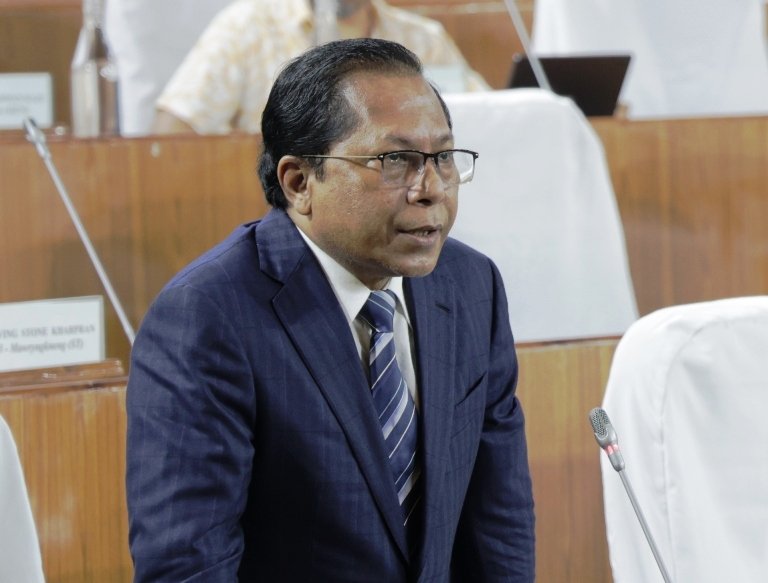
Shillong, Sep 9: Former Chief Minister and Leader of the Opposition Dr Mukul Sangma today criticised the state government’s decision to take over the responsibility of paying salaries of Autonomous District Council (ADC) employees, calling it confusing, contradictory and against the spirit of the Sixth Schedule of the Constitution.
Participating in a short duration discussion moved by fellow opposition MLA Ardent Miller Basaiawmoit in the Assembly, Dr Sangma said there is a lack of clarity in the government’s approach. “It somehow appears as though the announcement that the government will assume the responsibility of paying ADC employees was an option born out of confusion, without aligning with the spirit and principles of the Sixth Schedule,” he remarked.
He cited Paragraph 13 of the Sixth Schedule, which lays down the responsibility of strengthening ADCs to ensure effective decentralisation of power. He also drew attention to the 2014 tripartite settlement agreement signed among the central government, state government and the ANVC militant group.
“The intent of that agreement was to strengthen and empower the ADCs, not to dilute their powers. Any attempt to take a U-turn is a betrayal of that solemn commitment,” Dr Sangma cautioned.
Highlighting past examples, the opposition leader noted that the subject of primary education, originally under the ADCs, was taken over by the state government on the grounds that the councils could not pay teachers’ salaries. He warned that the current move could be another step towards weakening the constitutional bodies.
“The government’s unilateral decision, without exhaustive discussion or consensus, is contrary to the collective intent reflected in the text settlement agreement. Transparency is missing, and that raises serious concerns,” he said.
Dr Sangma urged the government to revisit its stand and ensure that ADCs are strengthened, not reduced to “orphans”.
“A clear message must go out to restore people’s faith and confidence. We cannot afford to weaken the very institutions that were created to protect our tribal identity and aspirations,” he concluded.