






By Dipak Kurmi
The tranquil landscape of Meghalaya’s West Garo Hills was recently shaken by a chain of violent incidents triggered by tensions surrounding the nomination process for the upcoming elections to the Garo Hills Autonomous District Council (GHADC). What began as protests over the participation of non-tribal candidates in the electoral process quickly escalated into clashes, arson, and widespread unrest across several towns, compelling authorities to impose curfews, suspend internet services, and deploy army columns to restore order. The unfolding events revealed the deep socio-political sensitivities surrounding identity, representation, and governance in the region’s autonomous institutions.
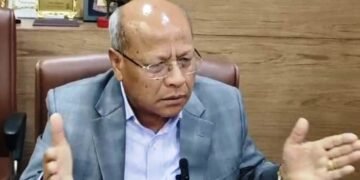
The immediate trigger for the crisis was the attempt by former Phulbari MLA Esmatur Mominin to file his nomination papers at the Deputy Commissioner’s office in Tura. On the first day of nomination filing, Mominin arrived early in the morning along with another aspiring candidate, Enamul Haque, and a group of supporters. According to reports, the candidates reached the office premises even before it officially opened. At that time, the formal notification from the DC office had not yet been released, creating an atmosphere of uncertainty. News of their presence soon spread rapidly across the town, drawing the attention of several local organisations and pressure groups that had been opposing the participation of non-tribal candidates in the GHADC polls.
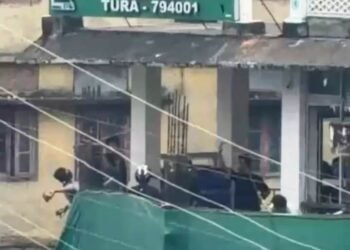
As word circulated, a large group of protesters gathered outside the Deputy Commissioner’s office complex. Despite the presence of security personnel, members of the group allegedly forced their way inside the premises. The situation quickly spiralled out of control as the crowd overwhelmed the available security arrangements. During the ensuing commotion, Mominin and Haque were reportedly assaulted, while some of their supporters fled the scene in panic. Police reinforcements were rushed to the spot and eventually managed to bring the situation under control before the violence escalated further.
Following the incident, both candidates along with four of their supporters were taken into protective custody and later shifted to Tura Civil Hospital for medical treatment. The attack sent shockwaves across the district and intensified the already volatile atmosphere surrounding the GHADC election process. Despite the violence, Mominin and Haque are reportedly planning to contest the upcoming council elections as independent candidates from the Phulbari region, a development that has further complicated the local political climate.
The unrest did not remain confined to Tura. Later that evening, anger spilled over into the plains belt of the district, particularly in Chibinang, a town situated between Phulbari and Tikrikilla and known for its pineapple trade. Chibinang is a demographically mixed area dominated by non-tribal communities, and tensions there have historically been sensitive due to issues of land rights and political representation. In what appeared to be a retaliatory act linked to the morning’s assault, a mob comprising several hundred people attacked the office of the Garo Students’ Union (GSU) at Chibinang market and set it on fire.
By nightfall, clashes erupted between groups from two communities in the town. The confrontation turned deadly, leading to the deaths of two individuals and leaving the entire region on edge. Initially there were allegations that the fatalities had resulted from police firing. However, authorities later clarified that the deaths occurred during a clash between rival groups rather than due to security force action. According to police reports and post-mortem findings, one victim suffered fatal injuries caused by a sharp weapon, while the other had bullet wounds consistent with a country-made firearm. Investigators indicated that some attackers may have been carrying illegal weapons during the confrontation.
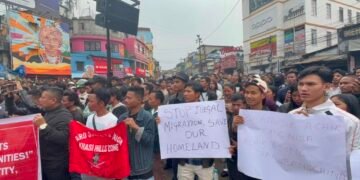
The violence continued to spread the following day, moving from Chibinang to the district headquarters town of Tura and later reaching Williamnagar and other locations. Incidents of vandalism, arson, and stone pelting were reported from several places as mobs targeted buildings and commercial establishments. At Tura Bazaar, protesters gathered outside the Deputy Commissioner’s office, reportedly attempting to prevent non-tribal candidates from filing nomination papers. Security forces faced stone pelting as rumours circulated that certain candidates had taken shelter inside the police station.
By afternoon, the unrest had intensified in multiple locations. In Williamnagar, mobs attacked and set fire to two buildings associated with religious gatherings, while several shops were looted and vandalised. A similar episode unfolded in Dadenggre civil subdivision, where a number of stores were ransacked. At least three vehicles were reportedly set ablaze during the rampage in Tura. The escalating disturbances overwhelmed local law enforcement, prompting the state government to take stronger security measures.
Authorities responded by imposing a strict curfew across Tura and several sensitive areas of West Garo Hills district. The curfew, issued under Section 163 of the Bharatiya Nagarik Suraksha Sanhita, prohibits unauthorised public gatherings, processions, and the movement of five or more persons in designated zones. Carrying arms or objects that could potentially be used as weapons, including sticks, rods, and stones, has also been banned. The curfew is enforced daily from 6:00 pm to 6:00 am until further orders, with officials warning that violations would invite penal action under Section 223 of the Bharatiya Nyaya Sanhita and other applicable laws.
The restrictions apply to several villages and neighbourhoods under Hallidayganj Police Station, Phulbari Police Station, and Selsella outpost under Tura Police Station. Areas such as Kasharipara, Charkasaripara, Lalmatia, Konarchar, Sobriari, Kharigaon, Panbari, Tetultila, Boroijhora, Jewali, Bollonggre, Jeldapara, Boldamgre, Guaraggre, Nawalgre, Gansenggre, Masangpani, Gudibala, Gomai Jhora, Demdema, Belbari, Babligre, Songjalgre, Shyaming, Chibinang, Lokaikmari, Batabari, Mengkakgre, Chandigre, Rongkhon, Takimagre, Old Bhatbari, Rajpur, Babulgre, Bamundanga and Chokchokia have all been identified as sensitive zones.
To prevent the circulation of rumours and inflammatory messages, internet services across the district were suspended for 48 hours. The administration noted that areas with mixed populations in the plains belt of West Garo Hills were particularly vulnerable to communal tension, necessitating urgent precautionary measures to maintain peace. District Magistrate Vibhor Aggarwal emphasised that the curfew was intended to prevent intimidation, disruption of public movement, and possible outbreaks of violence during the election process.
Given the scale of unrest and the strain on local security forces, the state government requested assistance from central agencies. Three companies of the Central Reserve Police Force and one unit of the Rapid Action Battalion were deployed to support local police. In addition, army columns were stationed in Chibinang and later moved to Tura to conduct flag marches aimed at restoring public confidence and deterring further violence. The first flag march took place in Chibinang, the area most severely affected by the clashes, and additional patrols were scheduled for Tura in the following days.
Police officials stated that despite the deployment of reinforcements, sporadic gatherings and attempts to defy curfew were reported. Security personnel continued to patrol sensitive localities, while fire services worked to extinguish the blaze at the damaged GSU office in Chibinang. Authorities also convened a peace meeting involving religious leaders, representatives of civil society organisations, and members of the Mothers’ Union to encourage dialogue and calm tensions between communities.
The crisis in West Garo Hills reflects a deeper debate surrounding the structure and jurisdiction of the Garo Hills Autonomous District Council, an institution created under the Sixth Schedule of the Indian Constitution to safeguard tribal self-governance. The question of whether non-tribal candidates should participate in its electoral process has periodically sparked controversy, especially in regions where demographic patterns have evolved over decades of migration and economic activity. For many indigenous groups, the council represents a crucial mechanism for preserving cultural identity and political autonomy, while others argue that democratic participation should not be restricted along ethnic lines.
As the district moves toward the scheduled GHADC elections, the immediate priority for authorities remains restoring normalcy and preventing further escalation. Community leaders have urged restraint and appealed to residents not to spread rumours that could inflame passions. While security deployments and curfew measures may temporarily stabilise the situation, the underlying issues of representation, identity, and political inclusion will likely continue to shape the discourse in Meghalaya’s Garo Hills long after the present unrest subsides.
(The writer can be reached at dipakkurmiglpltd@gmail.com)