








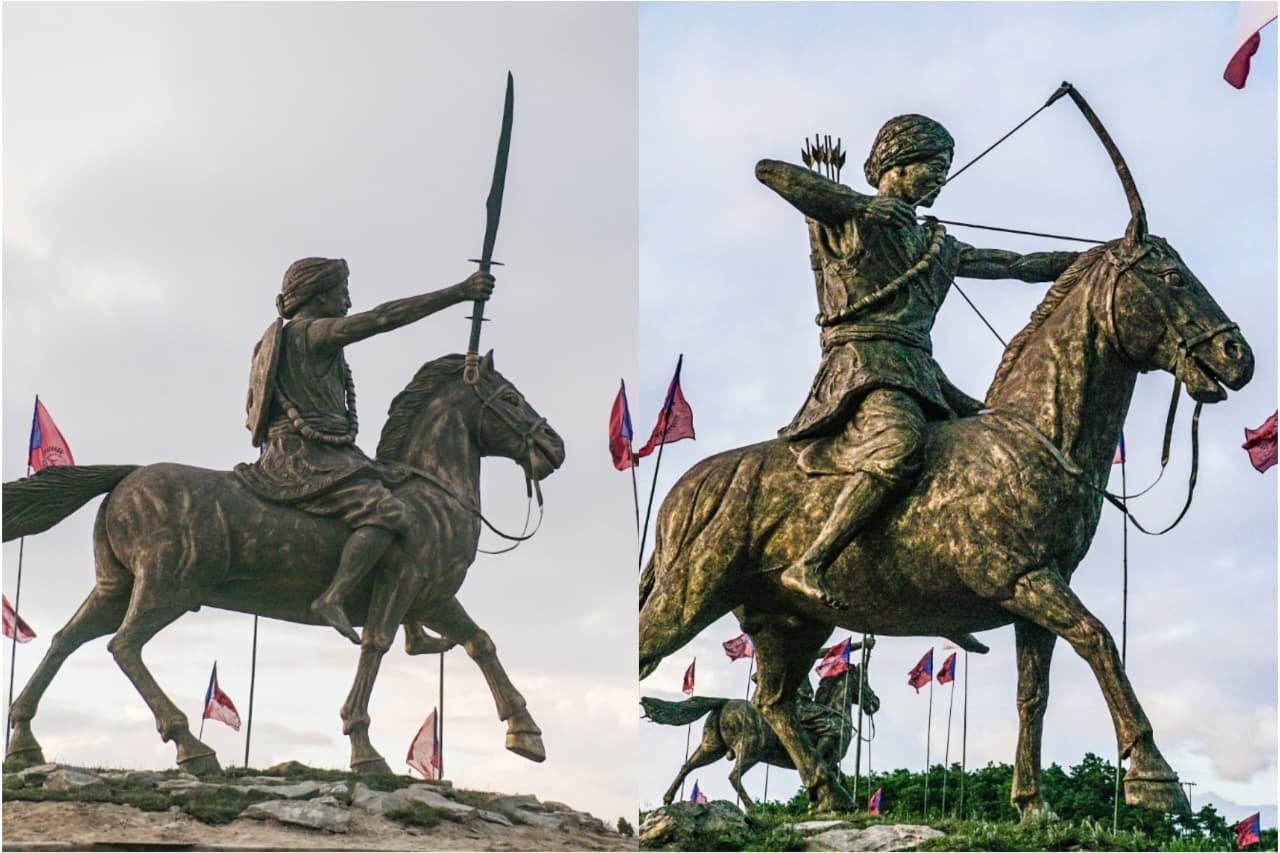
Shillong, Jul 17: In an effort to preserve indigenous history, the Hynniewtrep Youths’ Council (HYC) resurrected the memory of the heroic deeds of Bormanik Syiem of the erstwhile Hima Shyllong and Sngap Sing Syiem of Hima Maram by unveiling two full-length, 15-foot statues of the legendary chiefs at Laitarted, Nongthliew.
The ceremony coincided with the occasion of the 191st death anniversary of the iconic freedom fighter U Tirot Sing Syiem and the foundation day of the HYC.
The ceremony witnessed the gathering of prominent traditional heads, socio-political leaders and activists from across the state. The 15-foot statue of Sngap Sing Syiem was formally unveiled by Niandro Syiemiong of Hima Maram, while the figure of Bormanik Syiem was brought to light by Habapan Sing Syiem, the Deputy Syiem of Hima Khyrim.
The event also drew significant solidarity from the wider region, with prominent social activists from both the Garo Hills and Jaintia Hills traveling to Nongthliew to witness the historic tribute.
The statues were conceptualised and crafted entirely by artists of Riti Academy. The creation of the towering monuments was led by chief creative director Raphael Warjri, alongside the main sculpting team comprising Banteilang Hynniewta, Returnwell Sutong and Skhemlang Hynniewta. The project was brought to fruition with the assistance of local artisans Iallissing Mawrie, Bapynskhem Mawrie and Batskhemlang Kharumnuid.
The beginning of the Anglo-Khasi War had its roots in actions taken by Bormanik Syiem when he challenged the authority of the British East India Company in 1828 by protecting the rights of the Khasi inhabitants of the lowland area of Dimurua bordering Assam. He confiscated all revenues collected by the British tax officers and declared his determination to reoccupy his lowlands. Bormanik Syiem proved to be an astute military strategist; in collaboration with Tirot Sing Syiem, he planned and executed a series of successful ambushes and military encounters.
Sngap Sing Syiem continued the struggle and emerged as the last great leader of the Khasi armed resistance. During the Second Anglo-Khasi War (1835–1839), he transformed the rugged stronghold of Nongnah into an almost impregnable natural fortress. Employing masterful guerrilla tactics and exploiting the formidable terrain of Maharam, he repeatedly repulsed British military expeditions, inflicted heavy casualties upon the invading forces and prolonged the resistance for four arduous years despite overwhelming odds. His struggle ended only after internal betrayal exposed his defences, leading to his capture in 1839.