












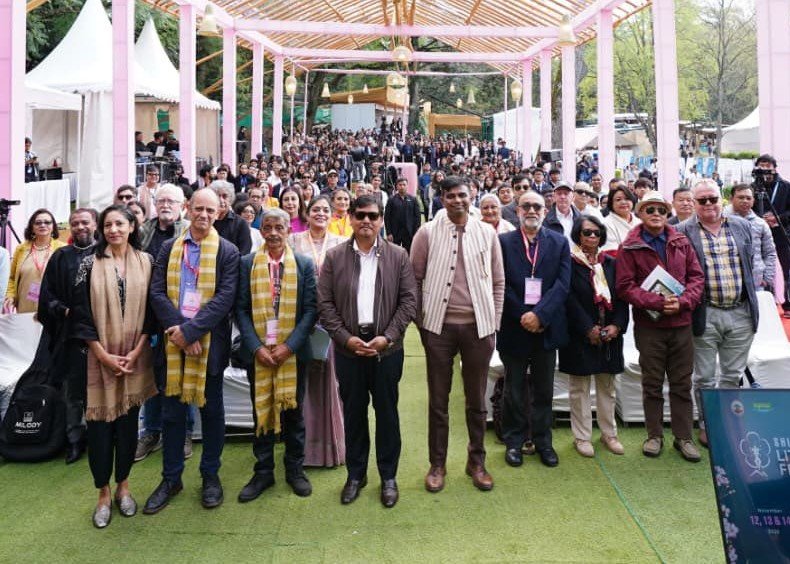
Shillong, Nov 12: The 6th edition of the Shillong Literary Festival opened at Ward’s Lake today, setting the tone for a three-day celebration of words, ideas and roots.
Organised by the Tourism Department, authors, poets and thinkers from Meghalaya, across India and abroad are attending.
Addressing the gathering, Chief Minister Conrad K Sangma said Meghalaya is today one of the fastest-growing economies in the country, but stressed that growth must be balanced.
“While the economy moves, it must trickle down and impact the individuals who it’s meant to,” he said.
He said through the festival, many youngsters will get opportunities and encouragement and motivation to start writing.
Speaking on the living root bridges, India’s nomination for UNESCO World Heritage Site status, he said, “Here we are not constructing, but we are weaving bridges.”
“Ensuring that we are connected to our roots is going to ensure that we as a society, as people, as a state, as a community, will not lose ourselves in the process of moving forward,” he added.
Tourism Commissioner & Secretary Vijay Kumar D said having Booker Prize winners at the festival is an inspiration, privilege and good fortune.
The festival launched new books by Daniel Challam (Postcards from the Khasi Hills: Shillong and Beyond in Panorama), Rudy Warjri (Adventures of a Peripheral Indian Diplomat), Sanjoy Hazarika (Lal Thanhawla), Yadawanka Pala (The Rainbow I Named), Streamlet Dkhar (Wad Shwa La Ka Tynrai), Bijoya Sawian (Chocho Momo and What Time Cannot Erase) and Anjum Hasan (Hometown).
Three significant publications on Khasi heritage, culture and traditional social institutions were released on the opening day by celebrated South African novelist and playwright Damon Galgut, winner of the 2021 Booker Prize.
The books were introduced by their authors, Raphael Warjri and Adeline Swer, before Galgut unveiled the titles.
The publications are Jutang Longblei: Khasi Divine Covenant and Khasi Matrilineal Clan Lineage System, authored by Warjri, and Matriliny versus Patriarchy, co-authored by Warjri and Swer, a graduate in B.Sc. Psychology Honours.
Matriliny versus Patriarchy examines the ancient customary institution of matriliny in Khasi society, its historical and cultural foundations, and its significance in maintaining the distinctive social identity of the community. It also critically investigates transitional pressures from surrounding patriarchal norms on contemporary Khasi society.
Jutang Longblei: Khasi Divine Covenant is a bilingual publication in Khasi and English documenting myths, legends and traditional narratives of the Khasi community. The folktales are arranged chronologically and interconnected to establish a coherent sequence of mythological events.
The third publication, Khasi Matrilineal Clan Lineage System, is an international edition of Warjri’s earlier work, MEI: Matrilineal Exogamous Institution. The initiative was undertaken in 2025 by Pidison Suchiang, President of the Greater Sylhet Indigenous Peoples’ Forum, to reach the substantial Khasi population in Bangladesh, particularly communities that continue to uphold the traditional matrilineal system.
Booker Prize-winning author Kiran Desai said, “I feel as if I’ve waited all my life to see this part of India. Something essential to the human spirit and to the artistic spirit is in the mountains and in the forests.”
Expressing her wish to learn about Khasi, Garo and Jaintia literature, she said, “I come as a very eager student.”
Galgut said, “The Indian landscapes and people and different cultures have sparked off my own creative impulses,” adding, “I can see even from the events up here on stage and the books that have just been officially launched, that this festival is going to be no different.”
Padma Shri awardee, Hally War also addressed the gathering, speaking on the importance of protecting and preserving roots.