












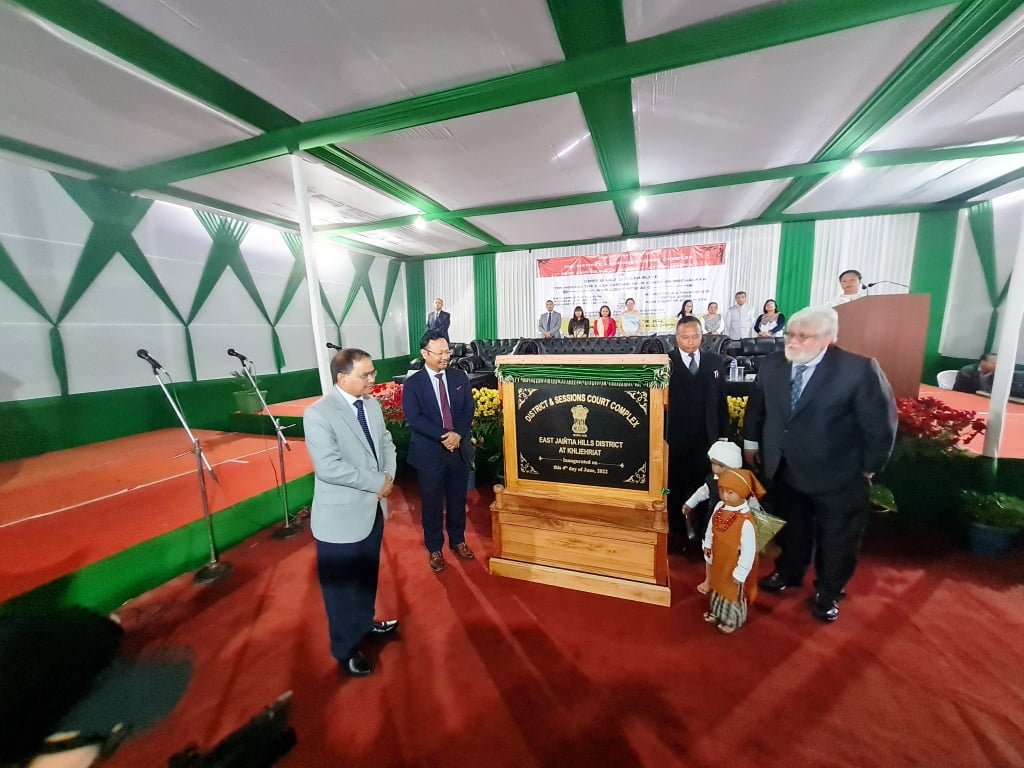
The Chief Justice of the High Court of Meghalaya, Justice Sanjib Banerjee, inaugurated the permanent court building of the District and Sessions Court, East Jaintia Hills, in Khliehriat yesterday in the presence of Law Minister James PK Sangma, Justice HS Thangkhiew and Justice Wanlura Diengdoh.
Several other dignitaries were also present.
Speaking on the occasion, Justice Banerjee congratulated the people of the district and expressed his thanks to the state government for the completion of the building.
“The plaque that was unveiled does not have any name and that is how public duty should be discharged – it has to be nameless, faceless, not conscious of who is doing it and to whom it is being done. It’s a duty and an obligation not a privilege or a matter of choice,” he was quoted as saying in an official press release.
He also said that “the state has done its bit by giving the infrastructure and it is for us to show ourselves to be worthy of it by manning it appropriately”.
He also stated that the court is the protector of rights, it is a place where rights are recognized and rights are appropriately handed down to the deserving. The Chief Justice also informed that, in the course of this month, the High Court will begin an exercise which will be an example for the rest of the country.
“We are having the functioning of the High Court audited by an independent agency, for our faults and deficiencies to be pointed out so that, instead of brushing the mistakes under the carpet, we can acknowledge them and correct ourselves as we go in to the future,” he said while also stating that the report will be a public document and open to anybody who is interested to take a look.
With courts going virtual during the Covid-19 pandemic, Justice Banerjee said that there were positives from the practice. With the return to relative normalcy, virtual hearings are operating in tandem with the physical system.
“A lawyer can attend their matter on the virtual platform and, through the virtual system, lawyers can link in and be able to witness the proceedings from wherever they are, which will save a lot carbon footprint and save a lot of energy and time and, most importantly, young lawyers will get the opportunity of seeing senior advocates from other parts of the country participating on the virtual platform and this will raise the local standard and the aspirations of the younger lawyers,” he added.
Meanwhile, Sangma said that the state government is in the process of establishing a national law college.