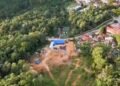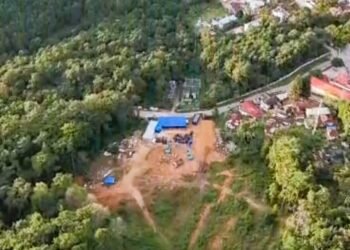
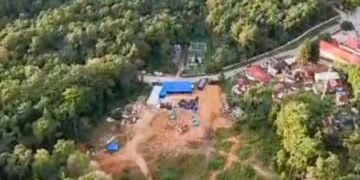



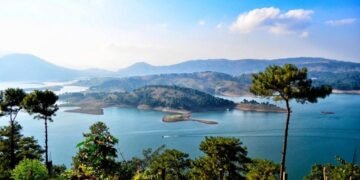








The Shillong Peak Ropeway has become more than a tourism project. At Rs 151 crore, with Rs 80.89 crore from the New Development Bank and Rs 70.11 crore under PM-DevINE, it is now a test of how Meghalaya balances development with environmental security.
Tourism is Meghalaya’s largest employment generator. A 913-metre ropeway from Madan Laban to Shillong Peak, cutting the journey to five or six minutes, could ease pressure on a congested hill road, improve visitor experience, and create jobs. The Chief Minister has said it could generate hundreds, if not thousands, of direct and indirect jobs.
The opposition also has a legitimate case to make. The Joint Action Committee, led largely by women from Laban and Lawsohtun, does not oppose a ropeway in principle. It opposes the location-Lum Shyllong, which it regards as a critical catchment and the lungs of Greater Shillong. Its concern is not abstract. It is about springs, streams, groundwater and the daily need for water.
The public needs clear answers. Therefore, this debate must move from assertion to evidence.
In 2022, the government’s own consultation, conducted by the Meghalaya Institute of Governance found that 80% of 27 participants were worried about a spring near the project. The government now says the ropeway is 3.15 km away from the main catchment, and the towers will take only 0.2% of the land. But distance alone does not settle questions of drainage, groundwater recharge, excavation and slope stability. A detailed, independent hydrological study, with baseline data and monitoring plan, should be placed in the public domain.
This water fear is not new. In 2021, the National Green Tribunal had already warned about this same hill.
In its judgment of July 13, 2021, in the cases filed by Raid Laban Dorbar and Greater Laban Community Development Society, the NGT noted that the slopes of Shillong Peak contain nine drinking water sources – Um Jasai, Um Sohkhlur, Um Mawlong, Um Kynrut, Um Shaw Shaw, Wah Risa, Wah Kdait, Wah Dienglieng and Um Jynriew – which supply drinking water to Shillong city.
The Tribunal directed the State Government to decide within four months whether the Lawsohtun area should be declared a Catchment/Critical Catchment Area under the Meghalaya Protection of Catchment Areas Act, 1990. And till that decision is taken, it ordered that no construction shall be carried out in the area.
That was five years ago. The question the JAC is asking today is simple. Was that decision ever taken, and if not, why is construction being allowed now in the same sensitive zone?
This is not only about cables and towers. Documents cited by the Green Tech Foundation show a four-storey building at the bottom and a three-storey building at the top, with restaurants and food courts. Restaurants need water. They make sewage and garbage. A ropeway with commercial facilities is a different project from a ropeway alone. The government must show the final drawings how water supply, sewage and solid waste will be managed at a sensitive site.
On August 26, 2026 in the Assembly, the government spoke about public hearings. On November 4, the Meghalaya Rural Development Agency said the project did not fall under Category A or B under the EIA Notification and therefore did not require a statutory public hearing, though an Environmental and Social Management Plan and consultation were undertaken under NDB safeguards.
A formal hearing and a bank consultation are not the same. The government must publish the notices, the attendance list, the minutes and the reports. Let people see who was called and what was said.
Other questions also need answers. Why is compensatory planting being done in West Khasi Hills, far away, and not near the trees that were cut? What is the status of permissions from the KHADC and Hima Mylliem? What checks were done before giving the contract?
The way forward is not to frame this as development versus environment. Meghalaya needs both.
The idea of an independent expert committee, with experts from IITs and NITs, is a good step. But its report must be public. Its findings must be followed.
A visit to ropeways in Sikkim and Shimla may help. But Shillong is not Shimla. Shillong’s water question must be answered in Shillong.
The President laying the foundation stone in 2024 was a proud moment. But a ceremony is not a clearance.
Shillong deserves a ropeway if it is safe, lawful and genuinely beneficial. It also deserves water security if the science says the present location puts it at risk.
Publish the documents. Prove the water is safe. Then let the facts decide where the ropeway should stand.