



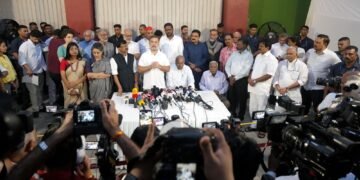




Shillong, Sep 4: Leader of the Opposition Dr Mukul Sangma has asserted that the foundations of Meghalaya’s good financial position were laid during his previous government and the current administration should not put this at risk by excessive borrowing.
Dr Sangma was Chief Minister from 2010 to 2018 when the current Meghalaya Democratic Alliance government took over. Dr Sangma said his government laid the foundation for fiscal discipline by bringing down the debt to GSDP ratio, which helped Meghalaya secure a credit rating higher than that of several other states.
“That is one of the reasons why Meghalaya was among the most favoured states to avail loan programmes under externally-aided projects,” he told reporters yesterday.
Dr Sangma added that the foundation was built through exhaustive due diligence and strict fiscal management and the state continues to benefit from it today.
He cautioned that the momentum must not be lost. “It must be ensured that this is not dislocated and that the state does not become overzealous in borrowing and spending,” he said.
This was a subject of the Comptroller and Auditor General of India’s latest report on Meghalaya – for 2024-25 – the state’s “rising debt stress” was flagged.
Dr Sangma also raised concerns over the manner in which borrowed funds are being utilised, alleging that the cost of several projects has been highly inflated. “A scheme that can be implemented at Rs 10 is being done at Rs 20,” he said.
According to him, precious resources drawn from the state’s own receipts and borrowings are being spent in a way that warrants close scrutiny.
He pointed out that during the recently concluded Autumn session of the Meghalaya Assembly he had moved a resolution on the need to audit projects undertaken in the state. While the resolution was specific to road projects, he said he would have gone further had he been allowed to elaborate during the debate.
“I am telling you, if any of the projects are picked up and audited vis-à-vis verifying the bill of quantities and the actual expenditure, the truth will come out,” Dr Sangma said. He described the pattern of spending as a matter of concern for the state’s finances.
Citing an example, the Leader of the Opposition referred to a major water supply scheme worth approximately Rs 850 crore and questioned how the cost was arrived at under the Engineering, Procurement and Construction model. “The reply of the Minister was to defend the government’s decision to award the project at that cost, saying it was an EPC,” he said.
Dr Sangma questioned the process of cost determination in EPC contracts, noting that the price is quoted by the bidder. “Unless there is fair competition, this space which provides for fair cost determination will elude the state,” he said. He asked whether tender conditions were framed in a manner that discouraged wider participation, with eligibility criteria designed to disqualify other bidders.
He flagged the possibility that terms and conditions were being set deliberately at the time of tendering to limit competition and push up costs. “There is a design to format the terms and conditions in such a way that other eligible contractors are kept out,” he alleged.
According to him, a level playing field would have ensured fair price discovery and allowed the state to spend only the actual amount from the public exchequer, thereby avoiding overspending. “This is required to be put under the scanner,” Dr Sangma said, adding that maintaining fiscal credibility was critical for Meghalaya, especially as the state continues to depend on borrowings and external assistance for key infrastructure.
He said that without transparency and accountability in project execution, the gains made in improving the state’s financial standing could be undermined.