








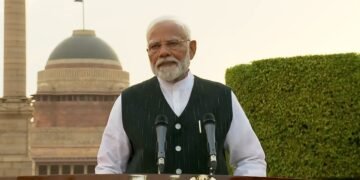



Shillong, Feb 16: Economic growth was a key feature of the Governor’s speech at the opening of the Meghalaya Assembly Budget Session today with CH Vijayashankar telling the house that the state’s economy nearly doubled in just seven years, from Rs 29,508 crore in 2018 to Rs 59,636 crore in 2025.
The Governor noted that the state is the only one in the country to sustain an average 10 percent growth for three consecutive years after the Covid-19 pandemic.
According to the Governor, Meghalaya is the second-fastest growing state in India after Tamil Nadu, with an impressive 9.66 percent real (meaning after taking inflation into account) GSDP growth in 2024-2025.
He also stated that to achieve growth targets, the government is implementing several externally aided projects (EAPs) across key sectors, including roads, power, agriculture, water conservation and tourism, supported by multilateral development agencies.
“Meghalaya is currently implementing 15 EAPS, with two additional projects under loan negotiation. The cumulative value of these projects stands at Rs 12,166 crore,” Vijayashankar said.
According to the Governor, these EAPs will help Meghalaya create vital infrastructure and 72 percent of the funding under these projects are grants from the central government, while the balance is contributed by the state.
The government is also leveraging support for core infrastructure projects from the Union Ministry of Development of the North-Eastern Region (DoNER) through various schemes to accelerate tourism, water supply and connectivity projects across the state.
Some of these projects include a Rs 234 crore Integrated Sohra Circuit to further place Sohra on the global tourism map, the Shillong Ropeway project and Unity Mall in New Shillong.
Vijayashankar pointed out that the recently released Economic Survey 2025-2026 by the central government has commended Meghalaya’s community driven development model for climate resilience and environmental safeguarding.
“This model showcases how grassroots participation is driving sustainable progress through large scale ecosystem based water security initiatives such as MegARISE, Spring Mapping Initiatives, and the Climate Adaptive Community Based Water Harvesting Projects. Meghalaya has mapped over 55,000 springs and implemented more than 500 community led water interventions across 8,430 hectares, significantly enhancing long term ecological stability,” the Governor said.
He also pointed out that the government remains firmly committed to attracting private investment through the public private partnership (PPP) model to drive economic growth and create employment for all the citizens.
Vijayashankar pointed out that in recent years, the state initiatives have catalysed over Rs 1,800 crore in private investment, with a target of mobilising more than Rs 8,000 crore by 2032 and generating over 50,000 direct and indirect jobs.
He pointed out that this momentum is reflected in flagship projects such as the Rs 330 crore Varun Beverages bottling facility in North Garo Hills, which is providing over 500 jobs in the area.
The governor also stated that a foundation stone was laid for the Rs 300 crore Taj Umiam Resort and Spa recently, which will be the largest hospitality project in the North East.
Viajayashankar pointed out over 2,960km of roads were developed post-2018 at a cumulative expenditure of over Rs 5,000 crore.
The Governor also said that through Pradhan Mantri Gram Sadak Yojna (PMGSY), in the last five years 1,180 road schemes have been completed at a total expenditure of over Rs 3,200 crore and connected around 300 habitations.
“Now under PMGSY IV 258 villages will be connected, each with a population of over 250. An additional Rs. 260 crore from the Central Road Fund is also being invested to strengthen rural roads. The 22,000 crore Shillong-Silchar Greenfield High Speed Corridor will be a great boost to regional connectivity and improving logistical efficiencies,” he said.
On women’s empowerment, Vijayashankar stated that the state has been significantly strengthened through the National Rural Livelihoods Mission.
He pointed out that more than 53,000 Self Help Groups (SHGs) have been formed, bringing over 5.38 lakh households into the SHG network. To support this progress, SHG households have received over Rs 94 crore through financial assistance, credit linkages, and livelihood investments.
On tourism, the Governor stated that the state has been a key sector in creating livelihood opportunities for the citizens.
He pointed out that since 2022, tourist footfall has grown by nearly 60 percent, reflecting the state’s rising profile as a premier destination in India.
“This surge has translated into an increase in local livelihood opportunities for over 75,000 individuals till 2025, thereby strengthening community participation in the tourism economy,” Vijayashankar said.
He said that as part of the state’s emphasis on homestays 877 applications have been sanctioned with disbursals of Rs 123 crore, enabling local entrepreneurs to offer authentic hospitality experiences and generating over 6,000 new jobs.
The Governor also pointed out that Meghalaya is emerging as one of the top five festival destinations and the concert economy continues to thrive and generate jobs across the state.
On healthcare, the Governor stated that by expanding access and improving delivery, Meghalaya has advanced health services with tangible results for every household.
He said that while the national average health expenditure is about Rs 3,169 per capita, the state has committed Rs 7,690 per capita. “This is more than double the national figure and the highest in the country. Health now constitutes 9.06 percent of the total budget, the highest share among all Indian states,” Vijayashankar stated.
The Governor pointed out that sustained investments in infrastructure, human resources, and system strengthening have transformed the sector. He said that over the past year, 51 new health facilities have been constructed, 544 facilities upgraded, and 2,500 healthcare professionals added to the workforce.
“A major milestone was achieved with the launch of Meghalaya’s first government medical college, Shillong Medical College, which welcomed its inaugural batch in September 2025, strengthening the long-term availability of doctors and improving access to tertiary care within the state,” he stated. “Initiatives such as Mother App have enabled 100 percent antenatal care checkups in select blocks, while 6,786 Village Health Councils and 7,041 ASHAs continue to anchor community-led healthcare delivery,” the Governor added.
On education, he said that the government remains steadfast in its commitment to improving learning outcomes and ensuring quality education across Meghalaya.
Vijayashankar informed that public investment in the education sector has increased substantially, rising from Rs 2,045 crore in 2018 to Rs 3,654 crore today, reflecting a strong focus on strengthening both access and quality.
The Governor said that central to this effort is Mission Education, a flagship programme transforming more than 2,000 schools through upgraded classrooms and modern facilities, supported by an investment of Rs 360 crore, with 97 percent of schools having completed all three phases. Phase 4 has now been approved to further expand infrastructure upgrades.
According to him, in 2025, the Secondary School Leaving Certificate examinations recorded a 96.08 percent pass rate, a 40.27 percent improvement over the previous year, while the Higher Secondary exams achieved an 82.8 percent average pass rate across all streams.
According to him, higher education in Meghalaya is witnessing unprecedented expansion. The first academic session of Captain Williamson Sangma State University commenced in 2025 with 14 departments and 568 students, marking a defining milestone in the State’s academic landscape.
He also stated that the Shillong Government College of Engineering has become operational, while the College of Architecture and Urban Planning at Tura is scheduled to admit its inaugural batch in academic year 2026-2027.