







Shillong, Feb 7: Shyntorbulia village in Ri-Bhoi district witnessed its first-ever free community health check-up camp today, bringing essential medical services to one of the most geographically isolated settlements in the region.
The village is cut off from the main road by two rivers on either side and hills on the remaining two sides. The nearest government dispensary is located around 15 km away at Mawhati, while Nongpoh Civil Hospital is nearly 30 km from the village, making access to healthcare extremely difficult for residents.
Last year, in December the villagers constructed a temporary wooden bridge over the Umsha River, providing a crucial connection to the nearest motorable road towards Nongpoh. The bridge is expected to remain usable only until the onset of the heavy monsoon in June–July. During the monsoon months, the village becomes disconnected from the main road and remains accessible only via a suspension bridge.
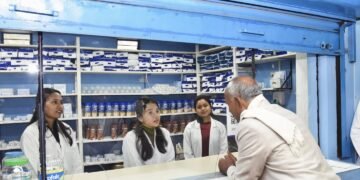
The health camp was organised by Rongjeng Welfare Foundation (RWF), a non-profit organisation working with underserved communities. A medical team led by Dr Naggroi Lyngdoh Nongpiur from Bethany Hospital attended to patients at the camp along with a team of medical professionals. Other doctors who provided consultations included Dr Trinayan Patowari, Dr Kaushik Hazaricka and Dr Krishnakshi Baishya (BAMS).
Around 80 patients from the village availed themselves of free medical consultations and were provided essential medicines at no cost.
Speaking on the occasion, Rosanna Lyngdoh, Project Manager of Rongjeng Welfare Foundation, said that the health camp was a much-needed intervention for the village. She added that the organisation plans to organise similar health camps every month for as long as the temporary bridge remains usable, before heavy monsoon rains once again cut off access.
Local residents expressed appreciation for the initiative, stating that regular outreach programmes are critical for remote villages like Shyntorbulia where distance, terrain and seasonal isolation continue to pose major challenges to accessing healthcare.