
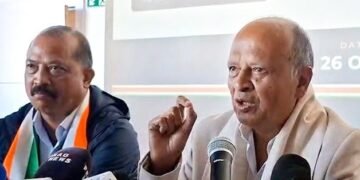
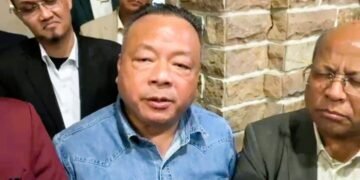




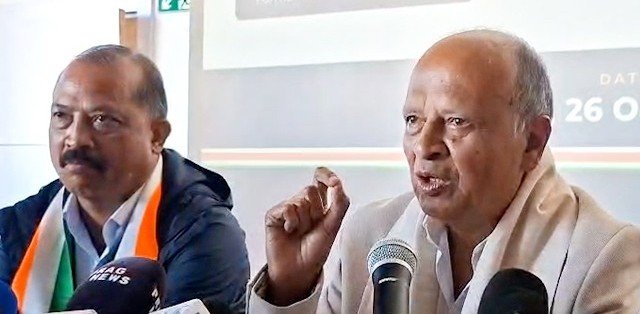
Shillong, Oct 26: Former National People’s Party (NPP) state president Wanweiroy Kharlukhi today announced his support for Congress Party candidate Vincent H Pala in the upcoming Shillong Lok Sabha by-election, saying the Congress must be strengthened in Parliament to oppose the Foreign Contribution (Regulation) amendment.
Kharlukhi, who resigned as NPP state president in June after leading the party in Meghalaya for more than a decade, said his decision to support Pala was linked to the Congress’s opposition to the proposed legislation, which he believes could threaten minority communities, particularly Christians.
Ending speculation about his political plans after leaving the NPP leadership, Kharlukhi said he had decided to publicly declare his support for the Congress candidate in the by-election.
Kharlukhi described Section 16-A of the FCRA Amendment Bill as particularly concerning, saying he felt threatened by its provisions despite India having completed 79 years of independence.
“I am very much against the FCRA amendment in its present form. For 79 years of independence, I feel threatened. Section 16-A is very disturbing and cannot be accepted,” he said.
Sec 16-A is meant to manage and vest foreign contributions and assets when an NGO or organisation loses its registration. If a body’s FCRA certificate is cancelled, surrendered, or ceases to exist, all foreign contributions and assets created out of them automatically and provisionally vest in a government-appointed authority. This has sparked fears in NGOs and church groups that their assets might be taken over by the government if they lose their FCRA status.
Kharlukhi credited the Congress with preventing the bill from being passed during the previous Parliament session and pushing for its examination by a joint parliamentary committee.
“Had it not been for Congress opposing the Bill in the last Parliament session, today it would have become an Act and I don’t know what would have happened to the Christian minority,” he said.
He maintained that the Congress was the party best positioned to challenge the BJP on the issue and called for greater parliamentary representation to strengthen the opposition to the Bill.
“Congress is very firm that this Bill should be totally withdrawn. If we want to protect ourselves, we have to strengthen Congress in Parliament. If Pala is there, there will be 99 MPs fighting this Bill,” he said.
Kharlukhi, however, clarified that the FCRA issue was not the reason he resigned from the NPP. He said his decision to leave the party and his subsequent support for Pala were separate matters, with the latter being driven by what he described as a national concern.
“I did not leave NPP only for FCRA. I support Pala because Congress stopped the Bill and forced it to the JPC. This is a national issue, you have to see which party can counter BJP in Parliament,” he said.
Though NPP politicians have also spoken out against the FCRA amendment, the NPP is a staunch ally of the BJP.
Asked whether he had been sidelined within the NPP before stepping down, Kharlukhi denied any internal dispute, describing his exit as a personal decision after spending nearly two decades at the helm, first of the Nationalist Congress Party (NCP) and then the NPP, when Purno A Sangma left the NCP to start a new political outfit.
“No, I was never sidelined. I left on my own feelings. After 17 years as president, it is time to give to someone else,” he said.
He also said he had no intention of blaming the NPP or its leadership for his departure, arguing that leaving a political party should not automatically mean criticising those who remain in it.
“When I leave a party, I never blame anybody. A person who leaves and blames somebody is stupid. I don’t want to be seen as stupid,” he said.
Kharlukhi also revisited the debate over Meghalaya’s reservation policy, saying his opposition to the policy had stemmed from concerns about the state’s political and administrative autonomy.
He argued that the manner in which the policy was implemented could divide the state and potentially undermine the powers currently exercised by its elected government.
During the discussion, he referred to concerns over the consequences of losing state-level authority over land and policing, particularly for tribal communities.
He cited his efforts on issues including the inclusion of Khasi and Garo in the Eighth Schedule of the Constitution, implementation of the Inner Line Permit (ILP), coal mining and the Look South Policy, saying these had not produced the results he had sought.
“Sending 1-2 MPs has no value. I raised the Eighth Schedule, ILP, coal mining, Look South Policy, no result in a House of 543,” he said.
His argument, he said, was that Meghalaya needed stronger representation from a party capable of influencing national decisions, particularly on issues involving minority rights and the state’s interests.
Kharlukhi remained guarded when asked whether he would formally join the Congress, saying he was in no hurry to make another political decision. “Time will tell. When we reach the bridge, we will cross the bridge. I am always patient,” he said.
Asked whether he would contest the 2028 Assembly elections, Kharlukhi declined to commit himself, saying he would consider his options when the time came. “Let me see when 2028 comes,” he said.