



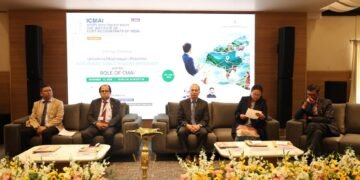





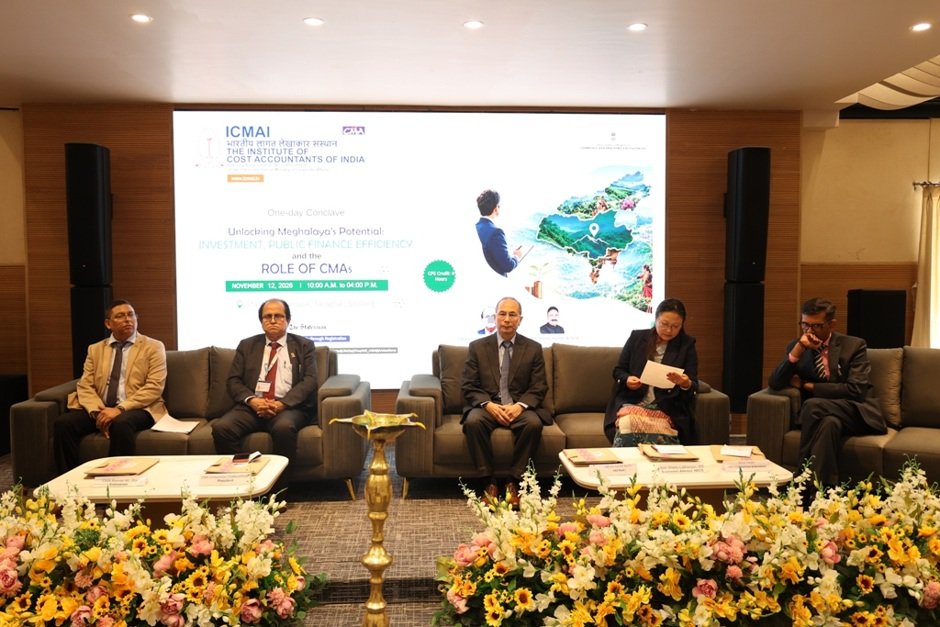
Shillong, Nov 12: A one-day state-level conclave on ‘Unlocking Meghalaya’s Potential: Investment, Public Finance Efficiency and the Role of CMAs’ was held at the State Guest House, here on Thursday.
The conclave was organised by the Institute of Cost Accountants of India (ICMAI) in collaboration with the Commerce and Industries Department.
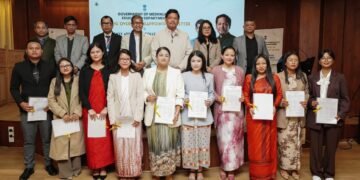
On the occasion, ICMAI signed a memorandum of understanding with Global University Eternal, which is expected to strengthen institutional collaboration and expand the institute’s reach through universities, particularly among students, by facilitating access to professional courses and joint academic programmes.
Former IAS officer Peter Watre Ingty highlighted Meghalaya’s tourism, mineral wealth, forests, organic agriculture and horticulture, noting that pineapple, orange, ginger and Lakadong turmeric have gained recognition in domestic and international markets. He also pointed to opportunities in hospitality, information technology, infrastructure, food processing, handloom and handicrafts, sericulture, weaving and renewable hydropower, besides Shillong’s reputation as the rock capital of the country.
On finances, Ingty said Meghalaya still depends significantly on Central transfers and grants-in-aid, with its own tax and non-tax revenue accounting for less than 25 per cent of total receipts. As a special category state, he said, it benefits from favourable central funding ratios, special capital assistance and externally aided projects. He said state-funded schemes account for around Rs 25,000 crore, while centrally sponsored schemes account for Rs 5,220 crore, with priority to education, rural development, healthcare, entrepreneurship and skill development.
Ingty said cost and management accountants could help ensure better utilisation of public resources, but stressed that investment projects must respect local sentiments and minimise impact on ecology and environment.
Commissioner and Secretary BDR Tiwari said Meghalaya was working towards becoming a USD 10 billion economy by 2028 and generating more employment under Mission 10. He said under Chief Minister Conrad K. Sangma, the state was working to become a leading state within the national development framework, with enormous potential due to its strategic location and resources.
Tiwari said water was a critical resource for the future. Meghalaya has abundant water, but availability in the lean season remains a challenge and needs effective, cost-efficient management. He said the state was recording growth of over 12 per cent, with Gross State Domestic Product up around 20 per cent over two years and more than doubled over the past decade.
Economic Adviser to the North Eastern Council Secretariat, Sherry Lalthangzo, said NEC’s Vision 2047 aims to raise Meghalaya’s per capita income from Rs 1.7 lakh to Rs 3.1 lakh through targeted interventions. She highlighted organic farming and region-specific products like Lakadong turmeric from Meghalaya, ginger from Mizoram and pineapple from Tripura, and said NEC was working with state governments, central ministries, external agencies and private investors. She also referred to a high-level committee of Northeastern Chief Ministers focusing on tourism, economic corridors and investment.
Executive Director of Asian Confluence, Sabyasachi Dutta, said Meghalaya was investing in its future and stressed preparing youth for Viksit Bharat 2047 and Viksit Meghalaya. Dutta outlined ICMAI’s 2026-27 roadmap focusing on public financial management, performance audits and cost governance, alongside infrastructure, energy, manufacturing, supply chain competitiveness, MSMEs and entrepreneurship.
Dutta said the institute’s initiatives for MSMEs and startups, including a dedicated promotion board and a handbook for Farmer Producer Organisations, would address management and sustainability challenges. He added that its specialised boards in agricultural cost management and banking, financial services, insurance and capital markets would equip students with skills and improve employment in fintech, banking and NBFCs.
The conclave brought together representatives from government, professional institutions and other stakeholders to deliberate on strengthening financial management, expanding investment and harnessing Meghalaya’s economic potential for sustainable growth.