
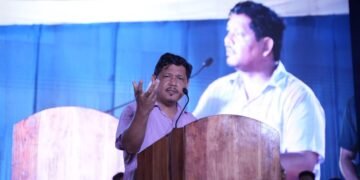



Shillong, Aug 7: State Congress Party leader Manuel Badwar has questioned the environmental and social costs of the proposed Shillong Ropeway project, urging the Meghalaya government to make public the studies and assessments carried out for the project and ensure greater transparency.
Badwar described the ropeway as a “vanity project” and said development initiatives should not come at the expense of Shillong’s environmental assets.
“I would say that vanity projects are not the most important projects in the state. These are projects which are just to add a little bit of shine to whatever development that is happening,” he said.
However, he clarified that the Congress was not opposed to development or the construction of the ropeway, but maintained that the project needed to be implemented in a manner that balances development with environmental concerns.
According to Badwar, the government should assess not only the financial cost of the project but also what he termed the “public cost”, including its impact on water catchment areas, groundwater, trees and air quality.
He said the hills around Shillong serve as important water catchment areas and questioned whether adequate studies on the potential impact of the project had been conducted.
“There should be proper calculations and proper mapping of certain catchment areas. Water catchment areas are also important, especially in this hill. There’s a whole lot of water that is actually being filtered and going through the valley. That’s also very, very critical because the groundwater would be impacted,” he said.
Badwar said such studies should be made public, claiming that he was not aware of them being released.
He also raised concerns over the extent of tree felling associated with the project, arguing that environmental impacts cannot simply be offset by planting an equivalent number of trees elsewhere.
“So just saying that we’re going to cut a thousand trees here and we’re going to plant a thousand trees somewhere else doesn’t make sense,” he said.
According to Badwar, trees in and around Shillong contribute to the city’s air quality and environmental balance, and their removal could have a wider impact that cannot necessarily be compensated for through plantation drives in other locations.
He said the scale of tree felling reported in connection with the project appeared disproportionate to the nature of the infrastructure being constructed.
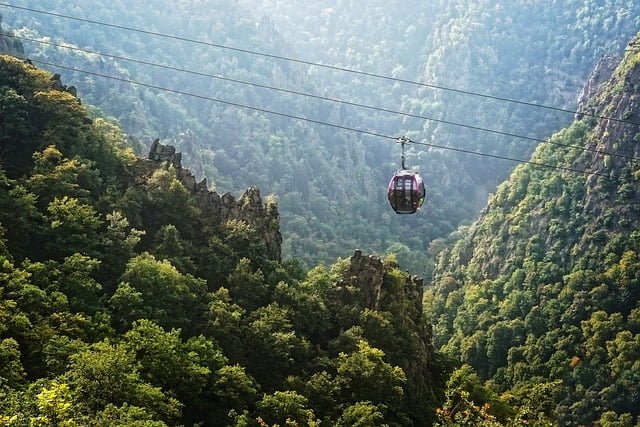
“It’s just a rope. At one end is a station and at the other end is a station. So you don’t need to overdo it,” Badwar said, questioning the extent of construction and tree cutting required for the project.
He also stressed the need to consider the actual traffic and carrying capacity of the proposed ropeway, arguing that the project should be designed according to Shillong’s requirements rather than simply as a large-scale infrastructure initiative.
Badwar said the government must also account for the broader social and economic costs of the project, particularly at a time when the state faces challenges in generating employment and income.
“We are not against progress, we are not against development, but not at this rate and not the kind of development that they’re doing,” he said.
Drawing a comparison with infrastructure projects in forested areas elsewhere, Badwar said development and environmental protection could coexist if projects were properly planned to minimise ecological damage.
He maintained that public protests against the project were legitimate in the absence of adequate information from the government.
“I understand when the various organisations are coming up right now, they’re protesting because there’s no transparency and, believe it or not, there’s actually no transparency,” he said.
Badwar urged the government to come forward with details of the project, including its social costs and environmental impact, and provide clear answers to concerns raised by citizens and organisations.
“I’m not saying that the ropeway should not be built, but it should be built in such a way that there’s balance,” he said.
He further called for greater scrutiny of the ongoing tree felling, alleging that the contractor may be going beyond what is necessary for the project.
“The continuous felling of trees, like how they have been doing now, I think it should be balanced and the government should at least look into it a bit more seriously because the contractor is overdoing it,” Badwar said.
He reiterated that the Congress viewed the concerns raised by protesters as legitimate, but said the government must ultimately address them through transparency and publicly explaining the project’s environmental and social implications.
“The government should come clean,” he said.