









Electoral politics means elections. It is the process of choosing political representatives to the Lok Sabha, State Legislative Assemblies, District Councils, etc. The crux of electoral politics is the presence of competition amongst the candidates. Each tries to win the votes of the electorate by any means possible. It involves promises, election manifestos, strategies, covert and overt money in return for votes, etc. In the true sense of the term, electoral politics is supposed to have a link with the election manifestos of the political parties. When voted to power the parties concerned then live up to their promises. This is where any electoral process can be considered as being of benefit to the people. But, that does not happen. Electoral politics today is just about winning and coming to power. The politicians and especially the government of the day then act ignorant of whatever was said and promised in their manifestos before the elections took place.
On 15th November, 2025, the President of VPP Ardent Basaiawmoit (while speaking at Laitkor, Shillong) told the state government of Meghalaya led by MDA to focus on governance and not on preparing for elections. On 5th December, 2025, the Deputy CM of Meghalaya Sniawbhalang Dhar (while speaking at Lumtiniang, West Jaintia Hills) got the opportunity to strike back by calling VPP a hypocrite for opposing BJP in the state while asking for projects at the centre from the BJP led NDA. Whether it is VPP or MDA parties or TMC, the fact is that all are already preparing for the next legislative assembly election.
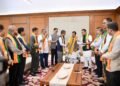
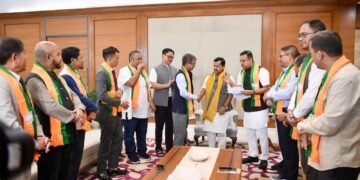
One of the main elements of electoral politics is strategy. A strategy is a course of action taken by a political party to achieve a predetermined goal. The goal for all political parties is to win the upcoming MLA election. The strategy of the NPP is basically a combination of acquisition, merger and breaking of the opposition. The focus is upon acquisition of sitting politicians into its fold. Where acquisition is not possible, there are attempts of merger. The merger of Mukul Sangma with NPP is a bold move although one that is highly unlikely. It is difficult to see the TMC leader and the NPP leader in the same boat. The most interesting strategy is the ‘breaking of the opposition’ at the ground levels. More and more such instances are visible particularly in Jaintia Hills under the leadership of the Deputy CM Sniawbhalang Dhar. On 12th December, 2025, around 600 workers of the VPP shifted to the NPP at Nartiang. One can predict that in the coming months many more shifts would happen. As far as the Garo Hills is concerned, the NPP believes that it is a done deal and one which Meghalaya would witness soon in the upcoming GHADC election.
The strategy of other parties is not very clear and maybe as the year 2026 passes by some developments would be seen. However, VPP can be considered as an exception. Its electoral politics is centered upon making the electorate alert and aware of the importance of a clean government and governance which is accountable to the people. It is primarily looking at the vote-base of the underprivileged and downtrodden and those who are seeking for a change from the current crop of political leaders. However, the challenge as was seen in the previous MLA election is that when the day of reckoning comes, money rules the roost.
As such, the strategy of the VPP completely depends upon how the party organizes itself at the ground – at the booth levels and the block levels. Electoral politics is all about having boots on the ground. This is becoming even more apparent now as compared to the past elections. Voters today are swayed by media and social media and the only solution to the political misinformation and disinformation is the one-on-one personal interactions at the household levels. The party that can organize itself on the ground will do well in the upcoming elections.
Another critical element of electoral politics is education. It has never happened in Meghalaya politics that the political parties would educate the electorate about their vision and mission. Unless the voters cast their votes on the basis of vision and mission, such voters can never be considered as wise voters. On this aspect, Meghalaya has a long way to go. Vision means how a political party sees itself and the state of Meghalaya at its very best in the long-term. The long-term in politics can be classified as 10 to 15 years. This refers to the best status of Meghalaya in terms of education, health, law and order, per capita income, decreased gap between the rich and the poor, etc. Mission is what a party does every day over the 10-15 years in order to achieve its vision. If a party is in the government, then its governance is a depiction of ‘what it does every day’. If a party is in the opposition, then its portrayal to the people as to how it would do things differently when it comes to power becomes the mission.
None of the parties have a clear-cut vision and mission. This is the reason why the voters are more likely to be swayed by money-power during times of elections. It is high time for the electorate to be aware and alert and focus upon only those parties who educate them on their vision, mission and future action plans. If the people want change and real development then it has to start with a well-informed electoral politics. This will force the political parties to reassess their strategies and be more responsible and accountable towards the electorate.
As a case in point, illegal coal mining and transportation continues unabated in Meghalaya. This is an open secret. This episode has a direct bearing on electoral politics. If the coal that is mined is illegal, it means the money generated from it is basically ‘black money’. This black money has to be converted to white money at some point of time. The best time to do that is during elections. When elections come, money always plays a huge role. The major chunk of that money in the next MLA election will be the money generated from illegal coal mining. If it continues without a stop, the illegal coal mining money will largely decide the next MLA election.
On another note, the way politicians and political parties are positioning themselves by jumping ship and looking for new alliances, there is a real possibility that a new political party will be coming up in Meghalaya. If that happens then there is a huge probability that the next MLA election will happen in 2027 itself and not in 2028.
These are the dynamics of electoral politics which Meghalaya faces continuously. On one hand is the money-power and the other is the desire for change through aware and alert voters. Which will prevail? We will find out very soon!