








By Benjamin Lyngdoh
It is Christmas time, again. For some Christmas is a faithful observance, for some a celebration, and there are those who take it as a festival. But, that is beside the point. The ground reality is that with every passing year Christmas in Meghalaya is basically a story of two halves – the haves and the have-nots. While some observe Christmas with fun and gaiety, food and drinks, new clothes and boots, lights and decorations; there are those for whom Christmas is just a quiet observance with a simple meal and without merriment. The very day after Christmas is back to business/work. Modesty is one of the messages of Christmas, but, in a world where a faithful observance takes the shape of a commercial celebration/festival – who would like to be modest? Either you are part of the Christmas celebration or you are not. Christmas time aptly reflects the state of the economy of Meghalaya. On one hand there is hype about the US$ 10 billion economy and on the other the gap between the rich and poor becomes wider with every passing Christmas.
According to NITI Aayog Multidimensional Poverty Index, 2025 report, Meghalaya is the third poorest state in India. Only Jharkhand (2nd poorest) and Bihar (the poorest) fared worse. Uttar Pradesh which used to be in the top 3 poorest states recently climbed to 4th position and today has 22.93% (down from 37.79%) of its population living under poverty. The population of Meghalaya living under poverty stands at 27.79%. As can be seen, there is a big gap between the poverty levels of Meghalaya and Uttar Pradesh. If proper policy interventions are not made then it would be difficult to catch Uttar Pradesh in the near future. An even bigger problem is Jharkhand. Its poverty level is 28.81% (down from 42.16%). If Meghalaya is not careful with its developmental interventions there is a high probability that it will slip into the second poorest state position by the year 2026.
Around 70% of the population of Meghalaya depend on agriculture for survival and livelihood. In the year 2024-25, Meghalaya received 56% less than normal rainfall due to the adverse impacts of global warming and climate change. The farmers depend on rain for irrigation of their fields. The decline in rainfall and added with extreme weather events like storms and floods has reduce the economy and livelihood of the majority. This is the reason why policy interventions need to be focussed and targeted towards the ones who really need it. In the case of Meghalaya, the ones who really need help are the farmers. Again, the majority of the farmers are small and marginal farmers who do not even own the land they cultivate in. Unless the farmers become economically strong and socially respected, Meghalaya will continue to be the top 3 or top 2 poorest states for many years to come. Now, where is the aura of the US$ 10 billion economy?
Further, per capita income is a good indicator of the state of any economy. It refers to the average income earned per person in a country/state. It is a result of gross domestic product (GDP) divided by the total population of the country/state. The per capita income of India for the year 2024-25 is US$ 2900 which converts to ` 261000/- per annum. According to the Ministry of Statistics and Programme Implementation (Govt. of India), the per capita income of Meghalaya for the year 2024-25 is ` 150000/- per annum which means on average every Meghalayan earns ` 12500/- per month. When these figures are compared with how wealth and resources are concentrated in a few hands, the gravity of the gap between the haves and the have-nots become worryingly clear. It is also to be understood that once the per capita income is low, it reflects upon the nature of basic healthcare facilities, schooling and education. If the human resource is not educated and healthy, where from will the capability to earn come?
The situation is made worse with the nature of the economy of Meghalaya. Every year thousands of youth are eligible to join the workforce, but, there is limited scope to be absorbed into gainful employment. The private sector is non-existent. There is less space for any big industry to develop here. Meghalaya suffers from the problem of too many small businesses which can employ only a limited few. It does not have big corporate or even medium-sized businesses that can employ a bigger number of workers. This only adds to the unemployment problem. In such a situation, there is a need for all the stakeholders to work together to change the trajectory of the economy. Else the only scope of meaningful employment for the youth from here onwards is outside the state/country. In some ways, the economy of Meghalaya can be classified as a closed economy. There is no scope for big investment from outside to come in. Weak governance of many years and the poor implementation of regulatory frameworks such as the land transfer act, labour license, trade license, no liaisoning with the dorbar shnong, etc are the main reasons for this.
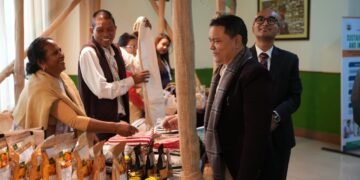
Again, it is Christmas time. Again we can see many rural folks from the far-off villages coming to Shillong city and other major towns of Meghalaya to sell their products/produce. They come with plastic bags and baskets of agricultural produce to sell. They walk the streets all day and hope that they can sell their goods and earn a bit and go back home with something to eat for their families.
Take for instance a real life example – ‘a woman with a basket of season fruits at Laitumkhrah, Shillong’. When computed the total revenue that she can make is around (approx) ` 600/- per day. After deducting expenses, she makes around (approx) ` 250/- per day and that too only when she can sell her entire plastic/basket of goods. Are such people visible to us?
One way of helping such rural folks is to be ‘vocal for local’. Vocal here means ‘demand’ and local the ‘supply’. Both are to supplement one another. As a starting point, consumerism has to have a flavour for local products/services. The consumers need to look at indigenous products with kindness to the extent possible. Wherever there is a choice between a local product/produce and the other; the selection must be for the local one. Today, there is no point in talking about long-term interventions and bold government decisions that would benefit the masses. Formulating and implementing such policies will take time. The economy of Meghalaya is weak and just a few benefits from its natural resources. The only immediate solution is for the average consumers to come together and realize that collectively we can make a difference to the livelihoods of the poor and the marginalized by buying what they have to offer. Look at their plastic bags and baskets with kindness. Can we have a ‘vocal for local’ Christmas budget? After all, it is Christmas time.
(The views are of the writer and do not reflect that of Highland Post. He can be reached at benjamin@nehu.ac.in )