









Those groups or individuals who oppose the Citizenship (Amendment) Act do not understand it, Union Minister of State for Home Affairs, Ajay Kumar Mishra said here today.
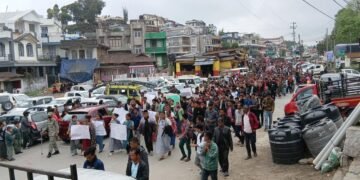
Yesterday, a North East-wide protest against the CAA was organised by the North East Students Organisation (NESO). North East political parties have also consistently opposed the CAA, at least in the context of their own individual states.
However, Mishra’s arguments seemed to show that he does not understand the opposition to the act in the North East.
While the rest of the country has witnessed protests against the legislation because it seemingly discriminates against Muslims, who do not benefit under the act, in the North East much of the opposition has been against the proverbial welcome mat given to immigrants under the CAA.
“Those who cannot understand CAA are opposing this act,” Mishra said, adding that no Indian citizen will be adversely affected by it. “The only amendment we have brought is to give citizenship to minorities from Pakistan, Bangladesh and Afghanistan who came here before 2014.”
On being asked about the intense opposition to the CAA and demand to exempt North Eastern states from it, Mishra said that dialogue will sort out the matter.
NESO has also filed a writ petition in the Supreme Court against the implementation of the CAA and the matter is still pending.
Meanwhile, on other matters the Union MoS made the right sort of noises with regards to the controversial Armed Forces (Special Powers) Act, which, he said, the central government is in the process of removing from the North East bit by bit.
However, on the demand for the Khasi and Garo languages to be included in the Eighth Schedule of the Constitution, Mishra was non-committal, preferring instead to harp on about the National Education Policy 2020.
“Our view is that all languages should be respected, whether they are spoken by a large number of people or a small population and we have already started it through NEP,” Mishra said.
On the subject of the Inner Line Permit (ILP), which pressure groups are adamantly in favour of and which the Assembly has also passed a resolution in favour of, the Union representative declined to say much of anything.
However, he spoke positively about the nascent peace talks with the outlawed Hynñiewtrep National Liberation Council, saying that this is one of many examples of how the central government has brought rebel activity under control through continuous dialogue.