




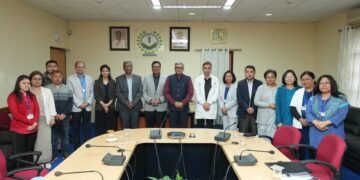





The participants of the panel discussion shed some light on the theme with their personal encounters with the various aspects of the conflict. The discourse ranges from psychoanalysis to cultural to social to political and even the literal reality of a conflict that prevailed with every individual person and the diverse communities in the society. One of the panelists lamented at the limited attendance and participation of local people during the interactive session in the gathering; whereas, reactions along with grumbles and complaints persisted at the gossip galore in the periphery. Therefore, there is a need for extensive discourses on public platforms and mass media with interactive comments and responses from the art fraternity to facilitate thorough study and refinement of contemporary art expression by local or regional artists. In one of the event more than a decade ago in Dhaka, Bangladesh initiated by Riti Academy of Visual Arts, there were certain relevant remarks by a few eminent Bangladeshi artists on the artworks from North East India, and the most significant is ‘The images are tribal in nature even as few of them are abstract, but there is a universal sense of contemporary expressions. Essentially, there is another aspect of conflict on the pertinent question “Does our art really matter?”. Significantly, there is a lack of exposure, communication, patronage, and neglect to elevate the art of North East India, even as the content is at par with any art from the so-called mainstream territory.
At the backdrop of the art exhibition, there are other sessions of academic discourse on other aspects of regional conflicts among the diverse communities in South East Asia alongside a few local specific issues of ‘Tangjait’ or the Khasi custom of the consecration of a new clan from mix-marriage of Khasi male with the female of another community, the online community that delves on the impact of social media in fomenting communal conflict and the deprivation, discrimination, and marginalization of the women and children in the realm of male chauvinism.
As far as Meghalaya is concerned, particularly the Khasi people, it is an oasis surrounded by the cultures of prominent art traditions. The folk art tradition among the Khasi people is affluent in the oral expression of folktales, music, dance, and to a certain extent weaving and bamboo crafts, with absolutely no traces of visual content on the other aspect of creative expression. The megaliths are bland, the housing pattern and basketry are without any intricate carving or plaiting of designs, and no other cultural objects with any elements of visual imagery. In this regard, the local Khasi artists are bereft of any folk art tradition from which they can derive inspiration in terms of image. Hence, the present generation of artists is responsible for creating an ethnic element against the cultural shock of the austere contemporary art scenario that has imbibed upon them, because the earlier exponents of visual art expression are highly influenced by the western notion of traditional realistic art.
This fortnight there was a whirlwind tour of the North Eastern States of Tripura and Arunachal Pradesh specifically for art, with an in-between stopover in our hometown participating in the Eying Conflict- An Art Exhibition at Synod College. At Agartala one of the local artists who hailed from Manipur and presently settles at London initiated an International Art Biennale proposed to be held at Tripura. Almost all the representatives from the North East brainstormed over the idea of a Biennale spearheaded by Radha Binod Sharma. There were presentations from each State on the probable activities for the mega art event slated to be held in 2021. The young and brilliant artist from Assam Mantu Das has been doing outstanding artworks in a few exhibitions in Europe. He was very enthusiastic about certain art expositions in the West, which brought the gallery to the street for a cross-section of people to experience and taste art. However, his notion was dismantled by Radha Binod Sharma, when he urged everybody to create something of a local novelty. All the other representatives were silent because they are yet to have any firsthand experience of mega international art events in the region or for that matter in the country. Of all the mega art events in the country, the Triennale initiated by Lalit Kala Akademi and the Kochi Biennale is considered to be among the largest contemporary art exhibitions in the country. The Kochi Muziris Biennale 2019 was curated by Anita Dube; and in 2017, one of the curators for the Students Biennale, Sarojini Lewis associated with Riti Academy and contributed by artists, Rembrandt I Kharnaior, Wanphai Nongrum, Treibor Lyngdoh Mawlong, and few other local young artists.
The situation is a paradox when the initiative came about from Radha Binod Sharma, a North East Artist based in London, who is concerned about the roots; while the rest are ignorant, even though one of them is familiar, but was fascinated by the conventional practice in the West. Nevertheless, the realization and connection is being discovered to think globally and act locally. In the deliberation, another brilliant artist, Bazik Thlana, a Ph.D. scholar and alumnus of Goldsmiths, University of London expressed confusion and apprehension over certain aspects regarding the structure and operation of the mega art exhibition in the region, even as everybody relied on the expertise of IMA Foundation based in London headed by Radha Binod Sharma. However, few artists have come up with innovative ideas that are original and may create a certain impact in the regional and national art circuit, although they wouldn’t dare claim yet in the art world. The Biennale is expected to be of a larger magnitude than the Kochi Biennale if all the eight states of the region converged for the same motive. The representative from Meghalaya, Raphael Warjri proposed for the subsequent Biennale in 2013 to be hosted in Meghalaya to coincide with the golden jubilee celebration of the Statehood, which he was hopeful the current government’s dispensation might take on a positive stride. One of the innovative activities that he suggested at the meeting is the animation shadow art created by Kynsai Rynjah and the light and sound abstract presentation of the Khasi concept about the genesis of mankind and its relation with the matrilineal system of clan lineage. Warjri is confident that matriliny will take center stage in every deliberation of images and oral discourse, as it was in conflict with the universal system of patriarchy prevalent throughout the world.
The proposed Biennale at Agartala is already getting a kickstart with the generous patronage of the Tripra Royal family, with the favorable intervention and commitment of the princess, Rajkumari Pragya Deb Barman. She narrated the long history of the royal family in the patronage of the arts including a certain significant contribution to Rabindranath Tagore during the inception of Santiniketan. She spoke at length on the potential of Tripura for the promotion of arts and stated that she will facilitate every probable resource of Tripra heritage to elevate the arts of North East India into universal stature.
Consequently, the Arunachal Literary and Art Festival has not been able to conform to the necessary vision for the region. However, there is great potential to be explored and the enthusiasm and passion of a few artists will be able to present the diverse ethnic art of the State with a contemporary outlook. One of the aspiring artists, Dakli Gara has already set up Chimchoo Art Gallery, the first ever public platform for contemporary art in Arunachal Pradesh. Moreover, the Thanka art tradition of the Buddhists will tremendously contribute to the growth of contemporary art expression in Arunachal Pradesh and Sikkim. Therefore, the diverse ethnic folk art of the North Eastern region of India will emerge as a spectacular exposition of folk and contemporary art with the synergy and symbiosis of each and every diverse community from the different areas of the region.
The Biennale is all set to showcase not only visual art but the other aesthetic involvement in local cuisine, herbal healing, folk performances, basketry, weaving, local angling techniques and community fishing, crop and animal farming, the sacred forests, the ethnic rituals and ceremonies, folk music and all sorts of expressions. These ethnic elements will also coexist alongside the modern technological demonstration of sound, light, images, metal and synthetic articles, and several other rare material interventions. As far as Meghalaya is a concern, certain unique folk expressions like the whistling communication of Kongthong, the Phawar, the scientific and mythical interpretation of the Sohpetbneng excavation, the Meghalyan Age archival and archeological remnants, the natural caves, and some other ancient and modern cultural and natural heritage of the State would be showcased in the mega art event. The Biennale could be one of its kind in the country that might create an indelible impression in the history of art in the world. The enthusiasm, passion, and dedication must work in tandem with the potential of resources, diverse culture, and varied natural structure of the North Eastern region; which extended from the magnificent Himalayas to the mighty Brahmaputra river, the living root bridges to the intricate bamboo tradition across the entire states of the region.