









One may not believe it, but houses that were built before the Great Earthquake of 1897 that hit Shillong still exist in exactly the same form in which they were first constructed.
Though only a few are left, some of the owners are trying their best to preserve these houses from decay, which is nothing less than an uphill task.
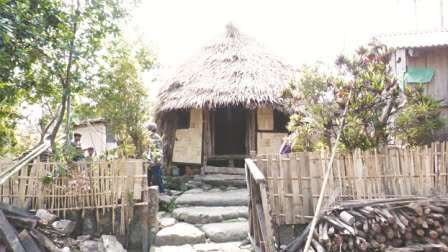
Amidst modern houses which dot the village, once such house exists in Nohwet village near Pynursla, East Khasi Hills.
According to the home’s septuagenarian owner, Pynsho Khongji, it was constructed in 1890.
The houses of this style are built on raised platforms. The roofs are of thatch, while the walls and floor are of wood.
Khongji informed that the walls and the floors have never been changed. The construction was also carried out without the use of nails. He informed that the thatched roof is changed every four years.
“When the time comes to change the roof we invite the villagers to help us with the work,” he explained.
Khongji also informed that when the Great Earthquake hit the region the house tilted sideways but was later restored to its original position by a mass of people pulling the structure back into place with a rope.
Khongji’s family wants to continue to preserve their heritage but are finding it difficult to maintain the house.
Ibansara Khongsar, Khongji’s daughter, said that since Nohwet is a tourist spot where a living root bridge is a major attraction, this traditional house could also be one of the attractions for visitors. Khongsar wants the government to recognise such houses as heritage sites to preserve a piece of the region’s history.
Development has been a boon to the villagers but has also had the negative effect of almost wiping out the region’s past.
“We want development but also urge the government to preserve our heritage,” another villager said.
Meanwhile, the Syiem of Hima Khyrim, Dr Balajied Sing Syiem, under whose jurisdiction Nohwet falls, said that he will direct his office to collect data on how many such homes still exist.
According to him, there are many ways to preserve such structures. The Syiem’s seat is also located in a heritage structure in Smit, the Iing Sad, which is a traditional house of worship and a sacred icon of the Khasi people.