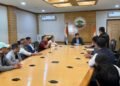

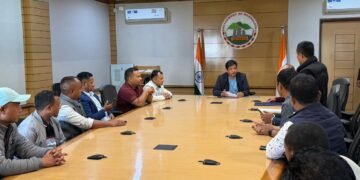








The North Eastern Regional Centre of the National Institute of Rural Development (NIRD) and Panchayati Raj and State Institute of Rural Development (SIRD) jointly organised a three-day regional training programme to strategise about the planning and implementation of carbon neutral villages.
The programme ran from August 9 to 11, a press release informed today, and was held to address India’s performance on climate action. Officials representing the Departments of Agriculture, Forestry, Fisheries, Soil and Water Conservation, Rural Development, and Panchayati Raj institutions drawn from all around Meghalaya participated in the programme to deliberate on biodiversity and the institutional mechanism for implementation, roles and responsibilities of Biodiversity Management Committees (BMCs) for good governance at the village level.
This training module was developed and designed by V Suresh Babu, Associate Professor at NIRD to create a pool of employees who can create awareness among the village communities and support the BMC, emphasising on access and benefit sharing provisions; preparing PBR (People’s Biodiversity Register); estimation of carbon emissions, sequestration process and sink; marketing of carbon credits and enhancement of biodiversity through holistic approaches of the rural development flagship programmes, including centrally-sponsored line department schemes that could enhance afforestation, biodiversity and livelihood opportunities of tribal rural households.
SIRD Director SR Marak welcomed the esteemed dignitaries, resource persons and the participants to the event. Babu, in his introductory speech, laid focus on the climate change performance Index (CCPI), India’s performance on climate action that has been rated as ‘high’ in greenhouse gas emissions, energy use and climate policy categories, ‘medium’ in renewable energy, and “is already on track to meet its 2030 emissions target aligned to a well-below the 2 degrees Celsius scenario”.
D Evanoreen Ann Khongwir, scientist at the Meghalaya Biodiversity Board (MBB), presented an interactive session on PBR and a case study of Chyrmang Nein BMC.
Participants were also exposed to the National Bamboo Mission under the expertise of retired scientist TC Bhuyan, a virtual session on carbon emission, estimation, sequestration and sinks by Tripura University assistant professor Sourabh Deb, among other subjects by other resource persons.
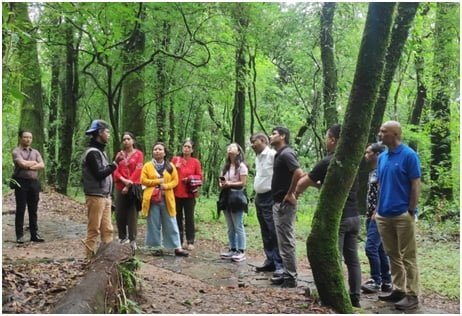
A visit was also made to the Mawphlang Sacred Groves, which is a carbon sink protected with the concept of local indigenous tribal divinity.
A similar programme was conducted for the first batch of participants on May 8-12, with a total of 27 participants.