













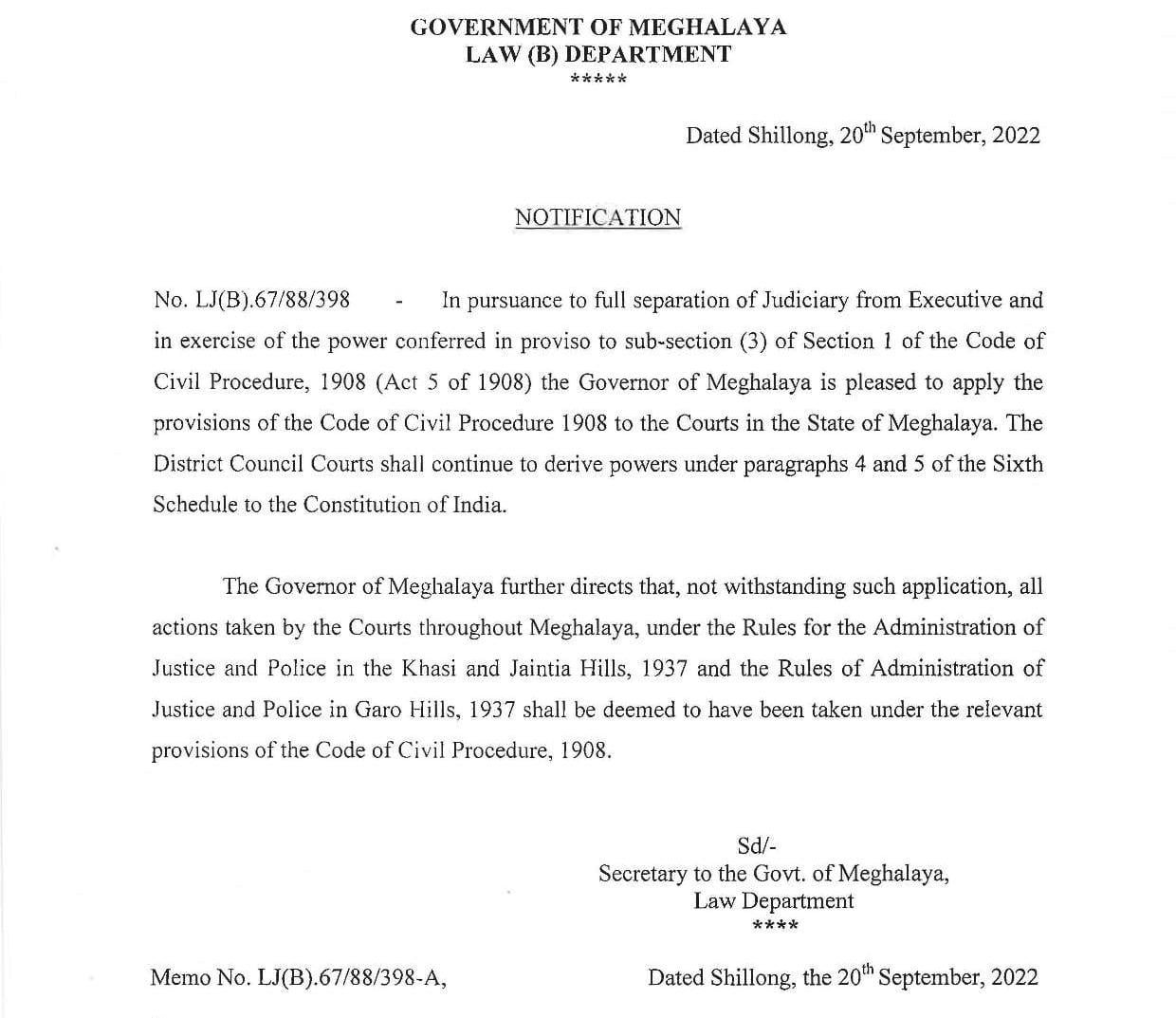
Senior lawyer S P Mahanta has today pointed out certain flaws in the recent notification issued by the Meghalaya government relating to application of CPC and Code of Criminal Procedure (CrPC) to courts in the State.
During a hearing of a criminal appeal filed by Komerchand Sing Wanrieh in the division bench of Meghalaya High Court today, Mahanta said that the pecuniary jurisdictions under the Civil Procedure Code (CPC) have not been covered by the recent notification issued by the government.
Mahanta also pointed out before the High Court that his suggestions as recorded in a previous court order have not yet been considered by the State government.
It may be noted that Mahanta during hearing of the case on August 24 had stated that while the present exercise by the State government is on pertaining to criminal matters, the civil code aspect should also be looked into.
He had also suggested that the State government should frame a draft Meghalaya Civil Courts Bill to deal with civil code matters.
Meanwhile, during today’s hearing, senior lawyer H L Shangreiso who appeared on behalf of Wanrieh sought time to deal with the effect of the notification issued in respect of the Code of Criminal Procedure, particularly since the notification provides that “all actions taken by the court throughout Meghalaya … shall be deemed to have been taken under the relevant provisions of the Code of Criminal Procedure, 1973.”
During the hearing, copies of the notifications published by the State government to implement the Code of Criminal Procedure, 1973 and the Code of Civil Procedure, 1908 have been handed over in the High Court. The notifications are dated September 20, 2022.
The High Court has decided to hear the case immediately after the vacation. The matter has been listed for hearing on October 10.
It may be mentioned that Wanrieh was convicted for murder and other offences by the Sessions Judge, Ri-Bhoi district on December 16, 2019 under Sections 302, 201, 34 of IPC and sentenced to suffer rigorous imprisonment for life and fine of Rs 50,000.
Later, Wanrieh moved an appeal to the High Court against the conviction and sentence.
During the hearing of the appeal on December 7, 2020, Wanrieh’s lawyer Shangreiso referred to the Notifications dated 21st April, 2006 and 29th March, 2007 issued by the Governor and stated that since the victim and the accused are tribals, the Sessions Judge, Ri-Bhoi district did not have jurisdiction to try the case.
Shangreiso in support of his argument relied upon the judgement of the Supreme Court on February 11, 2020 in the case of State of Meghalaya vrs Melvin Sohlangpiaw:2020 SCC Online SC 181.
In the judgement, the Supreme Court bench of Justice Mohan M. Shantanagoudar and Justice R Subhash Reddy had ruled that as per paragraphs 4 and 5 of the Sixth Schedule, the District Council Court has the exclusive jurisdiction to entertain a criminal case where both the accused and victim are tribals.
Advocate General Amit Kumar on the contrary relied upon another Notification dated 3rd May, 2018 issued by the Governor in exercise of the powers conferred under rule 1-A of the Rules for Administration of Justice and Police in the Khasi and Jaintia Hills, 1937 and further under sub-section (1) of Section 2 of the Meghalaya Autonomous Districts Administration of Justice Act (Assam Act XIV of 1960 as adapted and amended by Meghalaya) read with paragraph 5 of the Sixth Schedule to the Constitution of India.
According to Kumar, the Governor has also conferred similar powers on the District and Sessions Judge, Ri-Bhoi for trial of all offences punishable with death, imprisonment for life or imprisonment for a term exceeding five years under the Indian Penal Code.
He further submitted that if the powers are conferred by the Governor on both, namely, the District Council Court as well as the regular court, then naturally the regular court has the jurisdiction.