


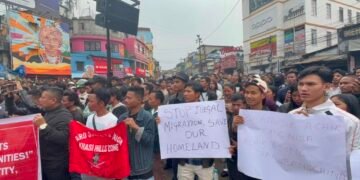








Shillong, Jan 23: The killing of Achik leader Dilseng M Sangma should not be taken as a random isolated event but a wake-up call to reckon the growing impatience between two communities, as a consequence of poor governance, four pressure groups in Garo Hills have said.
The Garo Students Union, Federation of Khasi Jaintia and Garo People, Association for Democracy and Empowerment and Achik Youth Welfare Organisation said poor governance are matters of unchecked illegal immigration, failure of law enforcing agencies in curbing illegal mining and timber smuggling in the plain belt of Garo Hills.
While civil society organisations have drawn attention to these factors from successive governments and Executive Committees and despite subsequent introductions of laws such as Migrant Workman Permit System (MWPS) and the Meghalaya Residents Safety and Security Act (MRSSA), not much has been achieved on the ground in terms of identification and eviction of illegal settlers in many tribal lands, the groups said.
Pointing out that despite the introduction of Garo Hills District (Transfer of Land) Act 1955 and the Meghalaya Land Transfer Act 1972, the groups said not much effort has been made by the concerned authorities to detect and evict the illegal settlement of non-tribal community in tribal lands which has also contributed in further fuelling tension and mistrust between the tribal and non-tribal communities.
According to the groups, another factor which contributes towards the mistrust and tension between the tribal and non-tribal communities of Garo Hills Region is the rampant disregard of the law of the land in terms of economic activities as there has been a rise in illegal stone quarries in the plain belt areas whereby some non-tribal people occupy tribal lands and mine stones with total disregard to the environment. Illegal mining is also rampant from rivers and streams rendering these water bodies unfit for consumption and domestic use, whereas many tribal residents rely solely on these natural water bodies for both consumption and domestic use. “These factors as one can clearly perceive further sows divide between the tribal and non-tribal communities of those areas as the tribal population respect and rely on nature to meet their daily needs and the miners who destroy the God gifted geography of the region through their illegal activities are often from the non-tribal community of those regions,” the groups added.
On illegal timber, the four pressure groups said traders are obtaining and transporting timber from tribal lands and reserved forests at night, which concerned authorities have not been able to put a full stop to such illegalities.
In the backdrop of these factors, the pressure groups have urged Chief Minister Conrad Sangma to introduce a mechanism that guarantees robust coordination between the Land and Revenue Department, Home Department, District Council Affairs Department, Forest and Environment Department, Autonomous District Councils, District Administration and the District Police Force.
Stating that while the Autonomous District Councils being the primary authority to identify and evict illegal settlers in tribal lands, to identify and seize any illegal mining activities and to identify and seize illegal felling and transportation of timber the groups said ADCs faces serious shortcomings because it cannot command the police force and thus rendered toothless.
The groups in the letter to the CM highlighted the “aggressive” nature of those involved in illegal mining and timber trade and suggested setting up a Battalion Camp of the Meghalaya Police in the sensitive areas of the plain belt.
“The situation in the plain belt areas of Garo Hills is very tense at the moment and any sensible person can understand that even a small spark can ignite a box full of explosives,” the groups stated.
They further urged the government to extend an ex-gratia of Rs 10 lakh to the next of kin of the murdered Achik leader.
Welcoming the formation of a Special Investigation Team to probe the murder, the groups stressed that the incident is a “by -product of the decades of frustration fostered between the two communities” that require time to correct through political will.