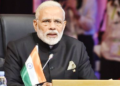


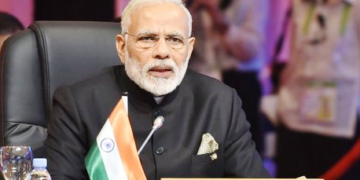




Born on 17 September 1950 in a small town called Vadnagar in Gujarat to the late Damodar Mulchand Modi and Hiraben Modi is our Prime Minister Narendra Damodardas Modi who turns 72 years of age today. Modi was born and raised in a humble background, where he completed his secondary education in the town itself. He has two elder brothers Som and Amrit before him, a sister Vasanti and two more brothers Prahlad and Pankaj after him. They were all eight in the family and lived in a three room house made of mud brick. The Modi family comes from the Ghanchi’s castes, who are traditionally producers of vegetable oil. It is a caste that cut across religious lines and there are many Muslim Ghanchis in Gujarat.
The neighbourhood that the Modi’s lived in was very close knit and mixing with all communities was normal and majority of his childhood friends were indeed Muslims. He was introduced by way of contact to the RSS a nationalist organisation at the age of eight, while in the evenings after school he would help his father in the tea stall. It was in the RSS that Modi met his mentor and guide Laxmanrao Inamdar fondly called ‘vakil saheb’ as he was a lawyer. Inamdar inducted Narendra Modi as a ‘balswayamsevak’ or junior cadet and taught him what it meant to be a volunteer to serve the nation and its people.
The tradition of childhood betrothal among Gujarati Ghanchis was prevalent in the 1950s and was more deeply ingrained than today; Narendra’s parents engaged him at three years of age to a girl from a nearby town who was later made known to all as Jashodaben Chimanlal Modi. Narendra was not made aware of his early betrothal until many years later of his life and when he would have fully understood the concept of child marriage at the age of seventeen, he abruptly left Vadnagar and went away in search of spiritual knowledge. He however later publicly acknowledged his wife when required to do so by law, but has made no contact with his wife ever since the period he left Vadnagar.
Modi had travelled to northern India for two years after leaving his parental home, visiting a number of religious centres and had spent most of his time in Calcutta. Upon his return to Ahmedabad in 1969 at the age of nineteen as a penniless and jobless youth, he was certain only about what he wanted to do, to work in the RSS and commit himself to some sort of social service to which he later became a full-time worker for the organisation. His arrival in Gandhinagar later coincided with the aftermath and recovery from the terrible 1969 communal riots that killed hundreds of people and then it was in the early 1972 just after the Bangladesh War that Inamdar or ‘vakil saheb’ stepped in and took Narendra formally into the RSS fold and also ordered him to resume his studies. And then it was after 1985 that Narendra began his political journey with the BJP for which there was never a turning back.
At the age of 36, Narendra Modi was given the responsibility of organising the campaign for the Ahmedabad municipal elections held in February 1987. He meticulously derived a methodical planning that brought success to the party who could win two thirds of the seats in the municipality. His accolades prompted L K Advani who was then the party chief to further assign Modi with more tasks as the organising secretary of the Gujarat BJP unit the same year. And in 1987, was the year when the party adopted the theory of ‘Integral Humanism’ the brainchild of Pandit Deendayal Upadhyaya that he firstly pronounced publicly in 1965. When one learns of what is involved in this theory, the similarities of what Modi speaks about so consistently every time begins to make sense?
Upadhyaya wanted to decentralise the government with a self-reliant economy organised from the ground up instead of from the top down. Importantly, Upadhyaya’s sense of inclusive and unbending secularism could be expressed in nationalistic rather than sectarian terms: ‘We are pledged to the service not of any particular community or section but of the entire nation. Every countryman is blood of our blood and flesh of our flesh. We shall not rest till we are able to give every one of them a sense of pride that they are children of the soil Bharat’. Later when Modi became the CM of Gujarat he was the only one to have wholeheartedly implemented these values although the infrastructural initiatives of the Vajpayee administration are still remembered with fondness by all of us as we watch the national highway network that came along.
After Advani became the national president of the BJP again, Modi in 1994 was sent back to Gujarat to prepare for the elections using the ‘organisation centered election model’. Modi threw himself into the task and the party won with two thirds majority with almost 42.5 per cent of vote share. Internal rumblings within the party prompted Modi to leave ground and exile to Assam to meet up with his old counterparts. Advani stepped in and in November 1995 appointed Modi as the national general secretary and with a base in Delhi, Modi was further given charge to organise the party in states of Haryana, Himachal Pradesh, Punjab and Jammu and Kashmir which could also be termed as the most fruitful period of his life.
Since his banishment in between the year 1995, Modi had only returned to Gujarat a few times to visit the Sanskardham School that he was closely associated with. Then in January 2001 came the calamitous Kutch earthquake, and voter disgruntlement prompted the party higher ups to consider Modi as an interim Chief Minister of Gujarat replacing Keshubhai Patel whose government was reeling under corruption allegations, Modi however declined the offer as he was to submit himself to assembly by-election while he was still happy as the organisational incharge. After much persuasion from Vajpayee, Modi relented to the offer and on 7 October 2001 was sworn in as the Chief Minister of Gujarat.
Despite local enemies from within the party the politically equated heavyweight backers from Delhi paved Modi the way to get things to action and perform as the CM to tidy the shambles enveloping the party in Gujarat as elections were due in 2003. He linked himself to a batsman in a one day test match and humbly accepted the role of interim CM so that he could return back to Delhi for his organisational duties. However pressure from the party resulted in Modi to continue with the task assigned to him till he became the longest serving Chief Minister of Gujarat from 2001to 2014.
The year 2014 was altogether a game changer, which saw the rise of the BJP under the leadership of Narendra Modi. Since he was projected by the party as the PM candidate, the numbers naturally transcended to seats and the party alone garnered 282 seats making the entire NDA to get more than 340 seats in the lower house. Thus, Narendra Damodardas Modi became the 14th Prime Minister of the largest democracy in the world. PM Modi created his first impact by letting the swearing in to be held in grandeur by inviting the leaders of almost all SE Asian countries. He has also been the first PM in the country to have kissed the floor of the entrance door to the central hall of the temple of democracy. Many criticised these gestures made by PM Modi as political gimmick or photo-op; however it cannot be denied that he humbly bowed down to show respect for the house of the people.
What followed later is the massive introduction of important schemes by the Modi led NDA government, like the Jan DhanYojna a scheme to make the banking sector inclusive to all, Skill India a programme to engage youths in job oriented skill development, ‘Make in India’ to encourage manufacturing units in the country, Swaach Bharat mission a scheme to achieve nationwide cleanliness, Beti Bachao Beti Padhao to empower the girl child, Mudra Yojna to encourage young entrepreneurs and small businessmen, Atal Pension Yojna a scheme to provide pension to the unorganised sector, PM Ujwala Yojna a subsidised scheme to provide gas to BPL families, and all other schemes that are people centric was brought under the direct benefit transfer wherein benefits are transferred directly to the account of the beneficiary preventing leakages that was root cause to corruption.
The famous slogan that PM Modi coined ‘sab kas sath, sab ka vikas, sab ka prayas’ which translates to as everyone’s support, everyone’s development and everyone’s trust has formulated a new hope for the countrymen to work together towards a common goal in making our nation great with values. PM Modi is indeed one of the few charismatic leaders that the country has ever seen in history, he is not of any particular caste or religion and he ensures empowerment of all. And as the country celebrates Prime Minister Modi’s 72nd birthday, we wish him good health, strength and zeal to serve the country better so that as a nation we can achieve greater heights in years to come that is truly ‘Atmanirbhar’ or self-reliant.