








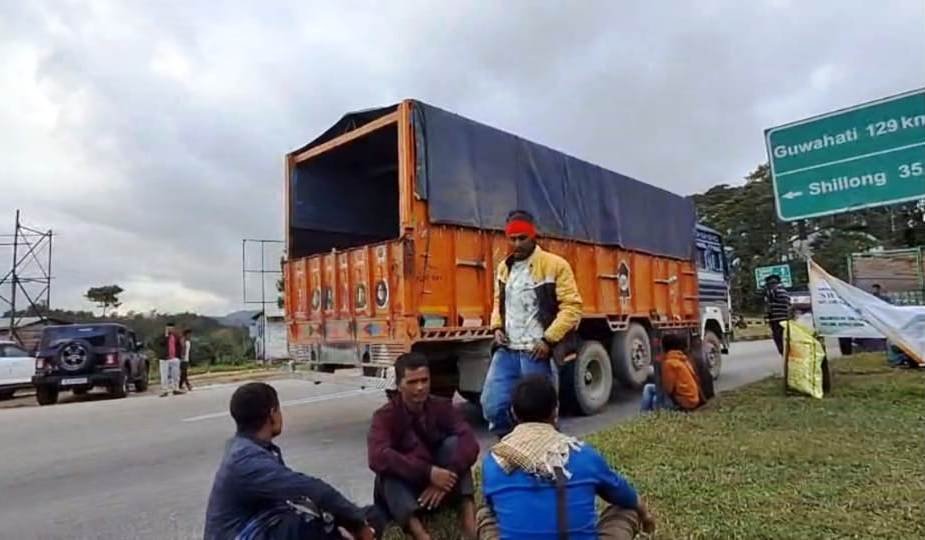
Shillong, Nov 6: A day after the arrest of Meghalaya Commercial Truck Owners and Drivers Association (MCTODA) president Mosklandar Marngar was arrested, truckers continued to protest in Mawryngkneng on Thursday.
MCTODA is demanding the immediate release of their leaders and members from police custody. Speaking to the media, an MCTODA leader said the association is not seeking to create law and order issues but rather to assert their rights and demand fair treatment from cement companies in East Jaintia Hills.
The association wants rates prescribed by the state government for transportation within Meghalaya to be extended outside the state as well. The state government’s argument to this is that the Meghalaya government cannot set rates when the trucks cross state lines.
MCTODA has received some support, such as from the All Khasi Meghalaya Tourist Taxi Association (AKMTTA), but not from other industry bodies, like the Jaintia Hills Truck Owners Association (JHTOA) and the East Jaintia Hills Truck Owners and Transporters Association (EJHTOTA).
These two associations are not supporting MCTODA’s strike, which began at the end of last month and which again grew violent today.
MCTODA members continued their protest at Mawryngkneng when a police team escorting cement and clinker trucks trying to cross the picket line arrived. The MCTODA members of the association decided to block the trucks as a protest and tried to force these trucks to turn back.
However, a war of words ensued between the protestors and district administration, which led to the police firing tear gas to disperse the members of the association.
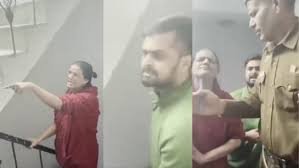
After this, several women of Mawryngkneng expressed their anger with the police for using tear gas and they tried to drive the police away from the scene.
The women were angry that police fired tear gas and lathi-charged the truckers yesterday morning and again today, as this created a sense of fear in the children of the area. Meanwhile, the Jaintia Students’ Movement (JSM) also condemned the use of tear gas on the strikers for its effects on ordinary people.
The strikes and disturbances have led to factories remaining closed and supply of cement running short in Meghalaya and parts of the North East as supply is disrupted.
The Sordar of Mawryngkneng, Peter J Lawai, has also strongly condemned the government’s decision to deploy police and their use of stun grenades (as has appeared in some reports) and tear gas.
Speaking to reporters at Mawryngkneng, Lawai warned that if the police continue to use force, the Dorbar Shnong will have no choice but to take a strong decision, alongside the villagers. He slammed the government for allowing police high-handedness in the area without the Dorbar Shnong’s permission.
Lawai criticised the police for their aggressive tactics, stating that their actions were an affront to the authority of the Dorbar Shnong. “The use of force by the police is merely to please certain individuals, to the extent that the police department no longer respects the authority of the Dorbar Shnong,” he alleged.
Meanwhile, the Deputy Commissioner of East Jaintia Hills, where many cement factories are located, laid out the state government’s case in a detailed press release and video statement, more for public consumption rather than the protesting truckers.
Shivansh Awasthi reiterated the government’s line that it cannot dictate inter-state transport rates as MCTODA is demanding.
Awasthi said that a coordination meeting was held on October 30 in Khliehriat, which was attended by representatives of the Jaintia Hills Cement Manufacturers Association (JHCMA), the JHTOA and the EJHTOTA. However, MCTODA declined to attend if the other two transporters associations were present.
The JHTOA and EJHTOTA confirmed to the DC and cement companies that they are operating smoothly with the cement plants and do not support the strike.
To try and resolve the issue with MCTODA, the DC and JHCMA held a separate meeting with it.
MCTODA’s demands included enforcement of freight rates, prevention of overloading, priority loading for local trucks, parking arrangements, timely freight payments and labour compliance. All of these were accepted except the implementation of rates across state boundaries.
Awasthi said that after detailed discussions, it was clarified by the JHCMA that the government notified freight rates for intra-state transportation within Meghalaya have already been implemented in full by all cement plants operating in the district.
However, Awasthi said that the MCTODA has demanded that the same notified rates be applied to inter-state transportation.
“It is important to note that no such provision exists in the Motor Vehicles Act, 1988 and no State Government can notify transportation rates for inter -state transportation,” the Deputy Commissioner said.
According to him the inter-state freight rates are determined by prevailing market conditions, distance, and mutual agreement between the consignor and the transporter.
Awasthi said that reports have been received of incidents involving damage to vehicles and harassment of drivers not participating in the strike.
“The district police of East Khasi Hills (where Mawryngkneng is located) have therefore taken lawful measures to clear blockades, restore traffic, and ensure the safety of all road users,” the DC said.