












By Dipak Kurmi
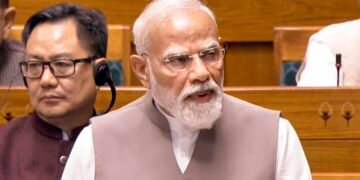
India is navigating a delicate economic phase. A combination of global pressures and domestic challenges has left businesses and households treading cautiously. Even before the latest upheavals, the country had been grappling with the impact of Trump-era tariffs, and a subsequent hike in visa fees by the United States targeting IT professionals added further strain. These developments dampened morale, lowered confidence in the business community, and created an atmosphere of uncertainty for the general public. Amidst this climate, it became imperative for the Prime Minister to communicate with citizens, restore confidence, and signal that the government was actively addressing economic challenges. Prime Minister Narendra Modi’s recent address to the nation, focusing on reforms to the Goods and Services Tax (GST), was aimed precisely at this task.
The speech arrived at a time when public resentment over GST’s original design was palpable. Introduced in 2017 as a unified indirect tax system, GST promised the ideal of “one nation, one tax” but was widely criticised for its complexity. Multiple tax slabs, the inclusion of essential goods under high tax rates, and onerous compliance requirements frustrated small and medium-sized businesses. Even proponents of the reform acknowledged that its implementation was flawed, creating an impression that the government had imposed a rigid system without adequately considering practical challenges. Against this backdrop, the Prime Minister’s announcement of a simplified GST regime, termed “Next-Gen GST,” sought to address long-standing grievances while reassuring citizens and businesses alike.
Modi’s reforms aimed to rationalize GST rates, condensing them primarily into two tiers: five per cent and eighteen per cent. Essential goods, including food, medicines, and other daily necessities, would either see eased rates or complete exemptions. Ultra-luxury items would attract a 40 per cent levy, while tobacco and related products would remain under 28 per cent plus cess. The simplification represented a direct response to the frustrations expressed by citizens and businesses over the previous multi-tiered system. By presenting the reforms as a “GST Bachat Utsav,” or GST Savings Festival, Modi sought not only to highlight the practical benefits for households but also to instill a sense of optimism ahead of the festive season.
The Prime Minister’s address, however, was more than an economic briefing. It was also a calculated political gesture. Opposition leaders had long labelled GST as a burdensome “Gabbar Singh Tax,” and the narrative of high tax incidence on basic commodities had become a potent critique. Modi’s speech strategically reframed the conversation. By emphasizing affordability, the double advantage for the poor and middle class, and positioning the reforms as steps toward a self-reliant India, he sought to anchor GST in the lived experiences of citizens. In particular, his appeal to the aspirations of the “neo-middle class” underscored an attempt to link fiscal policy with the tangible realities of millions who have emerged from poverty over the past decade. Critics, notably Congress chief Mallikarjun Kharge, dismissed these measures as “too little, too late,” yet even skeptics could not ignore the clarity and potential of the reforms.
For years, the labyrinthine structure of GST created confusion, burdened businesses, and slowed consumption. The simplification to two primary rates has the potential to alleviate these issues significantly. Households could save an estimated five to ten per cent on monthly expenditures for groceries and essential items, while businesses in sectors such as FMCG, consumer durables, automobiles, and construction are expected to experience a boost in activity. Cumulatively, the reforms are projected to generate up to Rs 2.5 lakh crore in savings for the nation. The timing of the announcement, coinciding with the start of the festive season, added a psychological incentive for citizens, potentially stimulating consumption and providing a visible sense of relief during a period traditionally associated with spending.
The success of these reforms, however, hinges on a combination of factors beyond mere rate changes. Modi’s address underscored the importance of embracing local products to create a virtuous economic cycle encompassing consumption, production, investment, and job creation. Despite the availability of high-quality Indian alternatives, imports continue to dominate several product categories, including toys, fruits, apparel, footwear, and manufactured goods. In the last financial year, India imported over \$500 million worth of toys and games, \$900 million worth of fruits, and more than \$600 million each in apparel, footwear, and miscellaneous manufactured goods. Modi’s appeal to citizens to “buy local” was a direct endorsement of domestic industry, emphasizing the dual responsibility of consumers to support Indian products and of manufacturers to meet global standards of quality.
Enhancing the quality of India-made products is central to this vision. The Prime Minister recalled India’s pre-colonial dominance in global trade, urging entrepreneurs to restore the reputation of Indian goods. Historically, Indian manufacturers thrived due to exceptional entrepreneurial spirit, calculated risk-taking, and robust family and community networks that served as informal support systems. Today, however, entrepreneurs often operate in isolation, bearing financial and social risks alone. Reviving a culture of mutual support, along with governmental facilitation, is crucial if India is to reclaim its historical prominence in trade and commerce. By coupling fiscal reforms with an appeal to entrepreneurship, Modi aimed to lay the groundwork for a more resilient economic ecosystem.
The potential social and economic impact of these GST reforms cannot be understated. Lower tax rates on essentials directly enhance affordability, improving the daily lives of millions. By stimulating demand for consumer goods and incentivizing domestic production, the policy also addresses longer-term objectives of industrial growth and employment generation. If implemented effectively, the new regime could mark a turning point in India’s economic trajectory, creating a more inclusive and accessible market system.
Nevertheless, the address also raised questions about perception and execution. Leadership in a democracy is as much about managing public trust as it is about enacting policy. Modi’s emphasis on clarity, affordability, and empowerment was designed to build confidence in the government’s responsiveness. The dual emphasis on fiscal prudence and cultural nationalism—encouraging Swadeshi consumption—reflected an understanding that economic reform must be accompanied by societal engagement. Yet the efficacy of these measures will depend on the cooperation of state governments, the efficiency of tax administration, and the ability to minimize compliance hurdles for businesses.
The broader historical and cultural context adds layers to the narrative of GST reform. India’s journey from a patchwork of multiple indirect taxes to a unified tax system in 2017 was an ambitious step in creating administrative coherence. However, as experience revealed, system-wide reforms of this magnitude require iterative adjustments to reconcile policy ideals with ground realities. The Next-Gen GST is thus not an isolated initiative but part of a continuum in India’s efforts to harmonize taxation, promote economic efficiency, and foster equitable growth.
The timing of the reform announcement, aligned with the start of the festive season, is also strategically significant. By linking economic policy to the rhythm of public life, the government has created both an immediate practical benefit and a symbolic reaffirmation of its commitment to citizen welfare. Savings on household essentials, anticipated boosts to sectors driving employment, and the long-term emphasis on self-reliance collectively signal a multidimensional approach to economic management.
Beyond numbers and rates, Modi’s address also highlighted a broader vision of economic citizenship. By urging both consumers and manufacturers to participate actively in the promotion of local goods, the reforms aim to cultivate a sense of collective responsibility. The government’s role is framed as enabling and supportive rather than coercive, creating conditions in which citizens, entrepreneurs, and policymakers work toward a common objective: sustainable, inclusive, and self-reliant growth.
The challenge, of course, lies in execution. The simplification of rates, if coupled with seamless implementation, can create the clarity and predictability essential for economic dynamism. Conversely, bureaucratic bottlenecks or uneven state-level adoption could dilute the intended benefits. Similarly, the call for Swadeshi consumption is contingent on Indian manufacturers responding with products that meet or exceed global standards of quality. Policy reform, economic behavior, and industrial capability must therefore converge to translate the Next-Gen GST into tangible outcomes.
The introduction of the restructured GST marks a watershed moment in India’s economic policy. It reflects a learning curve from past challenges, incorporates practical remedies for households and businesses, and seeks to rekindle optimism among citizens navigating a complex global and domestic environment. By simplifying rates, promoting affordability, and linking fiscal reform to the larger narrative of self-reliance and industrial revival, the government has attempted to create a framework that is both economically sound and socially resonant.
Next-Gen GST is more than a technical adjustment of tax slabs; it is an exercise in economic narrative, trust-building, and strategic governance. Its potential success lies not only in policy design but also in implementation fidelity, citizen participation, and the entrepreneurial capacity of India’s industries. If executed effectively, this initiative could achieve multiple objectives simultaneously: easing financial burdens on households, stimulating consumption, encouraging local manufacturing, generating employment, and reinforcing faith in the government’s responsiveness.
As the country embraces this new tax structure, the stakes extend beyond revenue collection. The Next-Gen GST represents a vision for India’s economic future—one that balances fiscal prudence with citizen welfare, integrates tradition with modernity, and links policy with perception. It is a reminder that reform is not merely about numbers or compliance; it is about creating conditions in which citizens, businesses, and the state can collectively navigate uncertainty, foster resilience, and build a prosperous, self-reliant India.
(The writer can be reached at dipakkurmiglpltd@gmail.com)