

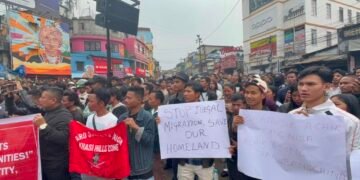
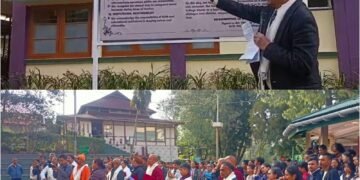

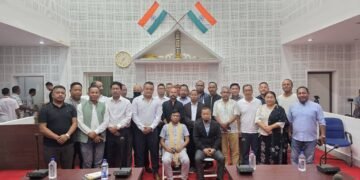





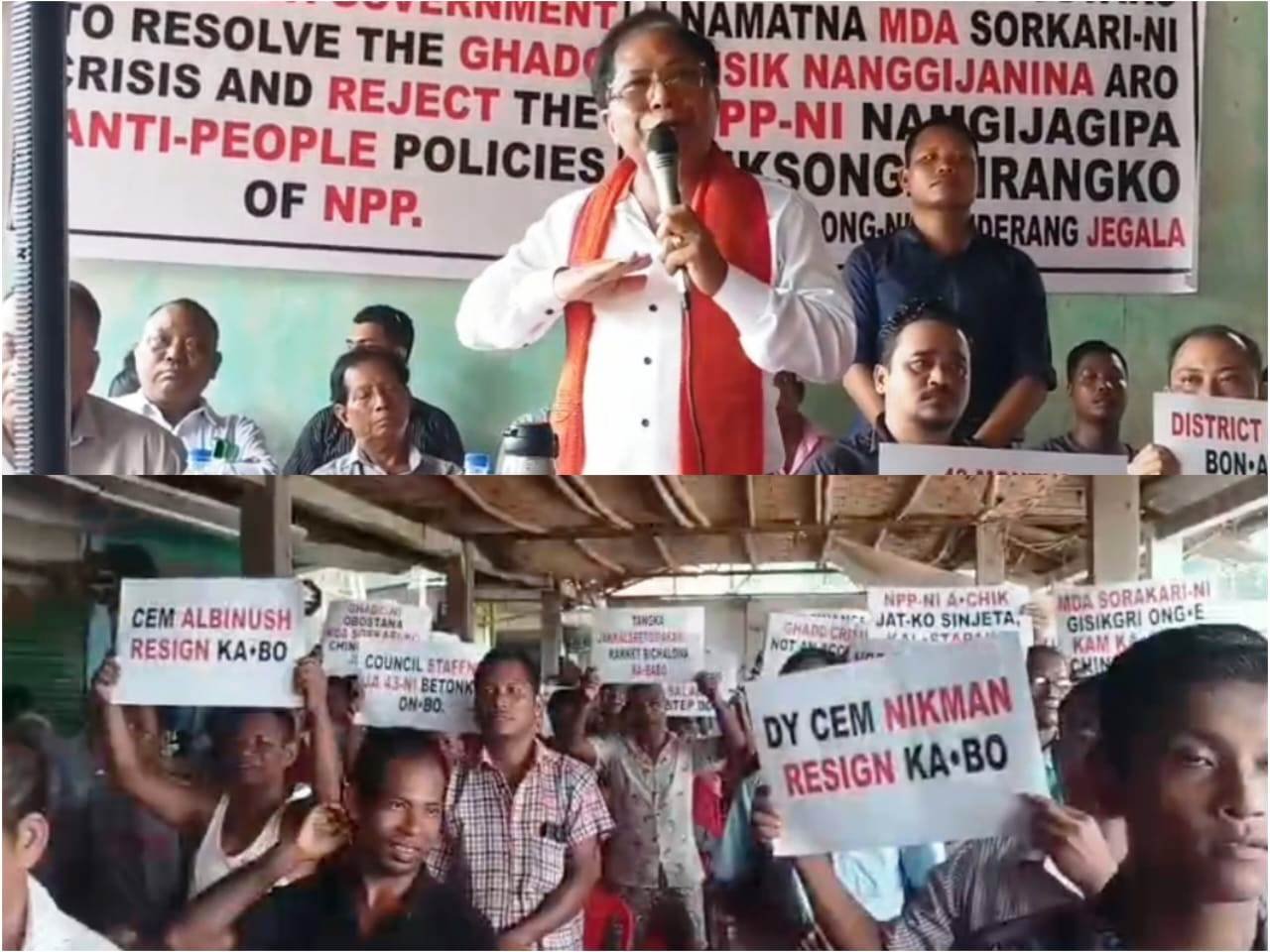
Shillong, Aug 27:Hundreds of people gathered yesterday at a public rally in Purakhasia to protest the state government’s handling of the ongoing crisis in the Garo Hills Autonomous District Council (GHADC) and its “anti-people” policies.
The rally, organised by the Joint Action Committee of Purakhasia, was attended by a broad cross-section of the community, including Nokmas, NGO leaders, senior citizens and a large number of youth.
The rally was led by Dr Mukul Sangma, Leader of the Opposition in the Meghalaya Assembly, and was joined by senior members and the rank and file of the Trinamool Congress (TMC), Dr Sangma’s party.
During his address, Dr Sangma strongly criticised the Chief Minister for earlier saying that the state government has no responsibility for paying the salaries of GHADC employees. This statement by the CM came before he announced that the government would take on the responsibility of paying all staff salaries of the three district councils from November.
GHADC employees have been protesting for the release of their pending dues, which now amount to nearly 44 months’ worth. While acknowledging that the state government may not be directly responsible for the salaries, Dr Sangma cited Article 275 of the Constitution, which mandates financial assistance to strengthen scheduled areas inhabited by Scheduled Tribes in various Autonomous District Councils.
The former CM stated that it was under this very constitutional provision that his government, in 2015-16, successfully engaged with the Centre to secure a historic Rs 100.71 crore special assistance package for the GHADC.
This package has been another issue fought over by Dr Sangma and the Chief Minister Conrad Sangma. Dr Sangma has claimed that the money was misappropriated when Conrad Sangma led the GHADC. Yesterday the latter denied this, saying that the full Rs 100.71 crore was never released to the GHADC but the tens of crores that were released were all accounted for and it was only because the other district councils did not provide utilisation certificates for their funds that the central government ended the scheme.
Dr Sangma stated that the present government has failed to secure further assistance, largely because they have not submitted the necessary utilisation certificates to the Union government.
He further stated that the case on the alleged corruption, mismanagement, and misappropriation of this fund is still pending in the Lokayukta, and called for the case to be fast-tracked to ensure accountability and enable the state to secure more funds for the GHADC.
The opposition leader highlighted that the State Finance Commission Act 2012 had already been passed during his government’s tenure, but the present government has failed to implement it or form the necessary committee.
Dr Sangma explained that once the Act is properly implemented, it would enable the GHADC to receive funds from the Consolidated Fund of the Union government, as per the provisions of the Union Finance Commission.
Sangma also spoke about the importance of the Tripartite Agreed Text Settlement with the ANVC and ANVC-B, which was a key factor in securing the aforementioned special assistance grant.
He expressed serious concern that the agreement has not been implemented or fulfilled to this day, questioning the present government’s seriousness and competency in upholding commitments.
Meanwhile, speaking on the issue of the Tura Medical College, Sangma expressed his alarm at the government’s move to a public-private partnership (PPP) model for its operation and management.
The TMC leader reminded the public that when the project was conceived during his tenure, his government had conducted extensive due diligence and concluded that a PPP model would be unsuitable.
He stressed that a government-owned and operated institution is vital for ensuring affordable healthcare and securing future employment for the state’s youth.
Sangma also pointed out that the central government provides financial assistance for such projects, making the pursuit of a PPP model unnecessary and a potential disservice to the people.