













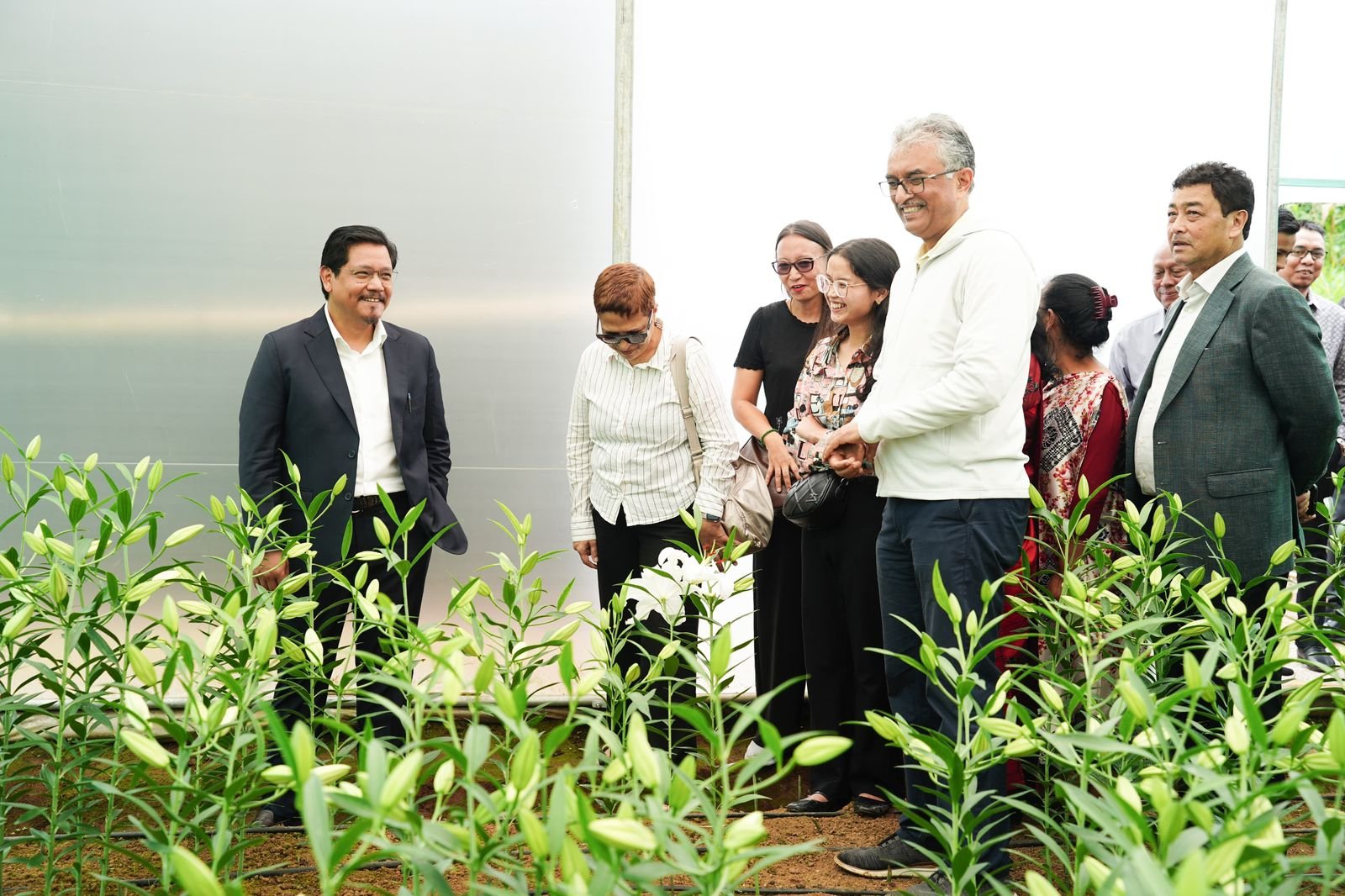
Shillong, Aug 5: Chief Minister Conrad K. Sangma today announced that the government has earmarked Rs 240 crore over the next three years under Floriculture Mission 1.0, with a vision to transform the state into a leading floriculture hub of the Northeast and the country.
Speaking during a visit to Mawkriah village in East Khasi Hills, accompanied by Agriculture Minister Ampareen Lyngdoh and MLA Ronnie Lyngdoh, the Chief Minister highlighted the mission’s goal of turning floriculture into a high-value, climate-resilient, and sustainable livelihood option.
Launched in March 2024, the mission aims to benefit over 3,000 farmers by providing a Rs 7 lakh subsidy package that covers inputs, infrastructure, and training. So far, nearly 500 farmers have already availed the benefits of the programme.
“This is the highest investment any government has made in floriculture in Meghalaya,” said the Chief Minister. “We expect a direct profit generation of Rs 600 crore through this mission over the next few years.”
The scheme will focus on cultivating high-value flowers such as Orchids (Dendrobium, Cymbidium, Vanda, and Phalaenopsis) and Oriental Lilium, which are in high demand both in India and in global markets. The state’s unique agroclimatic conditions—blending tropical and temperate elements—make it ideally suited for such crops.
To ensure quality and sustainability, the government has engaged two experienced service providers—Darjeeling Gardens and North Bengal Floritech – who will offer technical expertise, high-quality planting materials, infrastructure support, and assured market linkage through a three-year buyback arrangement.
“Region-specific flower clusters are being developed using scientific cultivation techniques,” the CM said. “We are building on the state’s natural strengths and innovating with improved systems.”
To meet growing demand and support the expanding floriculture ecosystem, the government is planning to set up dedicated storage and logistics hubs across key production clusters. These hubs will ensure timely transportation, preservation of flower quality, and efficient market access for farmers.