











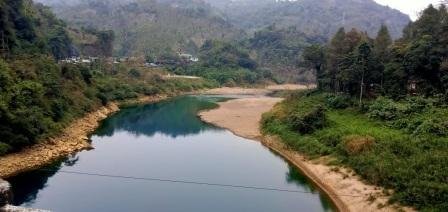
Every year during winter, Lukha River at Sonapyrdi in East Jaiñtia Hills district used to experience a strange phenomenon – discolouration of the water.
The water in the river turns deep blue during the months of December, January and February and stays so till the monsoon when high rainfall dilutes the pollutants.
However, this year there is good news. The river did not turn blue thanks to a pilot project to revive the river using algae, called phycoremediation.
Delhi-based Trinity Impex International has been entrusted with the Rs 2.5 crore pilot project of treating the water at the river and improving its pH value through use of micro-green algae.
Algae solution is considered as the only way to treat the acidic water and restore aquatic life in a water body.
Speaking to Highland Post today, secretary of Hynriew Shnong Wah Lukha Association, Daiapherbha Lamare said that scientists of Trinity Impex International have released algae into the river since last month and more will be released soon.
The algae were cultivated by Trinity Impex International in 14 different ponds at Sonapyrdi village.
“As it is today, there is hope for Lukha to return to its original nature. We are happy to see that no more discoloration of the river took place,” Lamare said.
“This is a pilot project funded through District Mineral Fund of cement companies located in East Jaintia Hills. We will be happy if there are other ways to restore the entire stretch of Lukha River,” Lamare added.
The pilot project for restoration of the Lukha River through micro-green algae started way back in 2019 with an initial experiment conducted by scientists of Trinity Impex International at Kyrhuhkhla River near Lad Rymbai.
After the success of the experiment, the scientists carried out a similar experiment at Lukha River in 2020.
Four scientists namely Trinity Impex International director Dr. Sapan Anand, Chief Executive Officer Dr. Sukh Dev Singh, Director Nikhil Kher and Deputy General Manager Dr. Dilip Kumar are involved in the project.
Dr. Sukh Dev Singh informed that a report was submitted to the Meghalaya State Pollution Control Board on the reasons why Lukha River turns blue.
He said that the river system from Mookynpad, that is yellowish, gets mixed with various metals and compounds and as it flows down streams and reaches Lukha River, it turns blue. This, he said, is the reflection of all the metals and compounds that do not get diluted during the winters when the river system is small.
Dr. Sapan Anand said algae plays an important role in rejuvenating the toxic river as these organisms will absorb the acid mine drainage and help in restoring the pH level of the water.
He also said that cleaning the rivers using the algae was done after a research of 20 years and that there are more than 27,000 types of algae and their different types can be used for different purposes.
The Lukha River is a major source of livelihood for many families.
It has turned blue since 2009 due to acid mine drainage and other industrial discharge into the river.