










By Anu P. James
The recent incident of the glass panel collision in Umiam has thrown light on one of the most colorful and vibrant inhabitants of our broad-leaved forests—the long-tailed broadbills. The long-tailed broadbill (Psarisomusdalhousiae) stands out as a jewel of the treetops; its shrill whistles and vivid plumage remind us of the richness of Meghalaya’s forests. The tragedy of their deaths against reflective glass is not merely an accident; it is a call to re-examine how our built environment interacts with fragile forest life and the natural world.
A Jewel of the Canopy
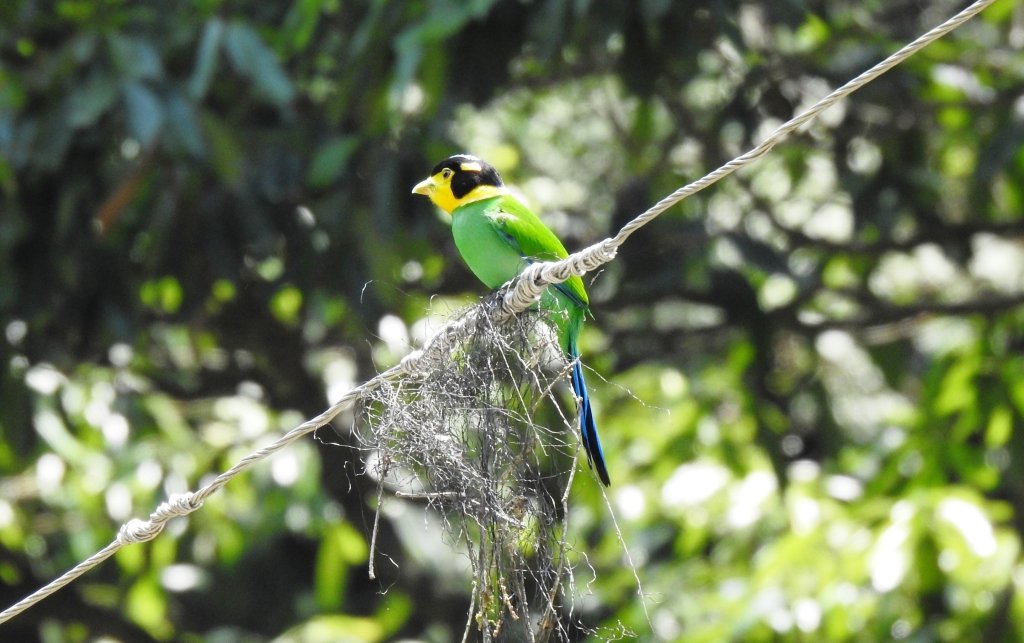
The long-tailed broadbill, often known as the “helmet bird” for its glossy black cap, is a striking canopy dweller of Asia’s broad-leaved forests. Measuring about 25 centimeters in length and weighing 50–60 grams, it is instantly recognizable by its bright yellow face and throat, vivid green body, bluish wings, and long tapering tail feathers.
This species is distributed widely from the Himalayan foothills of Nepal and Bhutan through Northeast India—including Meghalaya, Arunachal Pradesh, Nagaland, Manipur, and Sikkim and extends into Myanmar, Thailand, Laos, Vietnam, and Malaysia.
They thrive in subtropical and montane forests between 300 to 2,000-meters elevation. Broadbills are social and gregarious, moving in noisy flocks outside the breeding season, and they play an important ecological role by regulating insect populations. Their breeding behaviour is equally remarkable, with both sexes constructing elaborate hanging nests woven from moss and fibres, suspended high in trees near water.
Broadbills are canopy specialists. They spend most of their lives in the middle and upper layers of forests, moving in small, noisy flocks. Their diet consists mainly of insects like beetles, caterpillars, and other arthropods—which they glean from foliage. In this way, they help regulate insect populations and maintain the balance of forest ecosystems.
The long-tailed broadbill is currently assessed as a species of Least Concern by the IUCN, but its population trend is decreasing across much of its range. Although the bird enjoys a wide distribution the local populations are patchy and vulnerable to pressures such as habitat loss, forest fragmentation, and expanding urban infrastructure.
Why the Umiam Incident Matters
On January 24, 2026, several broadbills mistook the reflections of trees and sky in showroom glass panes for real habitat. Flying at canopy height and speed, they struck the panes with fatal force. Despite attempts by staff to revive them, many did not survive.
Glass collisions are not unique to Meghalaya. Globally, millions of birds die each year from such accidents. But for canopy specialists like the broadbill, the risk is particularly high. Their flight paths are aligned with treetop corridors, and when urban structures intrude into these zones, the danger multiplies.
This is not about one incident or one species. It is a wake-up call for all of us to rethink how development interacts with ecology.
Evolving Conservation Priorities
The Forest Department has long focused on protecting habitats from logging, shifting cultivation, and fragmentation. But the Umiam glass collision incident has broadened the scope of conservation priorities. Protecting birds like the broadbill requires ensuring that human structures do not become death traps.
The key priorities ahead include animal safe infrastructure, in this specific case, the bird-safe architecture. It also includes the most important aspect of habitat protection. If habitats are lost the biodiversity associated with them disappears. Maintaining and strengthening the habitat connectivity by way of community reserves and forest corridors are crucial for the long-term survival of many species like the canopy specialist broadbills. This unfortunate incident must have for the first time brought these beautiful birds to public attention and many must have seen these birds for the first time too. Hence ongoing Awareness campaigns and nature immersion experiences can strengthen our biodiversity conservation and make them more participative and all inclusive. Monitoring and research should continue to play a vital role in tracking populations and reporting mortality events. It is important to have the Policy integration of urban planning and biodiversity governance.
I recollect hours spent observing these birds, understanding their social interactions, photographing them and just sitting and enjoying their heavenly beauty and now seeing them dead is definite heartbreak. As someone who has spent years observing the forests of Meghalaya, I see the long-tailed broadbill not only as a jewel of the canopy but also as a messenger. Its shrill calls remind us that our forests are alive, vibrant, and interconnected. The deaths at Umiam are a tragedy, but they can also be a turning point. If we act now—by harmonizing development with ecology—we can ensure that the broadbill and numerous such graceful species continue to thrive in our surroundings for generations to come.
(The writer is an officer of the Indian Forest Service and is presently working as Divisional Forest Officer, Forest Utilisation Division, Shillong. Views expressed in this article are her own.)