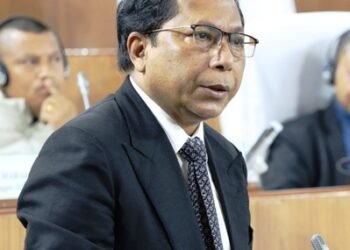










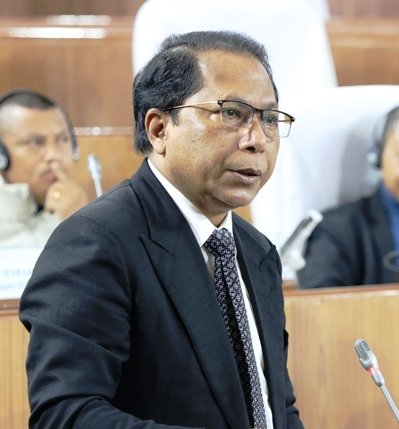
Shillong, Feb 17: Leader of the Opposition Dr Mukul Sangma on Tuesday raised strong concerns over the increasing alienation of tribal land in Meghalaya, urging the government to act with “unity and vigilance” to safeguard community ownership and mineral rights for future generations.
Participating in the special motion moved by Nongkrem MLA Ardent Miller Basaiawmoit, Dr Sangma described the issue as a serious challenge confronting the people at a crucial moment.
Dr. Sangma quoted a Bible verse from Deuteronomy 30:5, emphasizing that land is a precious gift entrusted to the people of Meghalaya. He articulated that it is vital to protect land to ensure that future generations inherit a prosperous and abundant legacy. The rising public resistance to certain land acquisition processes often stems from fears of losing ancestral land and surrounding resources.
Dr. Sangma referred to the July 3, 2019 Supreme Court judgment regarding coal mining in Meghalaya, which recognised that landowners hold rights not only to the surface but also to the minerals beneath. He warned of potential losses in control over valuable resources as “hasty” decisions regarding land transfers for investment purposes may overlook vital mineral potential.
Highlighting traditional landholding systems, he noted that in Garo Hills, Akhing land belongs to clans, while in Khasi areas, land belongs to the people. Large tracts of community land, he alleged, are being acquired in the name of investment, often without adequate understanding of what lies beneath the surface.
He said compensation is frequently calculated without factoring in potential mineral value, despite Meghalaya being rich in natural resources. “If we act out of short-term interest, future generations will remember us for failing them,” he warned.
Dr Sangma also flagged instances of illegal extraction of minerals and misuse of land, stating that many such offences are cognisable and require authorities to act without waiting for formal complaints. However, he alleged that reports are often ignored, cases are poorly pursued, and prosecutions fail due to lack of evidence. This, he said, results in loss of state revenue and deprives local communities of economic benefits.
He referred to a “painful incident” on December 19, 2025, which was raised in Parliament, and stressed that the government must be seen as a protector of people’s interests. Many affected individuals, he said, cannot afford to approach the judiciary when authorities fail to act.
Dr Sangma further underlined that land acquisition for development projects must strictly comply with the Fair Compensation and Transparency in Land Acquisition, Rehabilitation and Resettlement Act, 2013. Social Impact Assessments, he said, are mandatory and must consider landowners, tenants, and others dependent on the land for livelihood.
He pointed out that project alignments, including that of the Shillong Western Bypass, have been revised, affecting more people. In many cases, he said, affected families lack awareness of their rights and do not receive proper compensation, rehabilitation, or resettlement.
The government, he added, must review cases related to national highway projects and ensure that all legal provisions are implemented in letter and spirit.
Citing provisions under land regulations that allow eviction of illegal occupants from tribal land, Sangma said land acquired for a specific purpose must be returned if not used accordingly. He cautioned that even land held by government companies could later be privatised, leading to indirect alienation.
He called for strict scrutiny of all land acquisition and land bank initiatives, identification of illegal occupations, and restoration of misused land to rightful owners. Strong coordination with Autonomous District Councils and traditional institutions, he said, is essential to protect community land.
“In conclusion, we must act with unity and vigilance to protect the land gifted to our people,” Dr Sangma said, adding that the promise of inheritance, prosperity, and dignity for generations must be preserved.