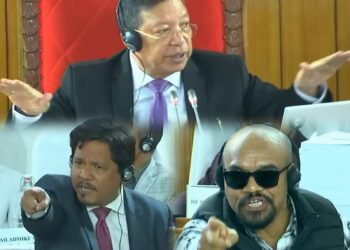
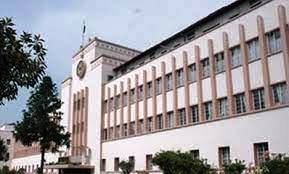
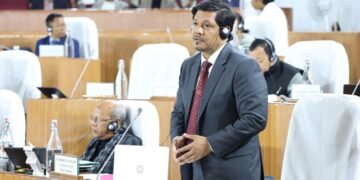
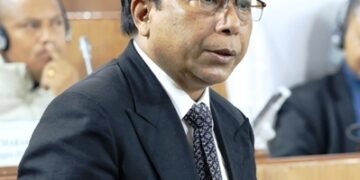
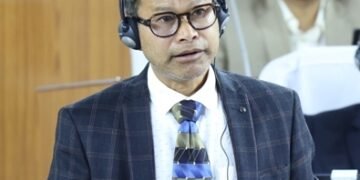

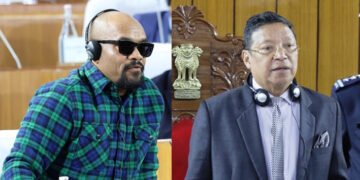







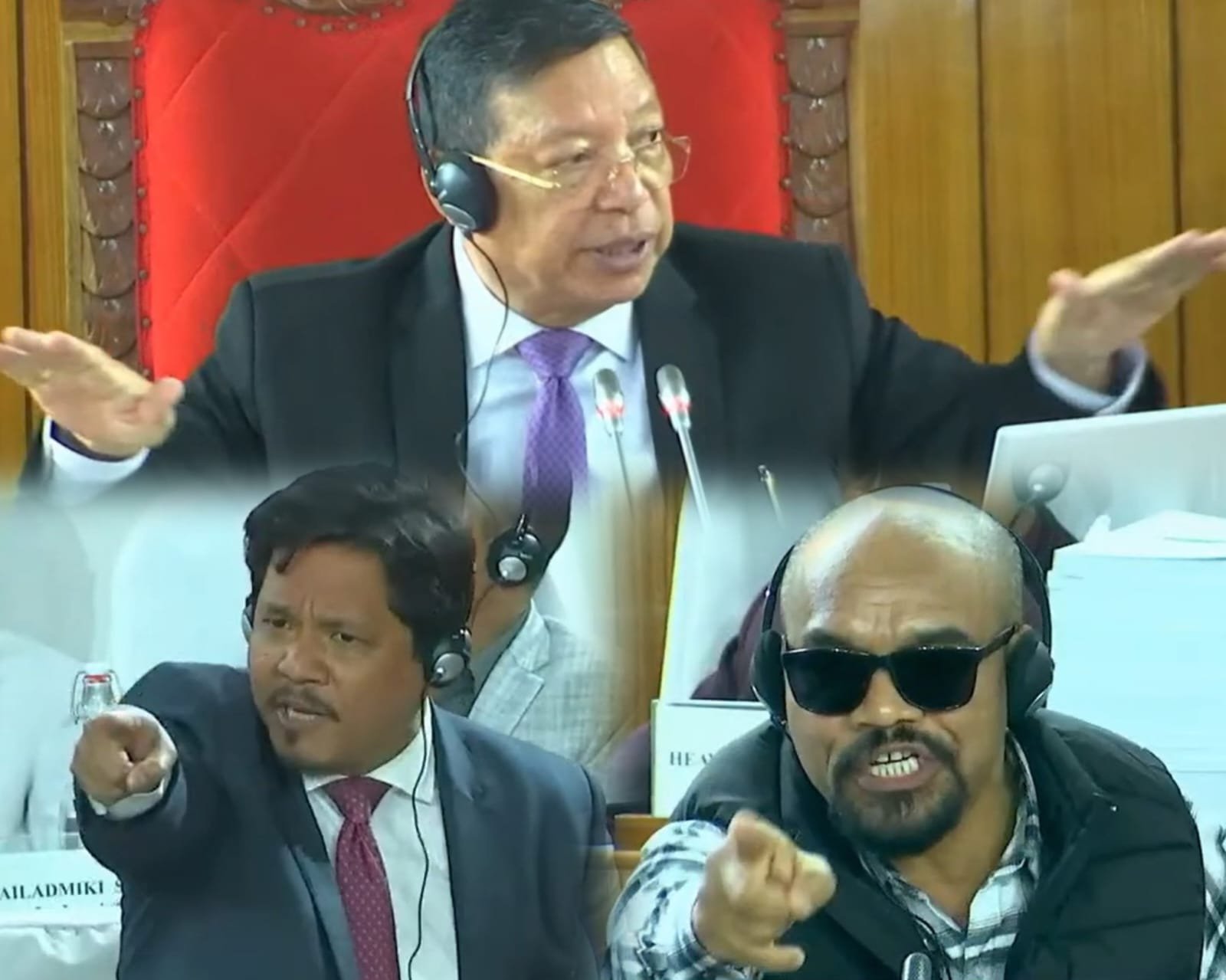
Shillong, Feb 18: After a prolonged period of relative calm, the Meghalaya Legislative Assembly witnessed unprecedented scenes on day three of the ongoing Budget Session as a heated debate over the Inner Line Permit (ILP) spiralled into a shouting match and ultimately an adjournment of the house.
The ILP, a long-standing demand of many citizens in Meghalaya, once again proved to be a politically sensitive subject, triggering a fiery confrontation between Chief Minister Conrad K Sangma and former Chief Minister and Leader of the Opposition Dr Mukul Sangma.
Initiating the debate, Dr Mukul referred to special permits, like the Restricted Area Permit and Protected Area Permit, issued by the Union Ministry of Home Affairs for foreigners travelling to parts of the North East. He argued that such regulatory mechanisms, while intended for security, had adversely impacted tourist inflow.
Seeking a categorical clarification, he asked whether the state government had given up pursuing the implementation of ILP in Meghalaya. The Chief Minister responded that he had already addressed the matter and reiterated that the government’s objective was to “find a mechanism” to regulate entry and curb illegal immigration. As Dr Mukul pressed for a direct “yes or no” answer, tensions escalated. Conrad objected to what he termed interference during his reply and urged the Speaker to intervene. “When I’m replying, the Leader of the Opposition should not interfere. I respect the passion, but there must be patience to listen. It is a sensitive topic,” he said, his face visibly flushed as voices rose across the house. The Speaker repeatedly appealed for calm.
Clarifying the government’s stand, Conrad stated that the administration continues to pursue ILP with the central government and has met the Union Home Minister multiple times. However, he maintained that the broader objective was to establish an effective mechanism to curb illegal immigration, whether through ILP, the Foreigners Act or other legal provisions. “We are pursuing all possible ways. We are committed to ensuring that illegal immigration is curbed. Whether it is ILP or the Foreigners Act, we will pursue it,” he asserted, adding that previous governments had not explored certain alternatives.
Dr Mukul, a former CM who was obviously the target of that barb, countered by defending measures enacted during earlier administrations, including the Meghalaya Residents Safety and Security Act (MRSSA) 2016 during his administration. He disputed Conrad’s claim that earlier governments had failed to act and raised concerns about the potential impact of restrictive mechanisms on tourism. “The limitation of this is that it will restrict foreigners from looking at Meghalaya as a destination,” he said, urging a careful examination of the issue to sustain high-end tourist footfall.
Responding in detail, Conrad explained that while the MRSSA was enacted in 2016, provisions relating to entry and exit checkpoints were included in the rules but not mandated in the act itself, making implementation legally untenable. He assured the house that the relevant High Court observations, along with the act and rules, would be placed on the table again.
The debate intensified when opposition legislator Ardent Basaiawmoit questioned the government’s seriousness, arguing that ILP was the best mechanism to address influx not only from foreign nationals but also from other Indian states. He contended that the government’s continuous “examination” of the issue suggested indecision and accused it of playing with public sentiment. He also raised constitutional concerns, referring to the adoption of the Bengal Eastern Frontier Regulation Act (the mechanism under which the ILP was introduced) through a Presidential order, and asked whether the state had challenged it.
In response, the CM stated that he had written multiple letters and met both the Union Home Minister and the Prime Minister on the ILP matter and questioned whether Basaiawmoit had ever done the same.
The opposition politician shot back, prompting Deputy CM Prestone Tynsong to intervene and accuse him of creating drama instead of speaking facts. As ruling and opposition members shouted at each other, the Speaker rose to his feet and adjourned the house for 10 minutes.
Upon resumption, Conrad reiterated that the government had not stopped pursuing ILP and remained serious about the issue, while also exploring alternative mechanisms. He called for a concerted effort from all sides, inviting opposition members to join the government in taking up the matter with authorities in Delhi.
However, the heated exchange did not end there. North Shillong MLA Adelbert Nongrum, also from the opposition bench, insisted on raising his point despite the Speaker initially declining further questions. When allowed to speak, Nongrum accused the incumbent government of fooling the people, prompting Tynsong to retort that Nongrum himself was misleading the public. The Speaker repeatedly urged members to sit down as tempers flared once more.
The argument finally subsided only when the bell rang, marking the end of Question Hour, cutting Nongrum off. The entire subject was sparked by Sohiong MLA Synshar Kupar L Thabah of the United Democratic Party (part of the ruling alliance) and it consumed the entire one hour of Question Hour.