












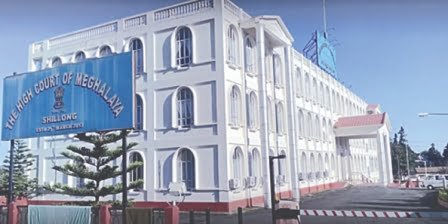
The State government will soon file an affidavit in the Meghalaya High Court to indicate the rules that have been brought with regards to the setting up of entry-exit points also known as facilitation centres in Umling, Umroi airport and Mendipathar railway station.
During today’s hearing of a public interest litigation (PIL) filed by one Ibahunlang Nongkynrih, the division bench of Chief Justice Sanjib Banerjee and Justice Wanlura Diengdoh directed the State government to file the affidavit within a fortnight from today. The next hearing will be held on March 16.
During the hearing, a copy of the government notification dated December 7, 2021 has also been brought to the notice of the High Court.
As per the notification, the facilities at the facilitation centres in Umling, Umroi airport and Mendipathar railway station were handed over to the Health Department of the State government for use as Covid-19 screening centres.
“The implication of such notification is that such centres were not used for the purpose of screening desirable or undesirable elements entering the State but only to screen the persons who were coming in as to whether they were afflicted by the dreaded disease,” the High Court said.
It may be noted that the PIL was filed challenging the validity of the Meghalaya Residents Safety and Security Act, 2016 and the possible draconian manner in which it may be implemented.
Though the State government referred to Article 19(5) of the Constitution as the basis for setting up the entry-exit point, however the grounds on which entry to or movement within the State may be regulated have not been spelt out in the impugned statute or in any rules framed thereunder.
The petitioner told the court that entry-exit gates have been set up at several points for checks to be conducted on persons seeking to enter the State. According to the petitioner, without any objective parameters being set down for denying entry or regulating the movement of any citizen of the country in the State, such check-posts may be impermissible and the exercise of authority thereat may be wholly arbitrary.
Earlier on September 21, 2021, the High Court had stated that it is prima facie evident that the Meghalaya government had legislative competency to enact the Meghalaya Resident Safety and Security Act (MRSSA), 2016, in exercise of powers conferred under the various Constitutional provisions.
The High Court also stated that it is also evident from a plain reading of the report in the form of an affidavit affirmed by the Chief Secretary to the Government of Meghalaya – particularly paragraph 21 thereof – that the purpose of establishing facilitation centres under sections 17 and 18 of the Meghalaya Resident Safety and Security Act (MRSSA), 2016, is “only” for verification of tenants and weeding out any “known” anti-social elements and wanted criminals.
“This specific averment is not indicative of the fact that the State of Meghalaya possesses other effective mechanisms for weeding out any “known” anti-social elements and/or wanted criminals and the situation in the State of Meghalaya is such that it requires to create and/or establish a facilitation centre “only” for weeding out any “known” anti-social elements and/or wanted criminals. This averment can also only mean the obvious, which we do not want to elaborate at this stage,” the court said.
The High Court also gave an opportunity to the State government to clearly and categorically spell out the purpose of establishing facilitation centres under the provisions of sections 17 and 18 of MRSSA, 2016, and also to inform the court know specifically as to whether the State government till date has no other effective mechanism for weeding out “known” anti-social elements from the State without impeding upon the fundamental rights of the residents.