








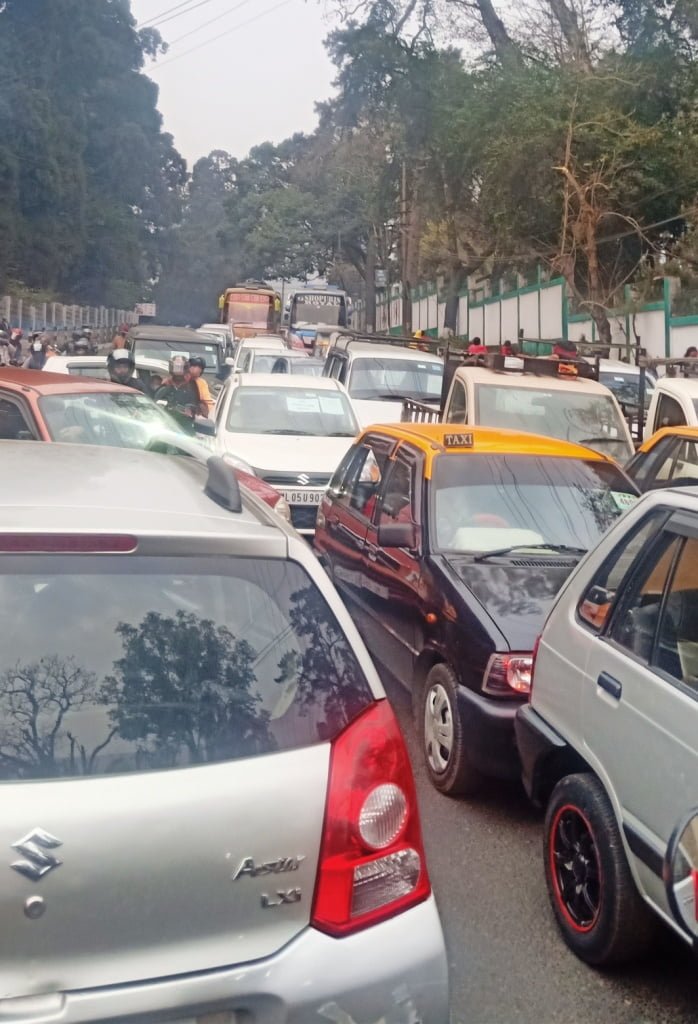
The State government has agreed to seek the advice of the Indian Institute of Management, Shillong, if possible, to help prepare a blueprint for the ultimate easing of the traffic congestion and smoother vehicular movement in Shillong city.
During hearing of a public interest litigation (PIL) filed by local lawyer Philip Khrawbok Shati in the Meghalaya High Court regarding traffic congestion in the city, suggestions have been made by the appearing parties pertaining to several roads that may be repaired or short stretches constructed, particularly on the outskirts of Shillong, to ease the congestion in the city centre and the main business district.
At the suggestion of the division bench of the High Court, Advocate-General Amit Kumar has also agreed to seek the advice of the Indian Institute of Management, Shillong, if possible, to help prepare a blueprint for the ultimate easing of the traffic congestion and smoother vehicular movement in Shillong proper.
“It would be best if a map of Shillong were to be prepared and the immediate ad hoc measures to improve the present situation indicated, in terms of repairs or construction of roads, and the long-term measures separately indicated so that the present problem can be eased to some extent over the next few months and years and ultimately addressed upon the completion of the entire project five or six years down the line. While it is imperative that immediate steps be taken to ease the traffic in Shillong proper, the State has constraints in terms of resources. However, a blueprint must be ready and the same implemented over a reasonable period of time upon making both a financial estimate thereof together with a cost-benefit analysis,” the High Court said.
One of the aspects earlier indicated by the Advocate-General on behalf of the State government was the procurement of electric buses. The State government had also stated earlier that the majority of parents of school-going children had also agreed that if a secured and dedicated public transport system was put in place for school students, individual cars carrying one student at a time may not congest the area around the schools. The other indication given by the State was to augment the public transport system and to revisit the flow of traffic in certain congested areas.
“Several measures have to be taken in tandem, not the least of them being the removal of vendors from pavements at key and congested places where the pedestrians’ footfall on the carriageways impedes the flow of vehicular traffic,” the High Court said.
For the more long-term solution, the High Court said that ropeways and cable-cars have to be looked into after an expert proposal is prepared for it to be financially assessed and, if feasible, implemented.
“In the context of preparing a long-term plan, the immediate measures that are necessary should not be abandoned,” the court added.
The High Court also said that while the appropriate authorities attend to the traffic problems in the heart of present Shillong, they must also be mindful of the New Shillong Township that is coming up and should have plans in place well ahead of the township being completely established so that the problem is not diverted from the present Shillong to the New Shillong Township.
Several learned lawyers assisting the court in the present matter suggested that in respect of the proposed New Shillong Township, clearly demarcated areas should be indicated for use as commercial, administrative, educational or residential enclaves. They further suggested that a traffic flow management plan should be in place before the township comes to live.
“The State would do well to project the possible flow of traffic in New Shillong once it is established and take measures before the township is established rather than being pushed to take the same several years down the line when the problem would already have arisen,” the High Court said. The next hearing on the matter will be held on September 23.