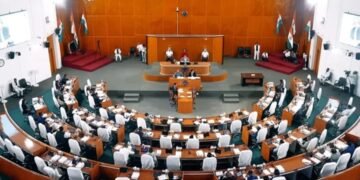
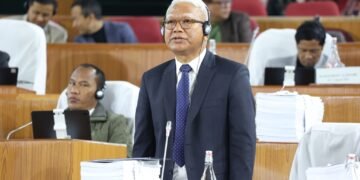
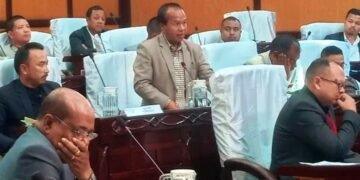

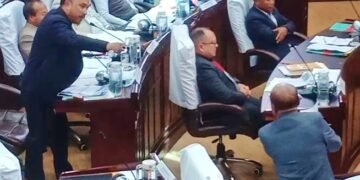






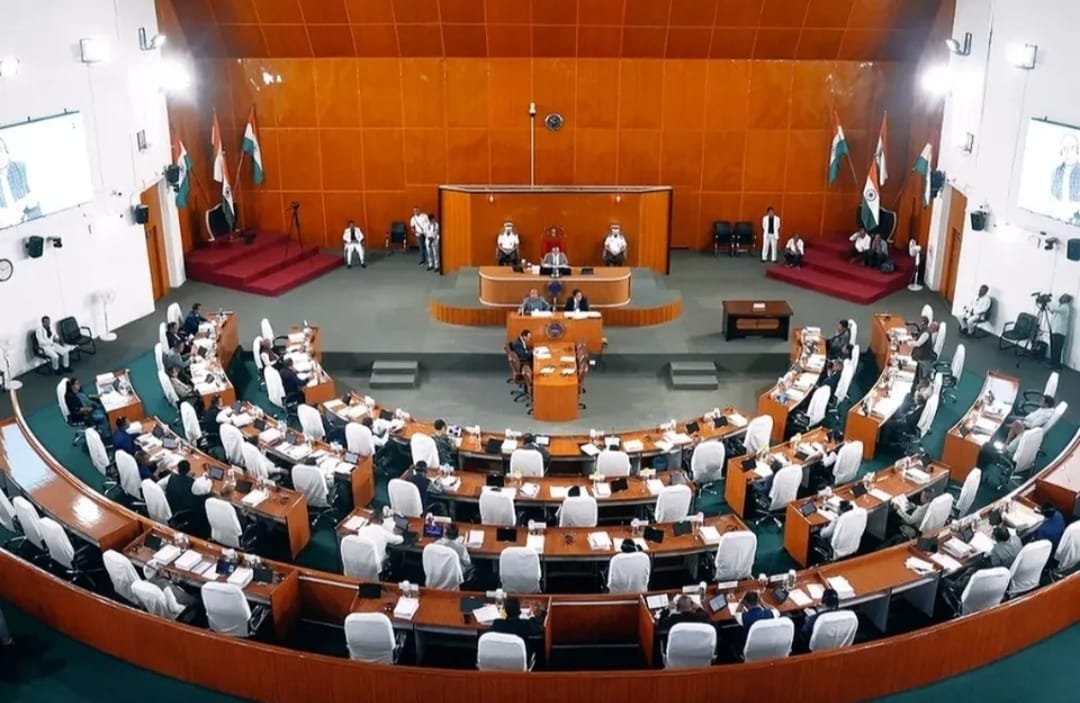
Shillong, Feb 18: The Meghalaya government is exploring the possibility of bringing the state under the ambit of the Immigration and Foreigners Act as a mechanism to regulate the entry of foreigners, even as it continues to pursue the long-pending demand for Inner Line Permit (ILP) with the Centre, Chief Minister Conrad K Sangma informed the Assembly today.
Sohiong MLA Synshar Kupar L Thabah of the United Democratic Party (UDP) placed a pointed question before the house, asking the reasons for proposing an “ILP-like law” instead of implementing the ILP in its original form and whether the government could elaborate on the proposed framework.
Thabah highlighted Meghalaya’s long borders with Assam (880km) and Bangladesh (440km) as vulnerabilities for the state. Assam is in the middle of an aggressive anti-infiltration drive, which may push migrants into Meghalaya, while Bangladesh is in a state of flux, which might also encourage migration.
Responding in detail, Sangma said illegal immigration has long been a matter of concern for citizens of Meghalaya and the North East. “At the end of the day, whether it’s MRSSA (Meghalaya Residents Safety and Security Act) or ILP or any other law, the objective remains the same – to protect our land and our people and curb illegal immigration,” he said.
The Chief Minister informed that the recently enacted Immigration and Foreigners Act by Parliament provides a possible mechanism. He explained that Sections 2Q and 2S of the act empower the central government to declare areas as “protected” or “restricted.” Once notified, foreigners entering such areas must obtain a special permit under Section 11.
“Upon notification of a district within the state as a protected or restricted area, all foreigners entering such a district shall be required to obtain a special permit,” Sangma said. “That is exactly what we are trying to achieve – a mechanism where foreigners who wish to come into the state would have to seek permission.”
However, this law only applies to foreigners, which would not satisfy those who want the ILP (which would apply to all outsiders, including Indian citizens not native to the state) implemented in Meghalaya.
The central government has notified Arunachal Pradesh, Manipur, Mizoram, Nagaland and Sikkim as protected areas. “Our desire and our purpose right now is to find a way in which we can also be included in this list,” he said.
On concerns that such a move might interfere with Sixth Schedule provisions, the Chief Minister asserted that there would be no constitutional conflict. “The issue of Sixth Schedule powers does not arise in this case. It is purely a permit which a foreigner will require to take from the authorised official before entering a restricted or protected area,” he said.
UDP member for West Shillong Paul Lyngdoh also raised concerns about the earlier implementation challenges of the MRSSA, particularly regarding check gates. The government’s power to check Indian citizens under this act was challenged as unconstitutional, which was upheld by the High Court of Meghalaya.
In response, Sangma said technology could play a key role. “The technological aspect is absolutely available, but the application of technology requires the mandate of the law. That is what we are examining,” he said, adding that digital systems could potentially make the permit process smooth and less inconvenient.
Leader of the Opposition Dr Mukul Sangma observed that the restricted area permit system for foreigners travelling to the North East was not new and referred to earlier frameworks under a 1950 order. He questioned whether the state was aware of these provisions and cautioned that strict permit regimes in the past had affected tourism inflow.
“We are aware of it,” the Chief Minister replied, but maintained that the 2025 amendment provided fresh scope. “When we examined this further with the Law Department, we realised that that mechanism could actually be created. That’s why we are pursuing this,” he said.