












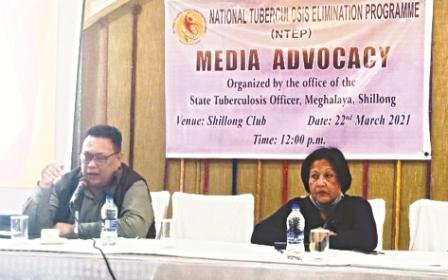
To eliminate tuberculosis in Meghalaya by 2025, under the National Tuberculosis Elimination Programme (NTEP), the state tuberculosis authorities have started a comprehensive active case search and house-to-house survey to achieve the target.
“We have identified 14 blocks phase-wise throughout the state and the identifying process has already begun in some blocks where our volunteers, including ASHA (accredited social health activists) conduct a house-to-house screening to identify the TB patients and collect their sample for testing,” Dr G Borgohain said during the NTEP event organized by the State Tuberculosis Officer.
Informing that up to 88 percent of tuberculosis patients in Meghalaya are successfully treated annually from out of the total of around 4,000-5,000 TB patients diagnosed every year, he said, “We have started the active case search where staff from the Health Department do the house-to-house visit to screen for TB patients and, in cases where there suspect TB, the patients are immediately tested and, if detected with TB, they are given treatment. We have also adopted new diagnostic technologies that are very fast in detecting TB cases and we are using good quality drugs and conducting research to further improve the programme.”
NTEP runs four schemes, including the Nikshay Poshna Yojana, where Rs 500 per month is given to all notified patients until the completion of treatment, including an honorarium to treatment supporters where Rs 1,000 per month is given for new retreatment cases and Rs 5,000 for drug-resistant tuberculosis.
Under the scheme, there is also ‘tribal patient support’, which is a one-time payment of Rs 750 to all the TB patients from tribal areas for new cases and incentives of Rs 500 for notification, including Rs 500 for treatment outcomes for private practitioners and informants.
Meanwhile, Dr Borgohain informed that most TB cases in Meghalaya are from East Khasi Hills because the population is high, though case numbers have been on a downwards trajectory since 2015.
However, he said that it is very important to track every TB case and treat them because if even one case is missed out then one TB patient can spread the disease to 10-12 others annually. He also cautioned against stigmatizing TB sufferers. The disease is completely curable and has nothing to do with living together or a person’s food habits, for example.
“Stigmatisation against the disease is still there and we have tremendous responsibility to remove this problem from society,” Dr Borgohain said.